
Short Answer
Definition of a Black Hole Image
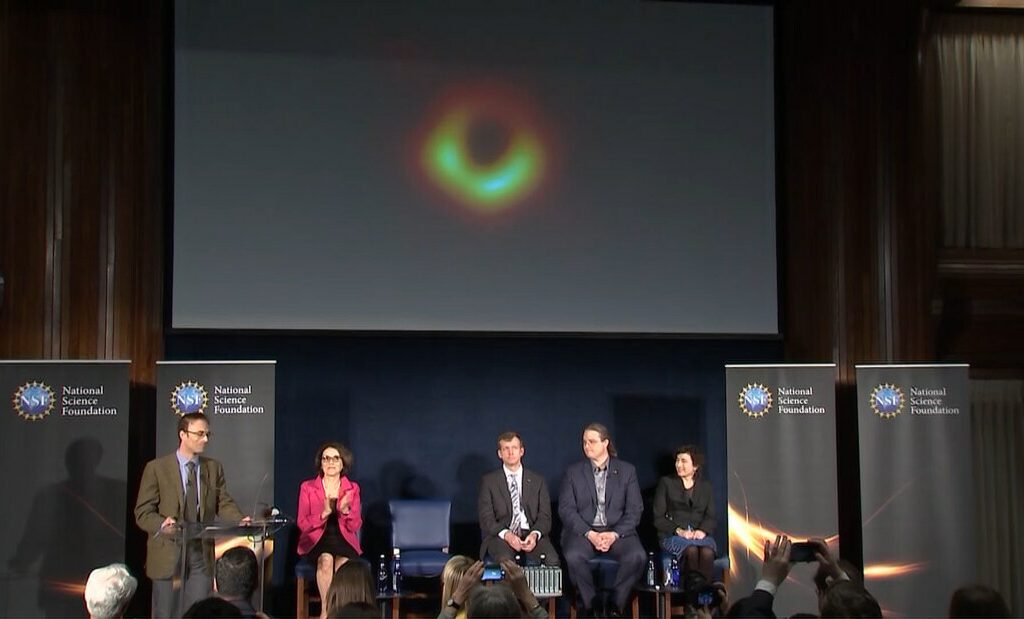
The first-ever photograph of a black hole, unveiled in April 2019, represented a groundbreaking milestone in astrophysics. This image transformed a concept once confined to theoretical physics and indirect evidence into a tangible visual reality. Black holes, by their nature, are invisible due to their event horizons, which prevent any light or information from escaping. The captured image instead revealed the shadow of the event horizon outlined by the luminous accretion disk, providing direct observational proof of these enigmatic cosmic objects.
Scientific Background and Significance
Black holes are regions in space where gravity is so intense that nothing, not even light, can escape beyond a boundary called the event horizon. The image captured the silhouette of this event horizon against the bright ring of superheated gas and matter spiraling inward, known as the accretion disk. This glowing ring, often called the photon ring, results from light bending in the extreme gravitational field surrounding the black hole, creating a distinctive shadow that can be imaged with sufficient resolution.
Technology and Methodology Behind the Image
The Event Horizon Telescope (EHT) Network
To achieve the resolution necessary to image a black hole’s shadow, scientists utilized the Event Horizon Telescope (EHT), a global array of radio observatories distributed across multiple continents. By synchronizing these telescopes to operate as a single, Earth-sized virtual instrument, the EHT employed Very Long Baseline Interferometry (VLBI). This technique combines signals from telescopes thousands of miles apart, achieving an angular resolution capable of discerning features as small as a few microarcseconds-comparable to reading a newspaper in New York from a café in Paris.
Synchronization and Data Collection
Coordinating the EHT’s observatories required precise synchronization using atomic clocks to ensure that radio wave observations were perfectly timed. The telescopes observed radio emissions at a wavelength of 1.3 millimeters, which allowed them to penetrate cosmic dust clouds that obscure visible light. This wavelength also optimized the resolution needed to distinguish the black hole’s shadow against the bright emissions of its accretion disk.
Data Processing and Image Reconstruction
The observational campaign generated an enormous volume of data-petabytes in size-that could not be transmitted via the internet efficiently. Instead, physical hard drives were transported to specialized data centers where supercomputers processed the information. Advanced algorithms correlated and synthesized the signals from the multiple observatories, carefully calibrating to minimize noise and atmospheric interference. The raw data was then interpreted using various imaging algorithms, including CLEAN and regularized maximum likelihood methods, which were cross-validated to ensure the accuracy and reliability of the final image.
Mathematical and Physical Principles
The image’s formation is governed by the principles of general relativity, which describe how massive objects warp spacetime. The black hole’s intense gravity bends light around it, creating the photon ring and the central shadow. The asymmetry observed in the ring arises from relativistic effects such as gravitational lensing and the black hole’s rotation, which influence the light’s path and intensity.
Case Study: The Black Hole in Galaxy M87
The black hole imaged by the EHT resides at the center of the elliptical galaxy M87, located approximately 55 million light-years from Earth. This supermassive black hole has a mass exceeding six billion times that of the Sun and is surrounded by a rapidly accreting disk of matter. Its immense size and environment made it the ideal candidate for this pioneering imaging effort. Studying this black hole provides valuable insights into galactic evolution, the behavior of matter under extreme gravitational forces, and potentially the nature of dark matter and dark energy.
Impact and Future Prospects
Scientific and Technological Advances
The success of the EHT project not only produced a historic image but also generated a vast dataset that will fuel astrophysical research for decades. The refined methodologies and technologies developed through this collaboration pave the way for future observations with enhanced resolution and sensitivity. Upcoming improvements aim to capture time-resolved images, effectively creating “movies” of black hole dynamics, including phenomena such as jet ejections and changes in accretion flows.
Cultural and Philosophical Influence
Beyond its scientific significance, the black hole image has inspired widespread public fascination and curiosity about the universe. It exemplifies the power of international scientific cooperation, demonstrating how shared expertise and resources can overcome formidable challenges to expand human knowledge. This achievement symbolizes humanity’s ability to explore and understand the most mysterious and extreme regions of the cosmos.
Common Misconceptions About Black Hole Imaging
The black hole itself was directly photographed.
The image shows the shadow of the event horizon outlined by the glowing accretion disk, not the black hole itself, which remains invisible.
The image was captured by a single telescope.
The image was produced by combining data from multiple telescopes worldwide using Very Long Baseline Interferometry.
Why Imaging Black Holes Is Crucial
Capturing the first image of a black hole is a landmark achievement that validates key predictions of Einstein’s general relativity under extreme conditions. It enhances our understanding of spacetime, gravity, and the behavior of matter in intense gravitational fields. Furthermore, it opens new avenues for exploring the role of black holes in galaxy formation and evolution, and it provides a unique laboratory for testing fundamental physics. This breakthrough exemplifies the synergy of advanced technology, theoretical physics, and global collaboration in pushing the frontiers of human knowledge.
FAQ
What is the significance of the black hole image?
The image provides direct observational proof of black holes, validating predictions of Einstein's general relativity and enhancing our understanding of gravity and spacetime.
Can we see black holes directly?
No, black holes themselves are invisible. The image shows the shadow of the event horizon against the luminous accretion disk.





Leave a Reply