
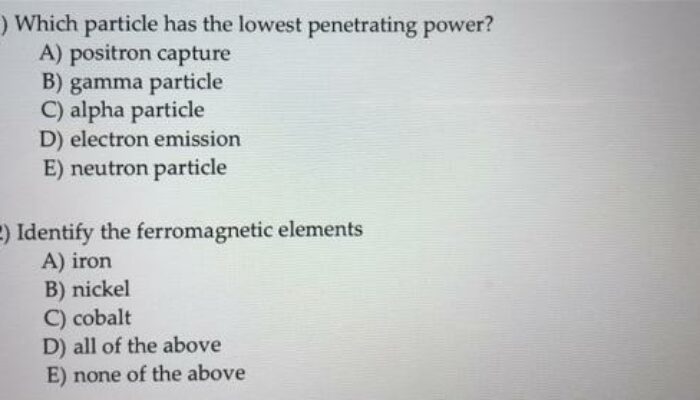
Short Answer
Understanding Penetrating Power in Particle Physics
Particle physics, a field often perceived as intricate, provides deep insights into the fundamental nature of matter and energy. Central to this discipline is the question: Which particle exhibits the lowest penetrating power? This inquiry not only highlights the distinct properties of various particles but also reveals essential principles governing radiation and its interaction with matter. Exploring particle penetration enhances our comprehension of nuclear stability, material behavior, and radiation safety measures.
Definition of Penetrating Power
Penetrating power refers to the ability of a particle or radiation to pass through materials without being absorbed or deflected. It depends on the particle’s intrinsic properties such as mass, charge, and energy, as well as the nature of the material it encounters.
- Alpha particles:
Heavy, positively charged particles with low penetration ability. - Beta particles:
Lighter, charged particles with moderate penetration capacity. - Gamma rays:
Massless, uncharged electromagnetic waves with very high penetrating power.
Categories of Radiation and Their Penetration Characteristics
Radiation emitted from unstable atomic nuclei primarily consists of alpha particles, beta particles, and gamma rays. Each type exhibits unique interactions with matter, influenced by their physical and energetic attributes.
Alpha Particles
Alpha particles are composed of two protons and two neutrons, making them relatively massive and positively charged. Their substantial mass and charge cause frequent interactions with atoms in materials, resulting in rapid energy loss. Consequently, alpha particles can be halted by very thin barriers such as a sheet of paper or the outer dead layer of human skin. Despite their limited external threat, alpha emitters like radon-222 pose significant internal health risks if ingested or inhaled.
Beta Particles
Beta particles are electrons (beta-minus) or positrons (beta-plus) with much smaller mass and charge compared to alpha particles. Their lighter nature and higher kinetic energy allow them to penetrate materials more deeply, typically requiring a few millimeters of plastic, glass, or metal to be stopped. This intermediate penetration makes beta radiation useful in medical treatments and radiation detection technologies.
Gamma Rays
Gamma rays differ fundamentally from alpha and beta particles as they are electromagnetic waves without mass or charge. Their high energy enables them to penetrate most materials extensively, necessitating dense shielding such as lead or thick concrete to reduce their intensity effectively. Gamma radiation’s penetrating ability demands stringent safety protocols in medical, industrial, and nuclear applications.
Mechanisms Behind Particle Penetration
The interaction of particles with matter is primarily governed by electromagnetic forces. Charged particles like alpha and beta particles lose energy through collisions and ionization of atoms in the material they traverse. Alpha particles, due to their large mass and charge, experience rapid energy dissipation, limiting their penetration depth. Beta particles, being lighter and less charged, interact less intensely, allowing deeper penetration. Gamma rays, lacking charge and mass, interact mainly through photoelectric effect, Compton scattering, and pair production, which occur less frequently, enabling them to travel further through matter.
Mathematical Perspective on Penetration
The penetration depth of particles can be described using the concept of stopping power, which quantifies the energy loss per unit path length as a particle moves through a material. The Bethe formula is commonly used for charged particles:
Stopping Power (S) = -dE/dx
- dE: Energy lost by the particle
- dx: Distance traveled in the material
This formula shows that heavier and more highly charged particles (like alpha particles) lose energy more rapidly, resulting in shorter penetration ranges compared to lighter particles (like beta particles).
Practical Applications and Implications
The varying penetrating powers of particles have significant consequences across multiple fields:
- Medical Uses:
Beta particles are employed in radiation therapy due to their ability to penetrate tissues moderately, while alpha particles are used in targeted alpha therapy for localized treatment. - Radiation Protection:
Understanding penetration helps design effective shielding materials to protect against harmful radiation exposure. - Environmental Safety:
Managing alpha-emitting radioactive waste requires careful containment to prevent internal contamination. - Space Exploration:
Shielding spacecraft from cosmic radiation involves materials that can attenuate high-energy particles and gamma rays to safeguard astronauts.
Material Science and Shielding Strategies
The effectiveness of radiation shielding depends not only on thickness but also on the composition of the shielding material. Dense elements like lead are preferred for gamma radiation due to their high atomic number, which increases interaction probability. For alpha and beta particles, lighter materials such as plastic or glass can suffice. Advances in composite materials aim to optimize protection by combining properties that attenuate different radiation types efficiently.
Common Misunderstandings About Particle Penetration
- Misconception: Alpha particles can penetrate deeply into the body.
Correction: Alpha particles cannot penetrate the skin but are dangerous if ingested or inhaled. - Misconception: Gamma rays are particles like alpha and beta.
Correction: Gamma rays are electromagnetic waves, not particles, and have no mass or charge.
Significance of Penetrating Power in Science and Technology
Understanding the penetrating power of different particles is crucial for advancing nuclear physics, improving radiation therapies, enhancing safety protocols, and developing innovative materials. It shapes how we interact with radioactive substances, design protective equipment, and explore environments with high radiation levels, such as outer space. This knowledge continues to drive scientific progress and protect human health in diverse applications.
FAQ
What particle has the lowest penetrating power?
Alpha particles have the lowest penetrating power, being stopped by materials like paper.
Why are alpha particles dangerous?
Alpha particles are dangerous if ingested or inhaled, despite their inability to penetrate the skin.
How does penetrating power vary among radiation types?
Alpha particles have low penetration, beta particles have moderate, and gamma rays have high penetration power.






Leave a Reply