
Short Answer
Definition of Gravitational Waves
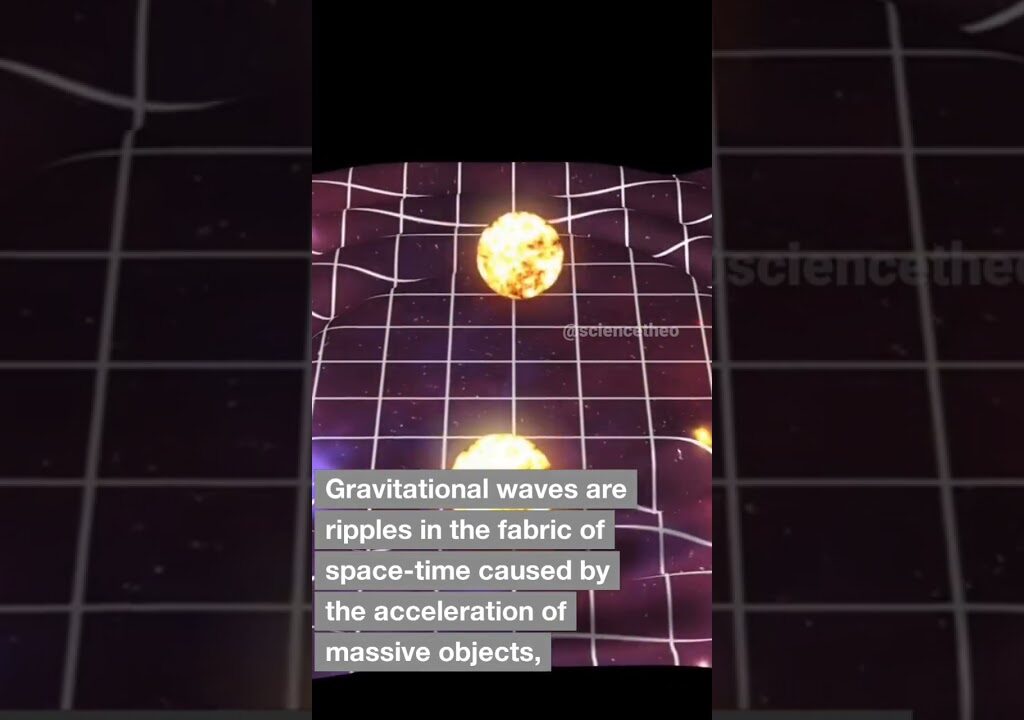
Gravitational waves are ripples in the fabric of spacetime generated by some of the most energetic and violent events in the universe. These waves propagate outward at the speed of light, carrying information about their cataclysmic origins. Unlike electromagnetic waves such as light or radio waves, gravitational waves are distortions of spacetime itself, caused by accelerating masses.
- Origin:
Produced by massive cosmic phenomena like merging black holes, neutron star collisions, and supernova explosions. - Nature:
Fluctuations in spacetime geometry rather than electromagnetic radiation. - Propagation:
Travel virtually unimpeded across the cosmos, preserving pristine data about their sources.
Historical Context and Significance
The concept of gravitational waves was first predicted by Albert Einstein over a century ago as a consequence of his general theory of relativity. For decades, these waves remained theoretical constructs, confined to mathematical models and scientific speculation. The eventual detection of gravitational waves marked a monumental milestone, confirming Einstein’s predictions and inaugurating a new era in astrophysics. This breakthrough fundamentally transformed our understanding of the universe by providing a novel observational channel beyond traditional electromagnetic methods.
How Gravitational Waves Are Generated
Gravitational waves arise when massive objects accelerate asymmetrically, causing ripples in spacetime. The most potent sources include:
- Black Hole Mergers:
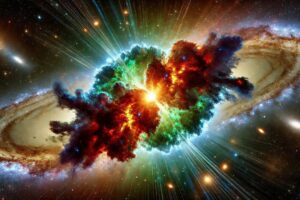
When two black holes spiral inward and collide, they produce intense gravitational waves detectable across billions of light-years. - Neutron Star Collisions:
The fusion of neutron stars emits gravitational waves alongside electromagnetic signals, offering multi-messenger insights. - Supernova Explosions:
The asymmetric collapse of massive stars can generate gravitational waves, revealing details about stellar death.
Detection Techniques and Technological Advances
Detecting gravitational waves requires extraordinary precision due to their minuscule effects on spacetime. Facilities like the Laser Interferometer Gravitational-Wave Observatory (LIGO) utilize laser interferometry to measure distortions smaller than a proton’s diameter. This involves splitting laser beams along perpendicular arms, reflecting them off mirrors, and recombining them to detect minute changes in distance caused by passing gravitational waves. The success of these detectors represents a remarkable fusion of physics, engineering, and computational science, pushing the boundaries of measurement capabilities.
Mathematical Framework and Formulae
Gravitational waves are described by perturbations ( h_{munu} ) in the spacetime metric ( g_{munu} ), governed by Einstein’s field equations:
[
G_{munu} = frac{8pi G}{c^4} T_{munu}
]
where:
- ( G_{munu} ): Einstein tensor representing spacetime curvature
- ( T_{munu} ): Stress-energy tensor of matter and energy
- ( G ): Gravitational constant
- ( c ): Speed of light
In the weak-field approximation, gravitational waves satisfy the wave equation:
[
Box h_{munu} = 0
]
where ( Box ) is the d’Alembert operator, indicating that perturbations propagate as waves at the speed of light.
Impact on Astrophysics and Cosmology
The advent of gravitational wave astronomy has revolutionized the study of the cosmos by providing access to phenomena invisible to electromagnetic observation. This new observational window allows scientists to:
- Probe Dark and Hidden Events:
Study black hole mergers and other events that emit little or no light. - Test Theories of Gravity:
Validate or challenge models of gravity under extreme conditions. - Understand Cosmic Evolution:
Gain insights into the life cycles of stars and the dynamics of compact objects.
Interdisciplinary and Global Collaboration
The detection and analysis of gravitational waves exemplify international scientific cooperation. Researchers from diverse fields and countries collaborate to develop detectors, analyze data, and interpret findings. This collective effort highlights the importance of shared knowledge and resources in achieving groundbreaking discoveries that transcend national and disciplinary boundaries.
Common Misconceptions About Gravitational Waves
Gravitational waves are the same as electromagnetic waves.
Gravitational waves are distortions in spacetime itself, not electromagnetic radiation like light or radio waves.
Gravitational waves can be easily detected with conventional telescopes.
Detecting gravitational waves requires highly specialized instruments like LIGO, capable of measuring incredibly subtle spacetime distortions.
Gravitational waves affect everyday life or cause noticeable effects on Earth.
The waves are extraordinarily faint by the time they reach Earth, causing changes far smaller than atomic scales.
Why Gravitational Waves Matter
The discovery and study of gravitational waves have profound implications for science and society. They open a new frontier in observational astronomy, enabling the exploration of cosmic events previously hidden from view. This advancement enriches our understanding of fundamental physics, including the interplay between quantum mechanics and general relativity. Beyond academia, gravitational wave research inspires public interest in science, fosters STEM education, and exemplifies the power of human curiosity and collaboration in expanding the boundaries of knowledge.
Real-World Examples of Gravitational Wave Observations
Since the first confirmed detection in 2015, gravitational wave observatories have recorded numerous events, including:
- GW150914:
The inaugural observation of merging black holes, confirming the existence of binary black hole systems. - GW170817:
A neutron star collision observed both via gravitational waves and electromagnetic signals, providing unprecedented multi-messenger data. - Subsequent Detections:
Multiple black hole mergers and neutron star events, enriching our understanding of compact object populations and cosmic phenomena.
FAQ
What are gravitational waves?
Gravitational waves are distortions in spacetime caused by massive objects accelerating asymmetrically, such as merging black holes and neutron stars.
Why are gravitational waves important?
They provide a new observational channel in astrophysics, allowing the study of phenomena that are invisible to electromagnetic observation.
How are gravitational waves detected?
They are detected using highly specialized instruments like LIGO, which measure minute changes in spacetime.
What misconceptions exist about gravitational waves?
Common misconceptions include the belief that they are the same as electromagnetic waves or that they can be detected with conventional telescopes.

Leave a Reply