

Short Answer
Understanding Topological Materials
Topological materials have recently become a central subject of investigation within the scientific community, attracting considerable attention from both physicists and engineers. These materials are distinguished by their extraordinary properties, which challenge conventional classifications in condensed matter physics. To appreciate their significance, it is essential to explore the connection between topology-a branch of mathematics concerned with properties preserved under continuous deformations-and the behavior of electrons in solid-state systems.
Definition and Key Characteristics
Topological materials are substances whose electronic properties are governed by topological invariants rather than traditional symmetry-breaking mechanisms. This unique characteristic leads to phenomena that cannot be explained by classical material science.
- Topological Insulators:
These materials behave as insulators in their interior but support conducting states on their surfaces or edges. These surface states are protected by topological order, making them impervious to defects and impurities. - Topological Semimetals:
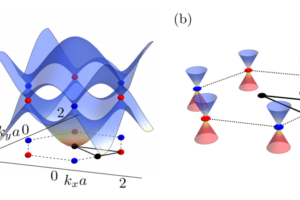
Examples include Weyl and Dirac semimetals, which exhibit exotic electronic structures such as Fermi arcs, enabling novel transport properties.
Mechanisms Behind Topological Behavior
The distinctive properties of topological materials arise from the interplay between the material’s electronic band structure and topological invariants. These invariants, such as the Chern number or Z2 index, classify phases of matter that remain stable under continuous perturbations. The robustness of surface states is a direct consequence of these topological protections, which prevent scattering and localization caused by disorder.
Mathematical Framework and Formulas
Topological phases are often characterized by mathematical quantities derived from the Berry curvature in momentum space. For instance, the Chern number (C) is given by:
C = (1/2π) ∫ F(k) d²k
where F(k) represents the Berry curvature over the Brillouin zone. This integer-valued invariant determines the number of protected edge states in quantum Hall systems and related topological insulators.
Applications in Quantum Computing
One of the most promising uses of topological materials lies in the realm of quantum information science. Quantum computers exploit qubits that can exist in superpositions, enabling complex computations beyond classical capabilities. Topological qubits, derived from the non-local encoding of quantum information in topological states, offer intrinsic fault tolerance. This resilience to local noise and decoherence addresses a major hurdle in developing scalable quantum computers, potentially revolutionizing computational technology.
Advancements in Spintronics
Topological materials also play a pivotal role in spintronics, a field focused on manipulating electron spin in addition to charge. Materials like Weyl semimetals exhibit unique surface states and Fermi arcs that facilitate precise control over spin currents. This capability could lead to more efficient data storage and transfer technologies, surpassing the limitations of conventional electronics.
Exploring New Phases and Fundamental Physics
The discovery of novel topological phases, including higher-dimensional topological insulators and particles such as non-Abelian anyons, challenges existing physical paradigms. These findings provoke profound questions about the fundamental nature of matter and the universe’s underlying laws. Studying these materials not only advances technology but also deepens our understanding of particle physics and cosmology.
Topological Materials and Phase Transitions
Topological invariants provide a fresh perspective on phase transitions that differ from classical symmetry-breaking transitions. These topological phase changes can reveal new behaviors in thermal, magnetic, and electronic systems, expanding our comprehension of material properties across various scientific disciplines.
Fabrication and Material Synthesis
Creating topological materials with precise bulk and surface characteristics demands advanced fabrication techniques, often at the atomic scale. The emergence of two-dimensional materials such as graphene and transition metal dichalcogenides has broadened experimental possibilities, enabling the exploration of new topological phenomena. Progress in synthesis methods is crucial for discovering and harnessing these unique properties.
Interdisciplinary Collaboration and Societal Impact
Integrating topological materials into practical technologies requires cooperation among physicists, materials scientists, and engineers. This interdisciplinary approach is vital for translating theoretical insights into real-world applications. Additionally, the societal implications of innovations driven by topological research must be carefully considered to ensure responsible development.
Significance and Future Outlook
The ongoing investigation of topological materials exemplifies human creativity in unraveling the complexities of the universe. Their remarkable properties hold the potential to transform technological landscapes and challenge our fundamental understanding of matter. As research progresses, the field promises exciting discoveries that could open new frontiers in physics and engineering, inviting scientists and technologists to participate in this dynamic and evolving narrative.
FAQ
What makes topological materials different from conventional materials?
They exhibit electronic properties governed by topology, such as conductive surface states despite insulating bulk behavior.
How do topological qubits improve quantum computing?
They offer intrinsic fault tolerance by resisting local disturbances, which is vital for reliable quantum computation.
Can topological materials be used in everyday electronics?
Potentially yes, through spintronics and advanced data storage, though practical integration is still under research.



Leave a Reply