
Short Answer
Definition of Baryons
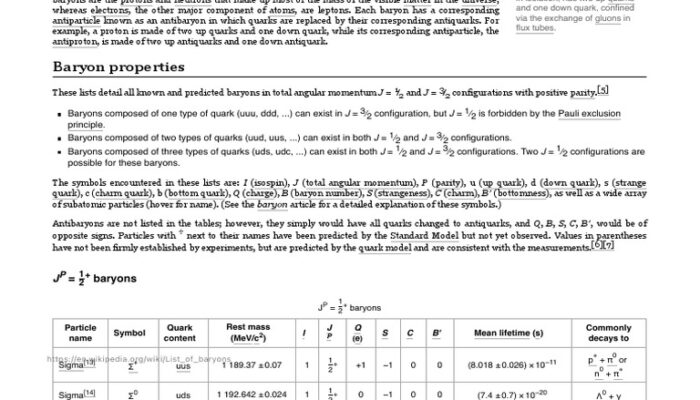
Baryons are a class of subatomic particles that serve as the fundamental building blocks of matter. Composed of three quarks bound together by the strong nuclear force, which is mediated by gluons, baryons include well-known particles such as protons and neutrons. These particles are essential components of atomic nuclei, making them critical to the structure of matter and the universe at large.
- Composition:
Baryons consist of three quarks, each carrying a color charge, held together by gluons through the strong interaction. - Baryon Number:
Each baryon carries a baryon number of +1, a quantum number that helps classify particles in particle physics. - Examples:
Protons and neutrons are the most common baryons found in ordinary matter.
Historical Background and Theoretical Foundations
The concept of baryons was formalized in the 1960s with the advent of the quark model, independently proposed by Murray Gell-Mann and George Zweig. This model revolutionized particle physics by categorizing hadrons-particles affected by the strong force-into baryons and mesons based on their quark content. Baryons, with their three-quark structure, embody the complexities of the strong interaction, a fundamental force that governs the behavior of particles within atomic nuclei.
Baryon Abundance and Cosmological Context
Despite their fundamental role, baryons appear to be less abundant in the universe than initially expected. Following the Big Bang, the early universe produced a vast number of baryons and their corresponding antibaryons. However, as the universe expanded and cooled, matter and antimatter annihilated each other, leaving behind a slight excess of baryons. This asymmetry is why the observable universe is predominantly composed of baryonic matter. Nevertheless, baryonic matter accounts for only about one-fifth of the total matter density inferred from cosmological observations, highlighting a significant discrepancy in the cosmic matter budget.
Dark Matter and the Baryon Mystery
The apparent scarcity of baryons relative to the total matter content leads to the hypothesis of dark matter-an unseen form of matter that does not emit, absorb, or reflect light but exerts gravitational influence. While baryonic matter forms stars, planets, and galaxies, dark matter is believed to constitute the majority of the universe’s mass. This raises the fundamental question: where exactly are the baryons? Understanding their distribution and the mechanisms that obscure them remains a central challenge in modern astrophysics and cosmology.
Quantum Chromodynamics and Baryon Interactions
Quantum Chromodynamics (QCD), the theory describing the strong interaction, provides a framework for understanding baryon behavior. Baryons rarely exist in isolation; they often form complex bound states and resonances that complicate their study. These states emerge under extreme conditions, such as those found in neutron stars or during high-energy particle collisions in accelerators, offering valuable insights into baryonic properties and interactions.
Baryons in Cosmic Structures
Beyond their presence in stars and galaxies, baryons are also found in the intergalactic medium, potentially residing in vast cosmic filaments that connect large-scale structures. The cooling and condensation of baryonic matter in these environments drive processes like star formation, which in turn influence the evolution of galaxies. Astrophysical models continue to explore these feedback mechanisms to better understand the role of baryons in shaping the universe’s architecture.
Observational Techniques for Detecting Baryons
Advancements in observational astronomy have enhanced our ability to trace baryons across the cosmos. Methods such as 21-centimeter hydrogen line observations and gravitational lensing have revealed baryons not only concentrated in luminous objects but also dispersed in diffuse gas clouds. This emerging field, sometimes referred to as cosmic archaeology, is crucial for mapping the intricate distribution of baryonic matter throughout the universe.
Connections to Fundamental Physics and Beyond
The study of baryons intersects with broader questions in fundamental physics, including symmetry breaking and the search for hypothetical particles like axions. These particles may influence the balance between baryonic and dark matter. Additionally, theoretical frameworks such as supersymmetry and string theory propose that baryons might exist in exotic states or higher-dimensional forms, potentially expanding our understanding beyond the Standard Model of particle physics.
Why Understanding Baryons Is Crucial
Investigating baryons is vital for comprehending the nature of matter and the evolution of the universe. Their interactions at the quantum level underpin the structure of atomic nuclei, while their distribution on cosmic scales informs models of galaxy formation and large-scale structure. The ongoing quest to locate and characterize baryons challenges existing theories and drives innovation in both experimental and theoretical physics.
Summary and Open Questions
The pursuit to identify the whereabouts and properties of baryons extends beyond cataloging the particles that constitute matter. It involves unraveling their complex interactions within the cosmic fabric and addressing profound questions about the universe’s composition. Despite significant progress, the full picture of baryon distribution and behavior remains incomplete, inviting continued exploration and discovery in the realms of particle physics and cosmology.
FAQ
What are baryons?
Baryons are subatomic particles made of three quarks, such as protons and neutrons, which are fundamental to the structure of matter.
Why are baryons important in cosmology?
Baryons help in understanding the composition of the universe, their interactions influence galaxy formation, and they highlight the mystery of dark matter.




Leave a Reply