
Short Answer
Definition of Quantum Computing
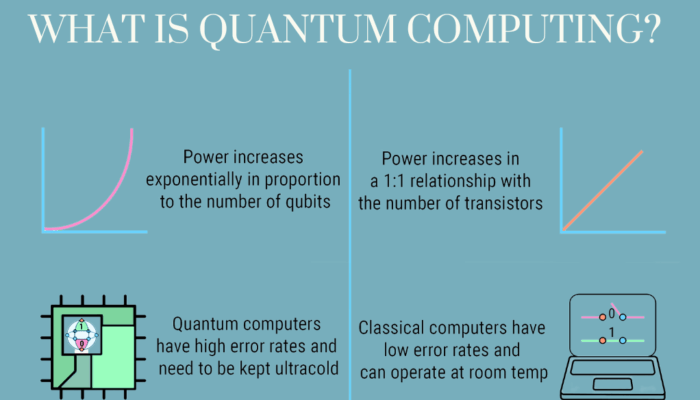
Quantum computing represents a groundbreaking advancement in computational technology, merging principles from quantum physics with computer science to create a new paradigm of processing information. Unlike classical computers that rely on binary bits (0s and 1s), quantum computers utilize quantum bits, or qubits, which can exist in multiple states simultaneously. This unique characteristic enables quantum computers to tackle problems that are currently infeasible for traditional machines.
- Qubits:
The fundamental units of quantum information, capable of representing both 0 and 1 at the same time through superposition. - Superposition:
A quantum phenomenon allowing qubits to be in multiple states simultaneously, vastly increasing computational possibilities. - Entanglement:
A quantum connection between qubits where the state of one instantly influences the state of another, regardless of distance.
Fundamental Principles Behind Quantum Computing
Quantum computing operates on the foundational concepts of quantum mechanics, which differ significantly from classical physics. The two key principles that empower quantum computers are superposition and entanglement.
- Superposition: Enables qubits to perform multiple calculations at once by existing in a combination of states.
- Entanglement: Links qubits in such a way that the measurement of one qubit instantly determines the state of its entangled partner, facilitating complex, parallel computations.
These phenomena allow quantum computers to process vast amounts of data simultaneously, offering exponential speed-ups for certain computational tasks compared to classical computers.
How Quantum Computing Works
Quantum computers manipulate qubits through quantum gates, which alter their states according to the rules of quantum mechanics. By applying sequences of these gates, quantum algorithms exploit superposition and entanglement to perform calculations that would be impractical or impossible for classical systems.
For example, in factoring large numbers-a task critical to cryptography-quantum algorithms like Shor’s algorithm can efficiently break down integers into their prime factors, a process that classical computers struggle with as the numbers grow large.
Mathematical Framework and Key Algorithms
The mathematical foundation of quantum computing is built on linear algebra and complex vector spaces. Qubits are represented as vectors in a two-dimensional Hilbert space, and quantum gates correspond to unitary matrices that transform these vectors.
Basic formula:
|ψ⟩ = α|0⟩ + β|1⟩
- |ψ⟩: The state of a qubit, a linear combination of basis states |0⟩ and |1⟩.
- α, β: Complex probability amplitudes, where |α|² + |β|² = 1, representing the likelihood of measuring the qubit in each state.
Quantum algorithms such as Grover’s algorithm for database searching and Shor’s algorithm for integer factorization leverage these principles to outperform classical counterparts.
Applications of Quantum Computing in Various Fields
The transformative potential of quantum computing extends across multiple industries:
- Pharmaceuticals:
Quantum simulations can model molecular interactions at an atomic scale, accelerating drug discovery and reducing experimental costs. - Finance:
Quantum algorithms can optimize portfolios and assess risks more accurately by processing complex datasets in real time. - Artificial Intelligence:
Quantum-enhanced machine learning techniques promise to handle vast datasets efficiently, potentially leading to breakthroughs in pattern recognition and decision-making.
Ethical and Societal Implications
While quantum computing offers remarkable advantages, it also raises significant ethical questions and societal challenges.
- Security Risks:
Quantum computers threaten current encryption standards, potentially exposing sensitive data unless new quantum-resistant cryptographic methods are developed. - Digital Inequality:
The high cost and technical expertise required for quantum technology may deepen the digital divide, favoring wealthy nations and organizations. - Environmental Concerns:
Maintaining quantum systems demands substantial energy and specialized materials, raising questions about sustainability and ecological impact.
Governance and Future Outlook
The rise of quantum computing necessitates proactive governance frameworks to ensure responsible innovation. Collaboration among policymakers, scientists, and ethicists is essential to establish regulations that promote equitable access, safeguard privacy, and minimize environmental harm.
Global dialogue and coordinated efforts will be crucial in balancing the immense benefits of quantum technology with its potential risks, shaping a future where quantum computing contributes positively to society.
Why Quantum Computing Is Crucial
Quantum computing stands at the frontier of technological evolution, promising to revolutionize computation by solving problems beyond the reach of classical machines. Its impact spans scientific research, industry, and security, making it a pivotal area of development in the 21st century. Understanding and addressing its challenges is vital to harnessing its full potential responsibly and sustainably.
FAQ
What is quantum computing?
Quantum computing is a new computational paradigm that uses quantum bits or qubits to perform calculations that would be impossible for classical computers.
How does quantum computing differ from classical computing?
Unlike classical computers that use binary bits, quantum computers use qubits that can exist in multiple states simultaneously, allowing them to solve complex problems more efficiently.
What are the applications of quantum computing?
Quantum computing has applications in pharmaceuticals, finance, artificial intelligence, and more, offering potential breakthroughs in these fields.
What are the ethical implications of quantum computing?
Quantum computing raises concerns about security risks, digital inequality, and environmental impact, necessitating careful governance and responsible innovation.






Leave a Reply