
Short Answer
Definition of Dark Matter and Dark Energy
Dark matter and dark energy are two fundamental yet invisible components that constitute the majority of the universe’s mass-energy content. Despite their dominance, their exact nature, origin, and evolution remain some of the most profound puzzles in modern cosmology and astrophysics.
- Dark Matter:
A form of matter that does not emit, absorb, or reflect light, making it undetectable by electromagnetic observations. It interacts primarily through gravity and is believed to be composed of exotic particles. - Dark Energy:
A mysterious form of energy that permeates all of space and is responsible for the accelerated expansion of the universe. It is often modeled as a cosmological constant or dynamic fields such as quintessence.
Origins and Timeline in Cosmic History
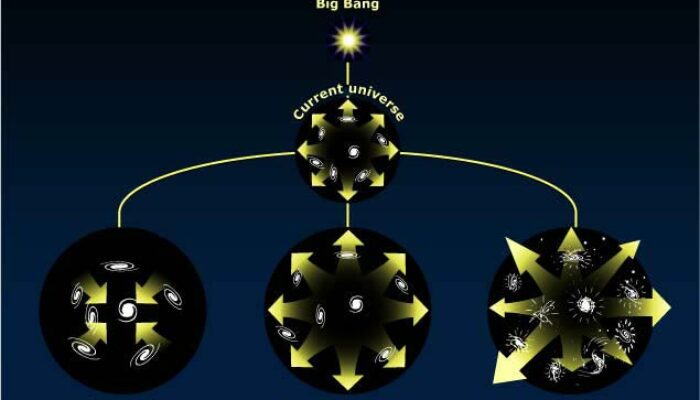
The genesis of dark matter and dark energy is intricately tied to the earliest moments of the universe, beginning with the Big Bang approximately 13.8 billion years ago. This event marked the birth of space, time, matter, and energy from an extremely hot and dense singularity.
Shortly after the Big Bang, the universe experienced a rapid expansion phase known as inflation, which set the stage for the formation of cosmic structures and the cosmic microwave background radiation. It is during or immediately following this inflationary epoch that dark matter is thought to have been produced.
Formation of Dark Matter
Dark matter likely originated from exotic particles generated in the early universe’s high-energy environment. Unlike ordinary matter composed of protons, neutrons, and electrons, dark matter particles do not interact via electromagnetic forces, rendering them invisible to direct detection.
Leading theories propose candidates such as Weakly Interacting Massive Particles (WIMPs) or axions. These particles emerged during symmetry-breaking phase transitions when the unified forces of nature separated into distinct interactions as the universe cooled. Produced in thermal equilibrium with the primordial plasma, these particles decoupled and remained stable, forming the dark matter that influences cosmic structure formation today.
The creation of dark matter is generally dated to within fractions of a second to a few microseconds after the Big Bang, coinciding with critical temperature thresholds in the early universe.
Emergence of Dark Energy
In contrast, dark energy’s origin is more enigmatic and less temporally defined. It is the driving force behind the universe’s accelerated expansion, a phenomenon observed only in the last few billion years through distant supernovae and cosmic microwave background studies.
One prevailing model treats dark energy as the cosmological constant, a uniform vacuum energy density inherent to space-time, possibly present since the Planck epoch (around 10-43 seconds after the Big Bang). However, its effects were negligible during the radiation- and matter-dominated eras of cosmic evolution.
Alternative theories suggest dark energy may have arisen from dynamic fields or phase transitions occurring later in cosmic history, becoming significant only as matter density decreased. These models reflect ongoing efforts to reconcile quantum field theory with cosmological observations.
Mechanisms Behind Dark Matter and Dark Energy
The production and influence of dark matter and dark energy involve distinct physical processes:
- Dark Matter Production:
Generated through particle interactions and symmetry-breaking events in the early universe, dark matter particles decoupled from the thermal plasma and have since influenced gravitational clustering. - Dark Energy Dynamics:
Modeled either as a constant vacuum energy or as a dynamic field, dark energy affects the expansion rate of the universe, counteracting gravitational attraction on large scales.
Mathematical Framework and Cosmological Models
The behavior of dark matter and dark energy is incorporated into cosmological equations that describe the universe’s expansion and structure formation.
The Friedmann equations, derived from Einstein’s General Relativity, govern the expansion rate (Hubble parameter, H) as a function of energy densities:
H² = (8πG/3)(ρ_m + ρ_r + ρ_Λ)
- H: Hubble parameter (expansion rate)
- G: Gravitational constant
- ρ_m: Matter density (including dark matter)
- ρ_r: Radiation density
- ρ_Λ: Dark energy density (cosmological constant)
Dark matter contributes to ρ_m, influencing gravitational attraction and structure growth, while dark energy (ρ_Λ) drives accelerated expansion.
Observational Evidence and Experimental Approaches
Multiple observational techniques and experiments have been employed to study dark matter and dark energy:
- Gravitational Lensing:
Massive objects like galaxies and clusters bend light from background sources, revealing the presence of dark matter through its gravitational effects. - Cosmic Microwave Background (CMB):
Measurements of temperature fluctuations in the CMB provide insights into the early universe’s composition, including the relative amounts of dark matter and dark energy. - Computational Simulations:
Supercomputer models simulate cosmic evolution, tracking how dark matter halos form and merge, and how dark energy influences expansion dynamics. - Particle Physics Experiments:
Underground detectors and particle accelerators search for direct or indirect signals of dark matter particles, aiming to identify their properties.
Common Misconceptions About Dark Matter and Dark Energy
Dark matter is just ordinary matter that is invisible.
Dark matter is fundamentally different from baryonic matter; it does not interact electromagnetically and cannot be detected by conventional means.
Dark energy is a new force pushing galaxies apart.
Dark energy is better understood as a property of space itself, causing accelerated expansion rather than acting as a conventional force.
Significance in Cosmology and Beyond
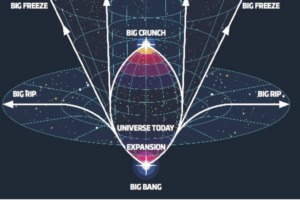
Understanding when and how dark matter and dark energy originated is crucial for unraveling the universe’s history and ultimate fate. Dark matter shapes the formation and clustering of galaxies, while dark energy governs the large-scale dynamics of cosmic expansion. Together, they challenge existing physics paradigms and drive the search for new theories that unify quantum mechanics and gravity.
Advancements in observational technology, theoretical modeling, and experimental physics continue to bring us closer to solving these cosmic mysteries, highlighting the profound complexity and richness of the universe’s fabric.
FAQ
When were dark matter and dark energy created?
Dark matter is believed to have originated within fractions of a second after the Big Bang, while dark energy's effects became significant later in cosmic history.

Leave a Reply