
Short Answer
Definition of Planetary Gravity
Planetary gravity refers to the force of attraction that a planet exerts on objects near its surface. This force governs the motion of celestial bodies and influences various physical phenomena on and around the planet. Gravity is a fundamental interaction that shapes the structure and behavior of planets, stars, and galaxies throughout the universe.
Fundamental Principles of Gravity
The gravitational acceleration experienced at a planet’s surface is described by Newton’s law of universal gravitation. The formula for surface gravity (g) is:
g = GM / R²
- G: The gravitational constant, a universal value.
- M: The total mass of the planet.
- R: The radius of the planet, or the distance from its center to the surface.
This equation highlights that both the mass of the planet and its radius critically determine the strength of gravity felt at the surface.
Key Factors Influencing Planetary Gravity
Mass: The Primary Contributor
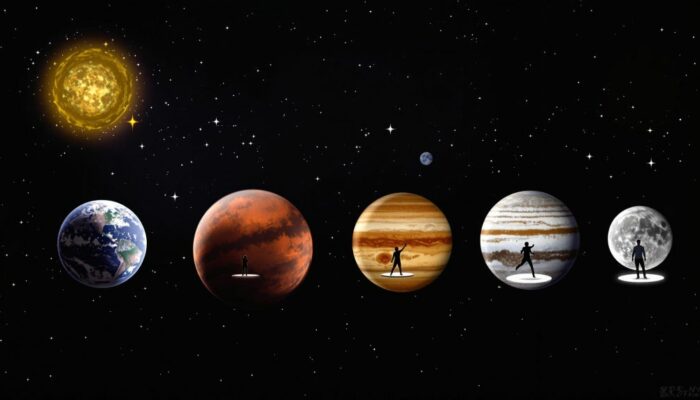
The magnitude of a planet’s gravitational pull is directly proportional to its mass. Larger planets, such as Jupiter, possess immense quantities of matter, resulting in stronger gravitational forces compared to smaller planets like Mars or Mercury. Mass encompasses all the material within a planet, including dense metallic cores and rocky mantles.
However, mass alone does not fully account for differences in gravity. For example, Earth and Venus have similar masses and sizes, leading to comparable surface gravity values, yet subtle differences arise due to other factors.
Radius: The Role of Planetary Size
The radius of a planet inversely affects surface gravity. Even if two planets share the same mass, the one with a larger radius will have weaker gravity at its surface because the gravitational force diminishes with distance from the center of mass. This explains why planets with extensive radii but lower densities, such as Saturn, exhibit lower surface gravity despite their substantial mass.
Density and Composition: Compactness Matters
Density integrates the effects of mass and radius by indicating how tightly matter is packed within a planet. A planet with higher density can exert stronger gravity at its surface even if it is smaller in size. Mercury, for instance, is smaller than Mars but has a higher density due to its metallic core, resulting in relatively strong surface gravity.
The internal makeup of a planet-whether rocky, metallic, or gaseous-significantly influences its density. Terrestrial planets like Earth, Venus, Mars, and Mercury have dense, rocky compositions with metallic cores, whereas gas giants primarily consist of hydrogen and helium, leading to lower densities.
Internal Structure and Mass Distribution
The arrangement of a planet’s internal layers-core, mantle, and crust-affects gravitational strength at the surface. A dense, concentrated core increases gravity, while a more uniform, less dense interior reduces it. Additionally, geological features such as mountain ranges and ocean basins create localized variations in gravity known as gravitational anomalies, reflecting uneven mass distribution within the planet.
Rotational Effects on Gravity
Planetary rotation introduces centrifugal forces that counteract gravity, especially near the equator. This effect causes an equatorial bulge, increasing the radius at the equator and thereby reducing gravitational acceleration there compared to the poles. The faster a planet spins, the more pronounced this variation becomes. Jupiter, with its rapid rotation, shows significant differences in gravity between its equator and poles.
Atmospheric Influence on Perceived Gravity
While a planet’s atmosphere contributes minimally to its overall mass, atmospheric conditions can subtly affect the sensation of gravity. Variations in air pressure and density influence buoyancy and resistance, which can alter how gravity is experienced, such as in lighter-than-air vehicles. The atmosphere also plays a role in shaping environmental conditions that interact with gravitational forces.
Real-World Examples of Gravity Variation
- Jupiter vs. Earth:
Jupiter’s massive size and rapid rotation create strong gravity overall, but its large radius and gaseous composition reduce surface gravity compared to what its mass alone would suggest. - Mercury vs. Mars:
Mercury’s higher density due to a large metallic core results in surface gravity comparable to Mars, despite Mercury’s smaller size. - Earth vs. Venus:
Both planets have similar mass and radius, leading to nearly identical surface gravity, illustrating how mass and radius interplay.
Common Misunderstandings About Planetary Gravity
- Misconception: Gravity depends solely on a planet’s mass.
Correction: Gravity is influenced by both mass and radius, as well as how mass is distributed within the planet. - Misconception: Larger planets always have stronger surface gravity.
Correction: A planet’s size and composition affect gravity; some large gas giants have lower surface gravity than smaller, denser terrestrial planets. - Misconception: Gravity is uniform across a planet’s surface.
Correction: Gravity varies with latitude due to rotational effects and local geological features.
Significance of Understanding Planetary Gravity
Grasping the factors that influence planetary gravity is essential for multiple scientific and practical reasons. Gravity affects planetary atmospheres, geological activity, and potential habitability. It shapes tectonic processes, erosion patterns, and biological evolution. For space exploration, understanding gravity variations informs mission design, landing strategies, and human adaptation to extraterrestrial environments. Moreover, studying gravity differences enhances our comprehension of planetary formation and the dynamic forces sculpting celestial bodies.
FAQ
What primarily affects a planet's gravity?
The primary factors are mass and radius, along with density and internal structure.
Do larger planets always have stronger gravity?
No, gravity also depends on density and composition; some larger gas giants have weaker gravity.
Is gravity uniform across a planet's surface?
No, gravity varies due to rotational effects and local geological features.

Leave a Reply