
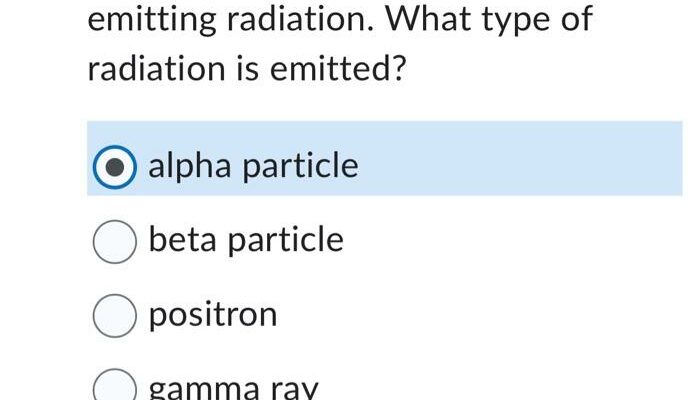
Short Answer
Definition of Gamma Radiation
Gamma radiation represents a unique and compelling phenomenon within particle physics, distinguished from other radioactive emissions by its nature and origin. Unlike alpha or beta particles, which are charged and possess mass, gamma rays consist of high-energy photons-massless and electrically neutral electromagnetic waves emitted from atomic nuclei during nuclear transitions.
- Nature:
Gamma rays are a form of electromagnetic radiation with extremely short wavelengths and high frequencies, surpassing even X-rays in energy. - Origin:
They are typically released when an unstable atomic nucleus moves from an excited state to a more stable, lower energy state, often following alpha or beta decay.
Fundamental Characteristics of Gamma Rays
Gamma rays differ fundamentally from particulate radiation due to their lack of mass and charge. While alpha particles are helium nuclei (two protons and two neutrons) and beta particles are high-speed electrons or positrons, gamma rays are pure energy packets-photons-traveling at the speed of light. This distinction necessitates a conceptual shift from viewing all radiation as particles to recognizing electromagnetic waves as a critical form of nuclear emission.
Mechanism of Gamma Radiation Emission
When a nucleus undergoes radioactive decay, it often remains in an excited, energetically unstable state. This can be likened to a compressed spring that must release stored energy to return to equilibrium. Gamma radiation serves as the mechanism for this energy release: the nucleus emits a gamma photon whose energy precisely matches the difference between the excited and ground states, thereby stabilizing the atom.
Mathematical Explanation of Gamma Emission
The energy of the emitted gamma photon can be expressed as:
E = Einitial – Efinal
- E: Energy of the gamma photon
- Einitial: Energy of the nucleus in the excited state
- Efinal: Energy of the nucleus in the lower energy state
This energy difference corresponds to the photon’s frequency (ν) through Planck’s relation:
E = hν
- h: Planck’s constant
- ν: Frequency of the gamma photon
Applications and Practical Uses of Gamma Radiation
Gamma rays’ exceptional penetrating ability makes them invaluable across multiple scientific and industrial domains:
- Medical Imaging and Therapy:
Techniques such as Positron Emission Tomography (PET) scans utilize gamma radiation to visualize internal body structures and diagnose diseases. - Industrial Radiography:
Gamma rays enable non-destructive testing of materials, allowing inspection of structural integrity without causing damage. - Energy Production:
Nuclear reactors generate gamma radiation as a byproduct of fission, and understanding this emission is crucial for reactor design and safety.
Gamma Radiation in Astrophysics and Cosmology
Gamma rays play a pivotal role in understanding cosmic phenomena. Gamma-ray bursts, the universe’s most energetic explosions, arise from cataclysmic events such as neutron star mergers or the collapse of massive stars into black holes. These bursts provide astronomers with critical data about the universe’s evolution and the fundamental nature of space-time.
Interaction of Gamma Rays with Matter
Although gamma photons themselves are not particles with mass, their interaction with matter can induce secondary effects. When gamma rays collide with atoms, they can transfer energy that ionizes atoms, producing charged particles. These secondary particles may trigger further reactions, creating a cascade of interactions within the material. This complex interplay is essential in radiation shielding and dosimetry.
Role of Gamma Emission in Nuclear Decay Chains
Gamma radiation often follows alpha or beta decay within radioactive decay chains. Daughter nuclei, left in excited states after initial decay, emit gamma photons to shed excess energy and achieve stability. This process is fundamental to the behavior and longevity of isotopes, illustrating the delicate equilibrium between nuclear stability and decay.
Common Misconceptions About Gamma Radiation
Gamma rays are particles like alpha and beta radiation.
Gamma rays are electromagnetic waves (photons) without mass or charge, differing fundamentally from particulate radiation.
Gamma radiation is always harmful and uncontrollable.
While gamma rays are highly penetrating and can be hazardous, they are precisely controlled and harnessed safely in medical and industrial applications.
Significance of Gamma Radiation
Gamma radiation holds profound importance in both theoretical and applied sciences. Its study enhances our understanding of nuclear physics, atomic structure, and cosmic events. Technologically, gamma rays enable advanced medical diagnostics, industrial quality control, and contribute to the development of nuclear energy. The ability to manipulate and detect gamma radiation continues to drive innovation and deepen our comprehension of the universe.
Future Perspectives and Ongoing Research
Exploration into gamma radiation remains a dynamic field, with ongoing research uncovering new properties and applications. Advances in gamma-ray detection and generation promise to expand their use in clean energy, medical therapies, and astrophysical observations. As scientific inquiry progresses, gamma radiation will continue to illuminate both the microscopic world of atoms and the vast expanse of the cosmos.
FAQ
What is gamma radiation?
Gamma radiation is a form of electromagnetic radiation emitted from atomic nuclei during radioactive decay.
How is gamma radiation different from alpha and beta radiation?
Gamma radiation consists of massless photons, whereas alpha and beta radiation consist of particles with mass.
What are the applications of gamma radiation?
Gamma radiation is used in medical imaging, industrial testing, and astrophysical observations.






Leave a Reply