
Short Answer
Definition of Adaptive Optics
Adaptive optics is an advanced technological system designed to enhance the clarity of astronomical observations by compensating for distortions caused by Earth’s atmosphere. This technology functions like a dynamic corrective lens, continuously adjusting to counteract atmospheric turbulence that blurs the images of celestial objects. By refining the incoming light from space, adaptive optics enables astronomers to obtain sharper and more detailed views of the universe.
Fundamental Principles of Adaptive Optics
When light from distant stars and galaxies travels through space, it eventually passes through Earth’s atmosphere, which is composed of layers with varying temperature and density. These fluctuations cause the light waves to distort, similar to the way ripples disrupt the surface of a pond. This atmospheric interference results in blurred and less distinct images, limiting the resolution of ground-based telescopes. Adaptive optics addresses this challenge by detecting and correcting these distortions in real time, restoring the integrity of the observed light.
Key Components
- Wavefront Sensor:
This device measures the distortions in the incoming light waves, identifying aberrations that degrade image quality. - Deformable Mirror:
A mirror capable of rapidly changing its shape to counteract the detected distortions, effectively “flattening” the wavefronts. - Control System:
A feedback loop that processes data from the wavefront sensor and commands the deformable mirror to adjust accordingly, often thousands of times per second.
Operational Mechanism
The adaptive optics system operates by continuously monitoring the incoming light wavefronts using the wavefront sensor. Upon detecting irregularities caused by atmospheric turbulence, the control system calculates the necessary adjustments and commands the deformable mirror to reshape itself. This rapid correction process occurs in real time, allowing telescopes to produce images with significantly improved resolution and contrast, closely approximating observations made from space.
Mathematical Framework
The effectiveness of adaptive optics can be described using wavefront correction mathematics. The incoming distorted wavefront, represented as W(x,y), is measured by the wavefront sensor. The goal is to apply a corrective wavefront C(x,y) via the deformable mirror such that the resultant wavefront R(x,y) = W(x,y) + C(x,y) approaches a flat wavefront, minimizing phase errors.
Key variables include:
- W(x,y): Distorted wavefront phase at position (x,y).
- C(x,y): Corrective phase applied by the deformable mirror.
- R(x,y): Resultant corrected wavefront.
The system aims to minimize the root mean square (RMS) of the phase error across the aperture:
RMS = sqrt{frac{1}{A} int_A [W(x,y) + C(x,y)]^2 dx dy}
where A is the telescope aperture area.
Applications in Astronomy
Adaptive optics has transformed observational astronomy by enabling high-resolution imaging of various celestial phenomena:
- Star Clusters and Nebulae:
Detailed studies of star-forming regions and the structure of nebulae have become possible, revealing intricate features previously obscured by atmospheric distortion. - Galactic Dynamics:
The technology allows astronomers to analyze the internal motions and structures of galaxies with unprecedented clarity. - Exoplanet Detection:
Adaptive optics plays a crucial role in isolating the faint light of planets orbiting distant stars, overcoming the overwhelming brightness of their host stars to enable direct imaging and characterization. - Stellar Surface Observation:
Monitoring active phenomena such as solar flares on distant stars provides insights into stellar magnetic fields and evolutionary processes.
Integration with Computational Techniques
Beyond hardware, adaptive optics benefits from sophisticated computational algorithms that reconstruct and enhance images from distorted data. These algorithms improve the interpretation of observations related to extreme cosmic events, such as black holes and event horizons, by extracting finer details from the corrected light. This synergy between optics and computation expands the frontiers of astrophysical research.
Challenges and Limitations
Despite its advantages, adaptive optics systems face several obstacles:
- Complexity:
The technology requires precise calibration and maintenance to function optimally, demanding specialized expertise. - Cost:
High development and operational expenses limit accessibility, particularly for smaller research institutions and educational facilities. - Technological Barriers:
Continuous innovation is necessary to improve system responsiveness, mirror actuator density, and sensor sensitivity.
Adaptive Optics Beyond Earth-Based Telescopes
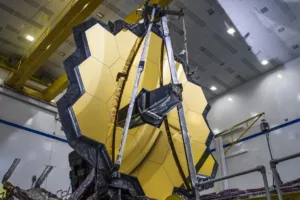
Adaptive optics is not limited to ground observatories. Space telescopes equipped with adaptive systems bypass atmospheric interference entirely, offering pristine views of the cosmos. These space-based instruments represent the next generation of astronomical observation, combining the benefits of adaptive optics with the absence of atmospheric distortion to achieve unparalleled image quality.
Significance in Astrobiology and Space Exploration
Enhancing observational precision through adaptive optics is vital for advancing our understanding of potentially habitable exoplanets and the conditions that support life beyond Earth. By improving the detection of astrobiological signatures, this technology supports missions aimed at exploring distant worlds and contributes to the broader quest to comprehend life’s distribution in the universe.
Conclusion: The Impact of Adaptive Optics on Astronomy
Adaptive optics marks a pivotal advancement in the field of astronomy, dramatically improving our ability to observe and analyze the universe. By mitigating atmospheric distortions, it transforms blurred celestial images into detailed vistas, enabling discoveries that deepen our cosmic knowledge. This technology not only enhances scientific inquiry but also inspires humanity’s enduring fascination with the stars, positioning us as active explorers in the grand narrative of the cosmos.
FAQ
What is adaptive optics?
Adaptive optics is a technology that improves astronomical observations by compensating for distortions caused by Earth's atmosphere.
How does adaptive optics work?
It uses a system of wavefront sensors and deformable mirrors to detect and correct atmospheric distortions in real time.
What are the applications of adaptive optics in astronomy?
Applications include high-resolution imaging of star clusters, exoplanet detection, and monitoring stellar phenomena.




Leave a Reply