
Short Answer
Definition of the Ergodic Theorem
The Ergodic Theorem is a fundamental principle in the study of statistical mechanics and dynamical systems. It establishes a crucial connection between the behavior of individual trajectories within a system and the statistical characteristics observed when considering a large collection of such trajectories. Essentially, the theorem asserts that, given specific conditions, the time average of a measurable quantity will converge to the ensemble average as time approaches infinity. This convergence highlights a deep philosophical insight: complex systems, despite their apparent randomness, exhibit an underlying order that can be described statistically.
Historical Background and Theoretical Foundations
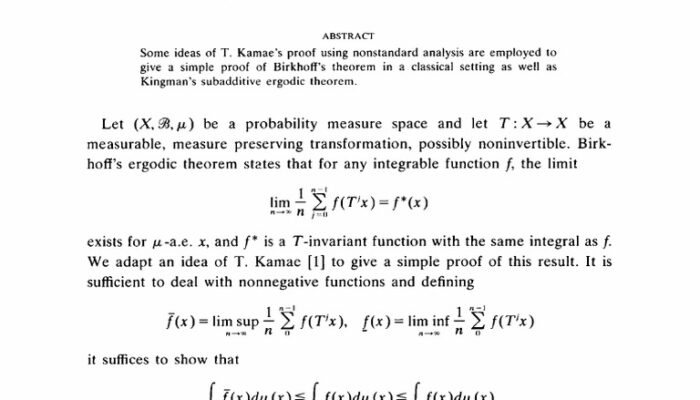
The groundwork for the Ergodic Theorem was laid by mathematicians such as George David Birkhoff, who rigorously explored the conditions necessary for ergodicity. Ergodicity is the property that ensures the equivalence between time averages (observed along a single trajectory over time) and space averages (calculated over the entire phase space). This equivalence implies that even chaotic or seemingly unpredictable systems possess a stable statistical distribution of states when observed over long periods. This insight has been pivotal in advancing our understanding of predictability within complex systems.
Principles and Mechanism of Ergodicity
At its core, the Ergodic Theorem relies on the concept that the long-term behavior of a system can be captured by averaging over time or across an ensemble of states. The theorem applies to systems where trajectories explore the available phase space thoroughly, ensuring that time averages reflect the overall statistical properties. This principle allows researchers to replace difficult-to-measure time averages with more accessible ensemble averages, facilitating analysis and prediction.
Mathematical Formulation
The Ergodic Theorem can be expressed mathematically as follows:
[
lim_{T to infty} frac{1}{T} int_0^T f(x_t) , dt = int_X f(x) , dmu(x)
]
- Where:
( f ) is an observable function defined on the state space ( X ),
( x_t ) represents the state of the system at time ( t ),
( mu ) is the invariant measure over the space ( X ),
and the left side denotes the time average, while the right side is the ensemble average.
Applications Across Disciplines
The Ergodic Theorem finds utility in a wide array of fields, demonstrating its universal applicability:
- Physics:
In statistical mechanics, it justifies the use of microcanonical ensembles by linking microscopic particle behavior to macroscopic thermodynamic properties. - Economics:
Market dynamics often exhibit ergodic properties, enabling economists to infer long-term trends from historical data despite short-term volatility. - Biology:
Population dynamics and evolutionary processes can be analyzed through ergodic frameworks to understand long-term statistical behaviors.
Implications for Predictability in Complex Systems
While deterministic systems are governed by initial conditions, the Ergodic Theorem offers a statistical perspective on predictability. It suggests that even when individual outcomes are unpredictable, the overall long-term behavior of the system can be anticipated through probabilistic means. This is particularly valuable in analyzing complex phenomena such as weather systems or financial markets, where numerous interacting factors create apparent chaos. The theorem provides a scaffold for understanding these systems’ statistical regularities despite their inherent unpredictability.
Philosophical Significance
Beyond its scientific applications, the Ergodic Theorem invites reflection on deeper philosophical questions about time, determinism, and randomness. It reveals a paradox where individual trajectories, which may seem autonomous and random, collectively produce statistically stable patterns. This challenges traditional views on free will and randomness, suggesting that order and predictability can emerge from chaotic processes. Thus, the theorem bridges mathematical abstraction with existential inquiries about the nature of reality.
Advancements and Modern Applications
Ergodic theory has spurred significant progress in various modern scientific fields:
- Information Theory:
Understanding the flow and processing of information in ergodic systems has enhanced data compression and transmission techniques. - Machine Learning:
Ergodic properties underpin the convergence of learning algorithms, aiding in the analysis of complex datasets and improving predictive models. - Computational Simulations:
Advances in computational power have enabled detailed simulations of ergodic systems, allowing researchers to visualize and analyze multi-dimensional phase spaces with greater precision.
Limitations and Conditions
Despite its broad applicability, the Ergodic Theorem is subject to important constraints. Not all systems are ergodic; some exhibit non-ergodic behavior due to factors such as boundary conditions, external perturbations, or discrete state transitions. These deviations mean that time averages may not always equal ensemble averages, limiting the theorem’s predictive power in certain real-world contexts. Recognizing these limitations is crucial for accurately applying ergodic theory to complex systems.
Conclusion: The Enduring Impact of the Ergodic Theorem
The Ergodic Theorem stands as a cornerstone in understanding the interplay between chaos and order within complex systems. By revealing how statistical regularities emerge from seemingly random processes, it provides a powerful framework for analyzing and predicting long-term behaviors across diverse scientific domains. Its influence extends beyond mathematics and physics, touching philosophical debates and inspiring ongoing research. Each exploration of ergodic principles brings us closer to deciphering the intricate patterns that govern the universe’s apparent unpredictability.
FAQ
What is the Ergodic Theorem?
The Ergodic Theorem relates the time averages of a system’s state to the ensemble averages, asserting that under certain conditions, both converge as time approaches infinity.
What are the applications of the Ergodic Theorem?
The theorem is applied in various fields such as physics, economics, and biology to analyze long-term statistical behaviors in complex systems.






Leave a Reply