
Short Answer
Definition of the Hydrogen Atom
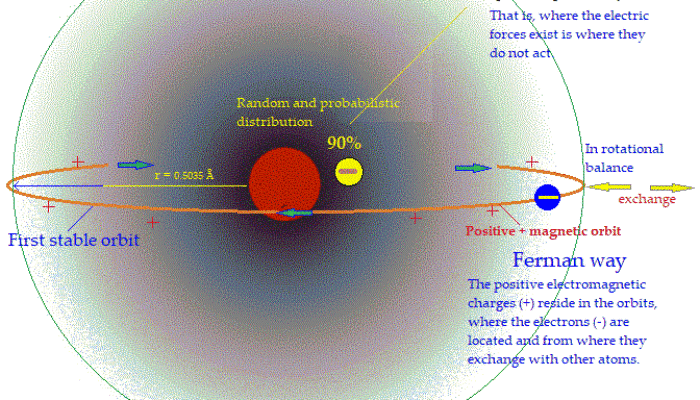
The hydrogen atom is the simplest and most fundamental element in the universe, consisting of a single proton orbited by one electron. It holds a pivotal role in both physics and chemistry as a model for atomic structure and behavior. Understanding the lifespan of a hydrogen atom involves examining its stability, interactions, and transformations across various environments, from terrestrial chemistry to cosmic phenomena.
Intrinsic Stability of Hydrogen
Hydrogen atoms exhibit remarkable stability due to the electromagnetic attraction between their lone proton and electron. This binding energy ensures that, under normal Earth-like conditions, hydrogen atoms can persist indefinitely without spontaneous decay. Unlike living organisms with finite lifespans, hydrogen atoms are often described as effectively “immortal” unless influenced by external forces or reactions.
Atomic Lifespan: Conceptual Clarification
When discussing the lifespan of a hydrogen atom, it is essential to clarify that atoms do not age or decay in the biological sense. Instead, their existence is defined by their stability and the potential for transformation through physical or chemical processes. The term “lifespan” in this context refers to the duration an atom remains in its original form before undergoing a change, such as nuclear fusion or chemical bonding.
Transformations Through Nuclear Fusion
One of the most significant processes affecting hydrogen atoms occurs in stellar interiors, where hydrogen nuclei fuse to form helium and release vast amounts of energy. This nuclear fusion process is the engine powering stars and dictates the cosmic lifecycle of hydrogen atoms. Within stars, a hydrogen atom’s “lifetime” can span millions to billions of years before it is converted into heavier elements, marking a transformative phase in its existence.
Chemical Reactions and Molecular Formation
Beyond nuclear processes, hydrogen atoms frequently participate in chemical reactions, bonding with other elements to form compounds such as water, acids, and organic molecules. These chemical interactions alter the atom’s state from isolated to part of complex molecular structures, extending its influence across biological and environmental systems. Although these bonds are often transient, they demonstrate hydrogen’s versatility and integral role in chemistry.
Isotopes of Hydrogen and Their Lifespans
Hydrogen exists in several isotopic forms, each with distinct nuclear properties that affect their stability and lifespan:
- Protium:
The most common isotope, consisting of one proton and no neutrons, is stable and can persist indefinitely. - Deuterium:
Contains one proton and one neutron, also stable and naturally occurring in small amounts. - Tritium:
Comprises one proton and two neutrons, is radioactive with a half-life of approximately 12.3 years, undergoing beta decay until it transforms into helium-3.
These isotopic variations introduce diversity in the concept of hydrogen’s lifespan, especially in the case of radioactive tritium.
Hydrogen in Cosmic Environments
In the vastness of space, hydrogen atoms encounter extreme conditions that influence their state and longevity. High-energy events such as supernovae can ionize hydrogen, creating plasma states that exist only briefly. Additionally, hydrogen gas clouds serve as the raw material for star formation, where gravitational collapse initiates new stellar bodies. This cosmic recycling underscores hydrogen’s continuous cycle of existence, transformation, and rebirth on a universal scale.
Why Understanding Hydrogen’s Lifespan Matters
Grasping the concept of hydrogen’s lifespan is crucial for multiple scientific disciplines. In astrophysics, it informs models of stellar evolution and the chemical enrichment of the universe. In chemistry and biology, hydrogen’s bonding behavior underpins molecular structures essential for life. Recognizing hydrogen’s dual nature-both enduring and mutable-enhances our comprehension of matter’s fundamental properties and the dynamic processes shaping the cosmos.
Common Misconceptions About Hydrogen’s Lifespan
Hydrogen atoms have a fixed, short lifespan.
Hydrogen atoms are generally stable and can exist indefinitely unless transformed by nuclear or chemical reactions.
All hydrogen isotopes are stable.
While protium and deuterium are stable, tritium is radioactive and decays over time.
Hydrogen atoms are static and unchanging.
Hydrogen atoms frequently undergo transformations through fusion, chemical bonding, and ionization, reflecting a dynamic existence.
Summary: The Dual Nature of Hydrogen’s Existence
The hydrogen atom embodies a paradox of permanence and change. Its fundamental structure allows for near-eternal stability, yet it is also subject to a wide array of transformative processes that redefine its identity. From the birth of the universe to the chemistry of life, hydrogen’s journey illustrates the intricate balance between constancy and flux that characterizes the atomic world. Appreciating this duality enriches our understanding of matter and the ongoing evolution of the cosmos.
FAQ
Do hydrogen atoms have a fixed lifespan?
No, hydrogen atoms do not have a fixed lifespan and can exist indefinitely unless transformed by nuclear or chemical processes.
What happens to hydrogen atoms in stars?
In stars, hydrogen nuclei undergo nuclear fusion, converting into helium and other elements over millions to billions of years.
Are all hydrogen isotopes stable?
No, protium and deuterium are stable isotopes, but tritium is radioactive and decays with a half-life of about 12.3 years.
Can hydrogen atoms be destroyed?
Hydrogen atoms can be transformed or destroyed through nuclear reactions like fusion, or by ionization in extreme cosmic conditions.




Leave a Reply