
Short Answer
Definition of Cesium and Atomic Clocks
Cesium is a chemical element classified among the alkali metals, symbolized as Cs with an atomic number of 55. It is distinguished by its silvery-blue hue and unique atomic characteristics, particularly the specific energy transitions within its atoms. These transitions occur at a microwave frequency of exactly 9,192,631,770 hertz, a value that has become fundamental in defining the modern second, the base unit of time.
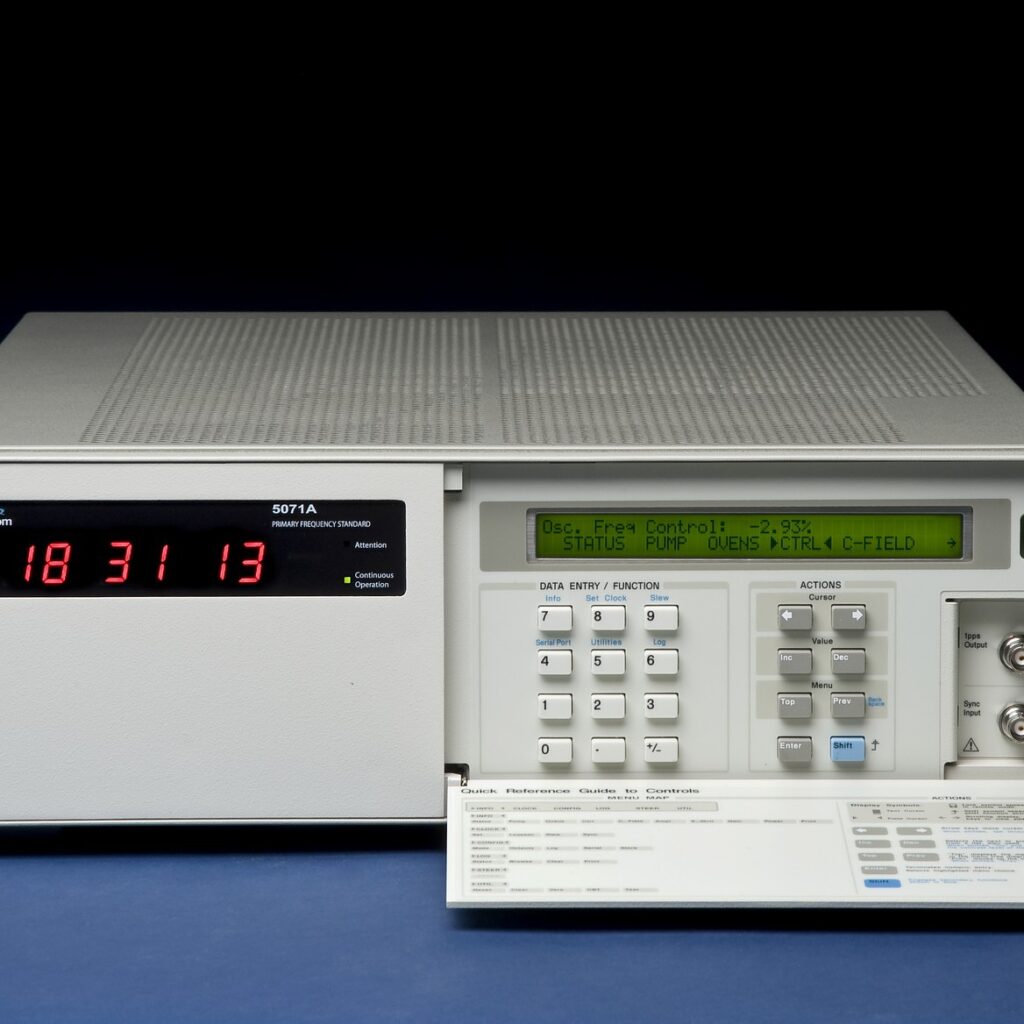
An atomic clock, on the other hand, is a highly advanced instrument designed to measure time with extraordinary precision. It harnesses the consistent oscillations of atoms-most commonly cesium-to maintain an unparalleled standard of timekeeping. While cesium is the elemental basis, the atomic clock is the engineered device that translates cesium’s atomic properties into a reliable temporal measurement.
Atomic Properties of Cesium and Their Role in Timekeeping
Cesium atoms exhibit a unique behavior when exposed to microwave radiation at a precise frequency. The electrons within cesium atoms transition between energy states, absorbing or emitting microwaves at 9,192,631,770 cycles per second. This frequency is remarkably stable and reproducible, making cesium an ideal reference for defining the duration of one second.
- Atomic transitions:
The specific energy level changes in cesium atoms produce a consistent electromagnetic signal. - Frequency stability:
The oscillation frequency of cesium atoms remains constant under controlled conditions, providing a reliable time standard.
How Atomic Clocks Utilize Cesium
Atomic clocks operate by directing cesium atoms through a vacuum chamber where they are exposed to microwave radiation tuned to the cesium transition frequency. The clock’s internal system detects the resonance condition when the microwave frequency matches the natural oscillation of the cesium atoms. This resonance is used to regulate the clock’s timing mechanism, ensuring that the passage of time is measured with extraordinary accuracy.
The process involves heating cesium to create an atomic beam, which then interacts with microwaves. The clock counts the number of oscillations of the cesium atoms, allowing it to maintain time with precision often within a few billionths of a second per year.
Mathematical Basis of Cesium Atomic Clocks
The defining formula for the cesium atomic clock is based on the frequency of the radiation emitted or absorbed by cesium atoms:
f = 9,192,631,770 Hz
- f: Frequency of the microwave radiation corresponding to the cesium atomic transition.
- Hz (Hertz): Cycles per second, the unit of frequency.
This frequency is internationally recognized as the standard for one second, linking atomic physics directly to the measurement of time.
Applications and Significance of Cesium Atomic Clocks
Cesium-based atomic clocks are foundational to numerous modern technologies and scientific fields. Their precision enables:
- Global Positioning Systems (GPS):
Accurate time measurement is critical for determining precise locations on Earth. - Telecommunications:
Synchronization of data transmission across networks depends on exact timing. - Scientific Research:
Experiments such as gravitational wave detection and satellite coordination rely on atomic clock accuracy.
These clocks also underpin international time standards, ensuring global consistency in timekeeping.
Exploration of Alternative Atomic Elements
While cesium remains the primary element for atomic clocks, ongoing research explores other atoms like ytterbium and strontium. These elements offer potential improvements in precision and stability, driven by advances in quantum mechanics and atomic physics. Such developments may lead to next-generation atomic clocks that surpass current capabilities, further refining our understanding and measurement of time.
Distinguishing Cesium from Atomic Clocks
It is essential to differentiate between cesium as a natural element and the atomic clock as a technological instrument. Cesium exists independently in nature, characterized by its atomic properties. The atomic clock, however, is a human-engineered device that exploits cesium’s atomic behavior to achieve precise time measurement. This distinction highlights the transformation of raw scientific phenomena into practical tools that serve critical functions in technology and science.
Philosophical and Scientific Implications
The advancement of atomic clocks, particularly those based on cesium, prompts profound questions about our perception of time and the universe. As measurement tools become increasingly refined, they challenge traditional concepts of temporality and open new avenues for exploring the fundamental nature of reality. This ongoing evolution in timekeeping technology not only enhances practical applications but also deepens our philosophical engagement with the fabric of time itself.
Summary: The Essence of Cesium and Atomic Clocks
In summary, cesium provides the atomic foundation for defining the second through its stable frequency of electromagnetic radiation. Atomic clocks are the sophisticated devices that harness this property to deliver unmatched precision in time measurement. Together, they represent a synergy of natural phenomena and human innovation, driving forward both technological progress and our understanding of time.
FAQ
What is cesium and why is it important for atomic clocks?
Cesium is a chemical element with unique atomic properties, specifically a precise frequency of microwave radiation emitted during electron transitions, making it ideal for highly accurate timekeeping in atomic clocks.
How does an atomic clock work using cesium?
An atomic clock heats cesium atoms and exposes them to microwaves at a specific frequency, measuring the oscillations to keep time extremely accurately.
What are the practical uses of atomic clocks?
Atomic clocks are critical for GPS navigation, telecommunications synchronization, scientific experiments, and maintaining international time standards.
Are there other elements used besides cesium in atomic clocks?
Yes, rubidium is commonly used, and research is ongoing into ytterbium and strontium to enhance precision further.






Leave a Reply