
Short Answer
Definition of Atoms and Molecules
Atoms and molecules are the foundational units that compose all matter in the universe. Understanding the distinction between these two entities is essential for grasping the microscopic framework that underlies chemical processes and biological systems.
- Atom:
The smallest unit of an element that retains its chemical identity, consisting of a nucleus surrounded by electrons. - Molecule:
A stable assembly of two or more atoms bonded together, forming the basic units of chemical compounds.
Structure and Characteristics of Atoms
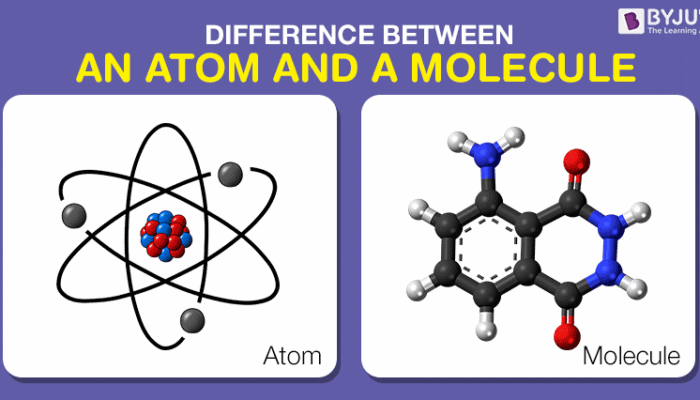
An atom can be envisioned as a tiny system with a dense central nucleus containing protons and neutrons, orbited by electrons arranged in specific energy levels. The nucleus acts as the core, where positively charged protons and neutral neutrons reside, while electrons move around this core in quantized shells. The number of protons, known as the atomic number, uniquely identifies each element and determines its position in the periodic table.
- Nucleus:
Composed of protons and neutrons, it forms the atom’s dense center. - Electrons:
Negatively charged particles orbiting the nucleus in defined energy levels. - Atomic Number:
The count of protons in the nucleus, defining the element’s identity.
Formation and Nature of Molecules
Molecules arise when atoms connect through chemical bonds, such as covalent or ionic bonds, creating compounds with distinct properties. This bonding process is comparable to musicians collaborating to produce a symphony, where each atom contributes to the overall structure and function of the molecule. The specific arrangement and type of bonds influence the molecule’s stability and reactivity.
- Covalent Bonds:
Atoms share electrons to form strong, stable connections. - Ionic Bonds:
Atoms transfer electrons, resulting in charged ions that attract each other. - Example:
Water (H2O) consists of two hydrogen atoms covalently bonded to one oxygen atom, exhibiting unique chemical behavior.
Atoms as the Building Blocks of Elements
Each element is defined by its atoms, which maintain the element’s unique chemical properties. The periodic table organizes elements based on atomic number and electron configuration, revealing patterns in chemical behavior and reactivity. This systematic arrangement helps scientists predict how elements will interact and combine.
Diversity and Complexity of Molecules
Molecules display a vast range of complexity, from simple diatomic molecules to large biomolecules. The diversity arises from different combinations of atoms and bonding patterns, resulting in substances with varied physical and chemical characteristics. Molecular geometry plays a crucial role in determining how molecules interact, especially in biological contexts where shape influences function.
- Simple Molecules:
Carbon dioxide (CO2) is a linear molecule involved in atmospheric processes. - Complex Molecules:
Glucose (C6H12O6) is a complex sugar essential for energy in living organisms. - Molecular Shape:
The three-dimensional arrangement affects reactivity and biological activity.
Interconnection Between Atoms and Molecules
The relationship between atoms and molecules is fundamental to chemistry and biology. Atoms serve as the elemental units, while molecules represent the combinations that give rise to the vast array of materials and substances in nature. This interplay facilitates chemical reactions, energy transformations, and the formation of complex structures necessary for life.
Significance in Science and Everyday Life
Understanding atoms and molecules is crucial for advancements in fields such as chemistry, physics, biology, and materials science. This knowledge enables the development of new materials, medicines, and technologies, and deepens our comprehension of natural phenomena. From the air we breathe to the food we consume, atoms and molecules are integral to the fabric of existence.
Common Misconceptions
Atoms are indivisible and cannot be broken down.
Atoms consist of subatomic particles (protons, neutrons, electrons) and can be split in nuclear reactions.
Molecules are always composed of different types of atoms.
Molecules can be made of identical atoms, such as O2 (oxygen gas).
FAQ
What is an atom?
An atom is the fundamental unit of matter, consisting of a nucleus with protons and neutrons, surrounded by electrons.
What is a molecule?
A molecule is a chemical structure formed when two or more atoms bond together.
How do atoms determine the properties of elements?
The number and arrangement of protons, neutrons, and electrons in an atom dictate the chemical properties of an element.
Why is molecular shape important?
The shape of a molecule affects its reactivity and interaction with other molecules, especially in biological systems.




Leave a Reply