
Short Answer
Definition of Atoms, Elements, and Molecules
Understanding the fundamental constituents of matter is essential for grasping the principles of chemistry and related sciences. Atoms, elements, and molecules are the core units that compose all substances in the universe, each with distinct characteristics and roles.
- Atom:
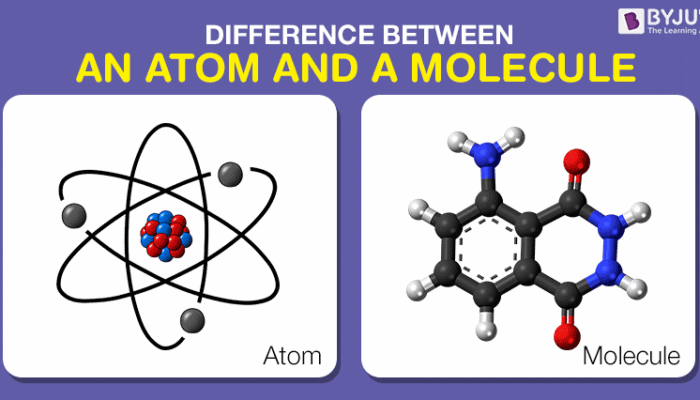
The smallest unit of matter that retains the properties of an element, consisting of a nucleus made of protons and neutrons, surrounded by electrons. - Element:
A pure substance composed entirely of one type of atom, defined by its unique number of protons (atomic number), and cannot be broken down into simpler substances by chemical means. - Molecule:
A chemical entity formed when two or more atoms bond together covalently, creating a compound with properties different from its constituent atoms.
Structure and Characteristics of Atoms
Atoms serve as the fundamental building blocks of matter. Each atom features a dense nucleus containing positively charged protons and neutral neutrons, encircled by a cloud of negatively charged electrons. The number of protons, known as the atomic number, uniquely identifies the element. For example, hydrogen’s atom contains a single proton, while uranium’s atom has 92 protons, defining their distinct identities.
Elements: Pure Substances with Unique Identities
Elements represent pure forms of matter that cannot be chemically decomposed into simpler substances. They are the fundamental categories in the periodic table, each with specific physical and chemical properties. Elements such as oxygen, carbon, and gold maintain their identity through various chemical reactions, serving as the foundation for forming compounds and more complex materials.
Molecules: Complex Assemblies of Atoms
Molecules arise when atoms connect through covalent bonds, forming stable groups that exhibit new properties distinct from individual atoms. For instance, a water molecule (H₂O) consists of two hydrogen atoms bonded to one oxygen atom, creating a substance essential for life. Molecules can range from simple diatomic forms like oxygen (O₂) to large biomolecules like proteins and DNA.
Classification and Examples of Atomic and Molecular Forms
Atoms can exist independently or as part of molecules. Noble gases such as helium and neon are examples of elemental atoms that naturally occur as single atoms due to their stable electron configurations. Conversely, many elements form diatomic molecules, such as nitrogen (N₂) and oxygen (O₂), where two atoms bond to achieve stability, altering their chemical behavior compared to isolated atoms.
Macroscopic vs. Microscopic Perspectives
From a macroscopic viewpoint, elements and compounds are observable and measurable, exhibiting distinct physical properties like melting points, boiling points, and solubility. For example, sodium chloride (table salt) is a compound formed from sodium and chlorine atoms, possessing characteristics different from either element alone. On the microscopic scale, atoms and molecules display complex quantum behaviors, including electron shell arrangements and wave-particle duality, which govern their interactions and properties.
Chemical Bonding and Its Significance
The formation of molecules depends on chemical bonds between atoms, which can be covalent, ionic, or metallic. These bonds dictate the structure, stability, and reactivity of substances, underpinning the vast diversity of chemical compounds. Understanding bonding mechanisms is crucial for advancements in fields such as organic chemistry, materials science, and pharmacology, enabling the design of new materials and medicines.
Philosophical and Scientific Implications
The distinctions among atoms, elements, and molecules extend beyond scientific classification, prompting deeper reflections on the nature of reality and existence. Atoms, as the smallest units of matter, reveal insights into the universe’s fundamental structure. The interplay of these units illustrates the interconnectedness of all matter, where simple components combine to form the complex world we experience.
Summary: The Interplay of Atoms, Elements, and Molecules
In essence, atoms are the foundational units of matter, elements represent pure substances defined by atomic identity, and molecules are the bonded assemblies of atoms that create new substances. This triad forms the basis of material reality, bridging the gap between microscopic particles and the macroscopic world. Exploring these concepts deepens our understanding of chemistry, physics, and the universe at large, highlighting the elegant complexity underlying everyday matter.
FAQ
What is an atom?
An atom is the smallest unit of matter that retains the properties of an element, consisting of a nucleus made of protons and neutrons, surrounded by electrons.
What distinguishes an element from a molecule?
An element is a pure substance made entirely of one type of atom, while a molecule is formed when two or more atoms bond together covalently.
Can atoms exist independently?
Yes, some atoms, like noble gases, can exist independently due to their stable electron configurations.




Leave a Reply