
Short Answer
Definition of Matter and Its States
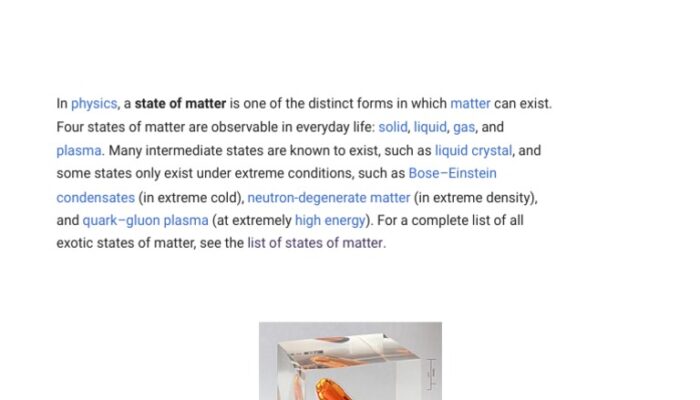
Matter, a fundamental concept in chemistry, refers to any substance that occupies space and has mass. The study of matter involves understanding its various states, each distinguished by unique physical properties and behaviors. Traditionally, matter is classified into four primary states: solid, liquid, gas, and plasma. These states form the basis for comprehending numerous chemical reactions and physical phenomena.
Characteristics of Solid State
Solids are defined by their fixed shape and volume. The particles in solids are tightly packed in a structured, often rigid arrangement, resulting in strong intermolecular forces that restrict particle movement. This close packing imparts solids with high density and stability. Crystalline solids, such as diamonds and table salt, exhibit an orderly, repeating particle pattern, whereas amorphous solids like glass and plastics lack this long-range order, leading to distinct physical traits such as varied transparency and thermal expansion.
Properties of Liquids
Liquids possess a definite volume but adapt their shape to the container they occupy. This flexibility arises from particles having greater kinetic energy than in solids, allowing them to move past one another while still being influenced by moderate intermolecular forces. Liquids are largely incompressible, maintaining consistent volume under pressure. A notable feature of liquids is surface tension, caused by cohesive forces among surface molecules, which enables phenomena like water droplets forming and insects walking on water surfaces.
Gas: Behavior and Principles
Gases differ markedly from solids and liquids by lacking both a fixed shape and volume, expanding to fill any container. Gas particles are widely spaced and move freely with high kinetic energy, experiencing minimal intermolecular attraction. The behavior of gases is governed by relationships between pressure, volume, and temperature, encapsulated in the Ideal Gas Law. Additional gas laws, including Boyle’s, Charles’s, and Avogadro’s laws, describe how gases respond to changes in these variables, underpinning applications in meteorology, engineering, and beyond.
Plasma: The Fourth State of Matter
Plasma emerges at extremely high temperatures when atoms lose electrons, creating a charged mixture of ions and free electrons. This ionized state is abundant in the universe, constituting stars like the sun, and is utilized in technologies such as fluorescent lighting and plasma display screens. Plasma’s unique properties, including electrical conductivity and magnetic field generation, make it a focal point in research areas like nuclear fusion and astrophysics.
Phase Transitions and Energy Exchange
Matter can shift between states through phase changes, processes driven by the absorption or release of energy, typically heat. Melting (solid to liquid) and evaporation (liquid to gas) require energy input, whereas freezing (liquid to solid) and condensation (gas to liquid) release energy. These transitions are visually represented in phase diagrams, which map the state of matter under varying temperature and pressure conditions. Understanding phase changes is essential for numerous scientific disciplines and industrial processes.
Supercritical Fluids and Their Applications
At the critical point, substances enter a supercritical fluid phase where liquid and gas phases become indistinguishable. Supercritical fluids exhibit unique properties, such as enhanced solvency and diffusivity, making them valuable in applications like extraction, pharmaceuticals, and environmental cleaning. Manipulating temperature and pressure to achieve these states has significant implications in materials science and industrial technology.
Exotic States of Matter: Bose-Einstein and Fermionic Condensates
Beyond classical states, exotic phases such as Bose-Einstein condensates and fermionic condensates arise under extreme conditions near absolute zero temperature. These states allow particles to occupy the same quantum state, providing a platform to explore quantum mechanics on a macroscopic scale. Research into these condensates advances our understanding of fundamental physics and may lead to breakthroughs in quantum computing and other technologies.
Importance of Understanding States of Matter
The study of matter’s states is not only a cornerstone of chemistry but also vital to numerous scientific and technological fields. From the solid materials forming our environment to the gaseous atmospheres surrounding us, the behavior and transformation of matter influence everyday life and industrial innovation. Mastery of these concepts enables advancements in fields such as materials engineering, environmental science, and astrophysics, highlighting the profound connection between matter’s states and the complexity of the universe.
FAQ
What is plasma?
Plasma is a state of matter created at high temperatures where atoms lose electrons, resulting in a mixture of ions and free electrons.
How do gases behave?
Gases have no fixed shape or volume and expand to fill their container, with particles that move freely and are widely spaced.






Leave a Reply