
Short Answer
Definition of Quantum Computing
Quantum computing represents a groundbreaking shift in computational technology, transcending the capabilities of classical computers. It leverages the principles of quantum mechanics to process information in fundamentally new ways, promising to revolutionize how we handle complex calculations, data analysis, and problem-solving. Unlike traditional computing, which relies on binary bits, quantum computing utilizes quantum bits or qubits, enabling a vast expansion in processing power and efficiency.
Fundamental Principles of Quantum Mechanics
To fully appreciate quantum computing, it is essential to understand the core concepts of quantum mechanics, the branch of physics that describes the behavior of particles at the atomic and subatomic levels. This domain defies classical intuition by revealing phenomena such as wave-particle duality, where particles exhibit both wave-like and particle-like properties. Two critical quantum phenomena underpinning quantum computing are superposition and entanglement.
- Superposition:
This principle allows qubits to exist simultaneously in multiple states, unlike classical bits restricted to either 0 or 1. A qubit can be in a linear combination of both states, enabling quantum computers to perform many calculations at once. - Entanglement:
When qubits become entangled, the state of one qubit instantaneously influences the state of another, regardless of the distance separating them. This interconnectedness enhances computational capabilities and challenges traditional notions of locality and information transfer.
How Quantum Computing Operates
Quantum computers harness superposition and entanglement to execute complex algorithms more efficiently than classical machines. By encoding information in qubits that can represent multiple states simultaneously, quantum systems can explore a vast solution space in parallel. Entanglement further allows qubits to coordinate their states, enabling operations that are exponentially faster for certain tasks, such as factoring large numbers or searching unsorted databases.
Quantum Computer Architectures
The design of quantum computers varies significantly from classical architectures, with several approaches under active development:
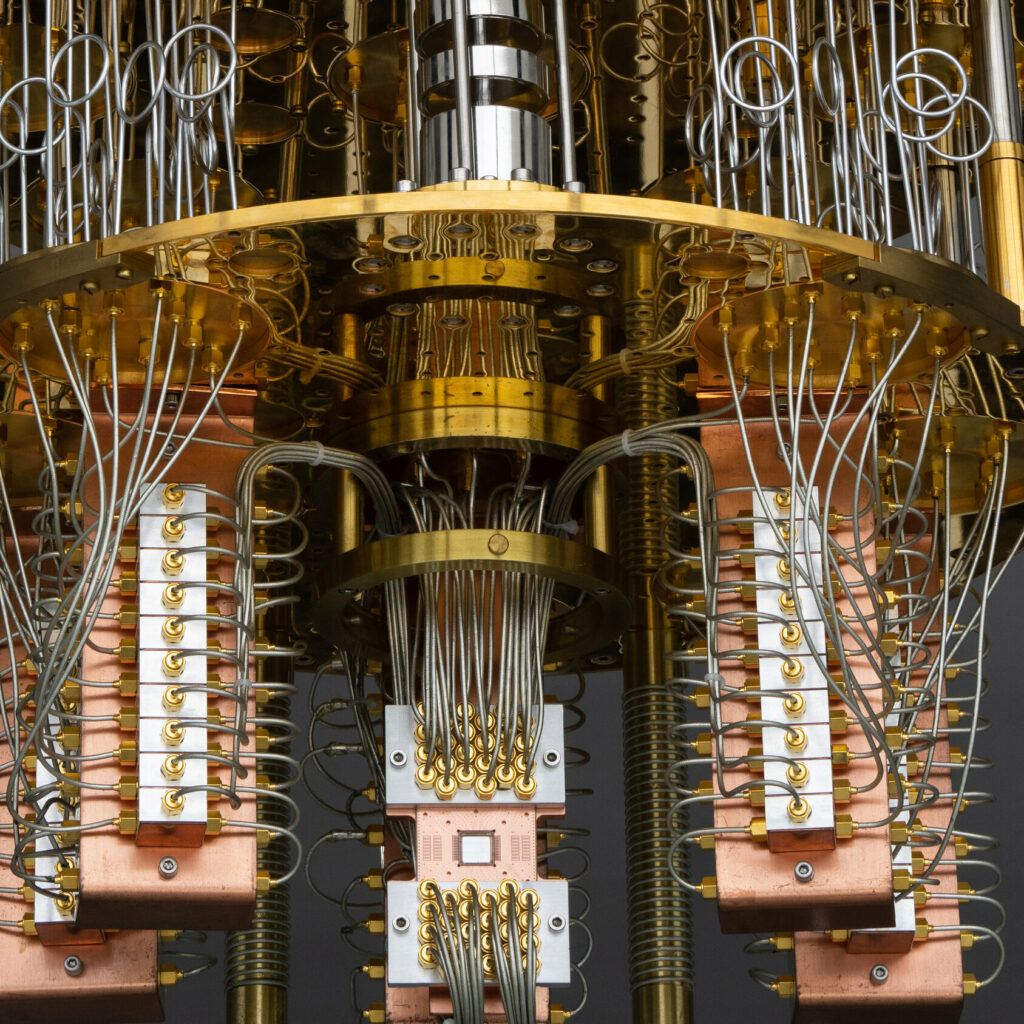
- Superconducting Qubits:
These utilize superconducting circuits cooled to near absolute zero to maintain coherent quantum states, offering fast operation speeds but facing challenges in error rates and scalability. - Trapped Ion Qubits:
Ions are confined and manipulated using electromagnetic fields, providing high-fidelity qubit control and long coherence times, though with slower gate speeds. - Topological Qubits:
This emerging approach aims to encode information in topological states of matter, potentially offering greater resistance to decoherence and errors.
Each architecture presents unique trade-offs, and ongoing research focuses on improving stability, coherence duration, and scalability to build practical quantum machines.
Applications and Impact of Quantum Computing
Quantum computing holds transformative potential across diverse fields:
- Cryptography:
Quantum key distribution leverages quantum mechanics to enable secure communication channels that can detect eavesdropping, enhancing cybersecurity. - Materials Science and Drug Discovery:
Quantum simulations can model molecular interactions with unprecedented accuracy, accelerating the development of new materials and pharmaceuticals. - Artificial Intelligence and Machine Learning:
Quantum algorithms like Grover’s and Shor’s offer speedups in database searching and integer factorization, which could lead to breakthroughs in data analysis and AI model training.
Challenges in Quantum Computing Development
Despite its promise, quantum computing faces significant obstacles:
- Quantum Decoherence:
Qubits are extremely sensitive to environmental disturbances, causing loss of quantum information and errors. - Error Correction:
Developing effective quantum error correction techniques is critical to maintaining reliable computations over time. - Hardware Scalability:
Building large-scale quantum processors with thousands or millions of qubits remains a formidable engineering challenge.
To address these issues, researchers are exploring hybrid quantum-classical systems that combine the strengths of both paradigms to optimize performance and reliability.
Philosophical and Cultural Significance
Beyond its technical aspects, quantum computing invites profound philosophical reflection. It challenges classical assumptions about reality, causality, and the role of observation in determining physical outcomes. The entanglement phenomenon, in particular, raises questions about the interconnectedness of the universe and the limits of human knowledge. This intersection of science and philosophy enriches the discourse surrounding quantum technologies and their broader implications.
Conclusion: The Future of Quantum Computing
Quantum computing is not just a technological breakthrough but a deep exploration into the fundamental nature of computation and reality. As advancements continue, the fusion of theoretical insights, practical applications, and philosophical inquiry will shape the trajectory of this transformative field. The potential to solve previously intractable problems and redefine our understanding of information processing positions quantum computing as a pivotal force in the evolution of science and technology.
FAQ
What is quantum computing?
Quantum computing is a type of computation that uses quantum-mechanical phenomena to process information.
What are qubits?
Qubits are the basic units of quantum information, capable of representing multiple states simultaneously.
What are the applications of quantum computing?
Applications include cryptography, drug discovery, and advancements in artificial intelligence.






Leave a Reply