
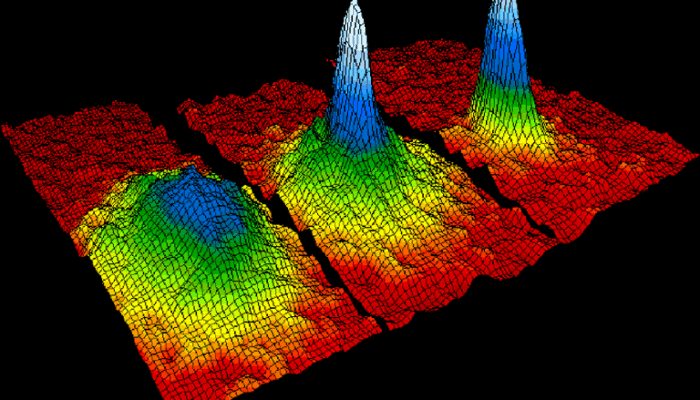
Short Answer
Definition of Bose-Einstein Condensate
A Bose-Einstein condensate (BEC) represents a unique phase of matter that emerges under extreme conditions, where particles known as bosons coalesce into a single quantum state. First theorized by physicists Satyendra Nath Bose and Albert Einstein in the early 20th century, this state exemplifies the extraordinary quantum phenomena that occur at temperatures approaching absolute zero. In this regime, individual atoms lose their distinct identities and behave collectively as a unified quantum entity, revealing behaviors that defy classical physics.
Fundamental Properties of Bose-Einstein Condensates
The defining characteristic of a BEC stems from the quantum statistics of bosons, particles that can occupy identical quantum states simultaneously. This contrasts sharply with fermions, such as electrons, which are restricted by the Pauli Exclusion Principle from sharing the same state. Common bosons include photons and certain atoms like rubidium-87, which, when cooled sufficiently, accumulate in the lowest energy state, resulting in a macroscopic quantum phenomenon.
- Quantum Coherence:
At ultralow temperatures, bosons synchronize their wavefunctions, creating a coherent matter wave that behaves as a single quantum object. - Superfluidity and Superconductivity:
The condensate exhibits frictionless flow and zero electrical resistance, phenomena that challenge classical understandings of energy dissipation.
Mechanism of Bose-Einstein Condensation
The formation of a Bose-Einstein condensate requires cooling a dilute gas of bosonic atoms to temperatures mere billionths of a degree above absolute zero. This is achieved through advanced techniques such as laser cooling, which slows atomic motion by using photon momentum, and evaporative cooling, which selectively removes higher-energy atoms to lower the overall temperature. As the system crosses a critical temperature threshold, a large fraction of atoms collapse into the ground quantum state, producing the condensate.
Mathematical Framework and Quantum Statistics
The behavior of bosons in a BEC is governed by Bose-Einstein statistics, which describe the distribution of indistinguishable particles over energy states. The critical temperature ( T_c ) for condensation in an ideal gas can be approximated by the formula:
T_c = frac{2pi hbar^2}{mk_B} left( frac{n}{zeta(3/2)} right)^{2/3}
- ( hbar ): Reduced Planck’s constant
- m: Mass of the bosonic particle
- k_B: Boltzmann constant
- n: Particle number density
- ( zeta(3/2) ): Riemann zeta function evaluated at 3/2 (~2.612)
Below this temperature, the ground state becomes macroscopically occupied, leading to the emergence of the condensate’s collective quantum properties.
Experimental Realization and Techniques
Creating a BEC in the laboratory is a complex endeavor requiring precise control over atomic interactions and environmental conditions. Laser cooling uses tuned laser beams to reduce atomic velocities, while evaporative cooling further lowers temperature by removing the most energetic atoms from a magnetic or optical trap. These methods enable researchers to reach the ultracold regime necessary for condensation.
Once formed, the condensate can be manipulated using optical lattices-periodic potentials created by intersecting laser beams-that allow physicists to simulate solid-state systems and explore novel quantum phases.
Quantum Interference and Observable Phenomena
Bose-Einstein condensates exhibit remarkable quantum interference effects, akin to those seen in light waves. When two condensates overlap, their wavefunctions interfere, producing patterns that confirm the wave-like nature of matter at macroscopic scales. This phenomenon parallels the famous double-slit experiment and provides compelling evidence for the fundamental principles of quantum mechanics.
Applications and Technological Implications
The unique quantum coherence and stability of BECs have promising applications across various scientific and technological fields:
- Quantum Computing:
BECs offer a platform for developing qubits with enhanced coherence times, potentially advancing quantum information processing. - Precision Sensing:
Their sensitivity to external fields makes BECs ideal for detecting subtle variations in magnetic and gravitational environments. - Fundamental Physics Research:
BECs serve as testbeds for exploring quantum phase transitions, superfluidity, and other exotic states of matter.
Philosophical and Conceptual Insights
The existence of Bose-Einstein condensates challenges traditional notions of individuality and separability in physics. As particles merge into a single coherent state, the boundary between individual and collective behavior blurs, prompting reflections on the interconnectedness of matter. This duality-where the condensate is simultaneously a collection of particles and a unified quantum wave-invites deeper philosophical inquiry into the nature of reality and consciousness.
Future Directions and Research Frontiers
Ongoing investigations into BECs continue to push the boundaries of quantum science. Innovations in manipulating condensates with light and magnetic fields are uncovering new quantum phases and enabling simulations of complex materials. As experimental techniques improve, the discovery of even more exotic states of matter and their potential applications in technology and fundamental physics remain promising areas of exploration.
Summary
Bose-Einstein condensates exemplify the extraordinary outcomes of quantum mechanics, where bosonic particles unite into a coherent quantum state at ultralow temperatures. This phenomenon not only deepens our understanding of quantum behavior but also paves the way for revolutionary advancements in technology and enriches philosophical perspectives on the fabric of existence. As research progresses, BECs will undoubtedly continue to illuminate the intricate relationship between the microscopic quantum world and macroscopic reality.
FAQ
What is a Bose-Einstein condensate?
A Bose-Einstein condensate is a state of matter formed when bosons are cooled to temperatures near absolute zero, causing them to occupy the same quantum state and exhibit macroscopic quantum phenomena.
How is a Bose-Einstein condensate created?
BECs are created by cooling dilute gases of bosonic atoms using laser cooling and evaporative cooling techniques to reach ultralow temperatures near absolute zero.
What are the applications of Bose-Einstein condensates?
BECs have applications in quantum computing, precision sensing, and fundamental physics research exploring quantum phase transitions and superfluidity.
Who first predicted Bose-Einstein condensates?
The existence of Bose-Einstein condensates was first predicted by physicists Satyendra Nath Bose and Albert Einstein in the early 20th century.






Leave a Reply