
Short Answer
Definition of Measuring Instruments
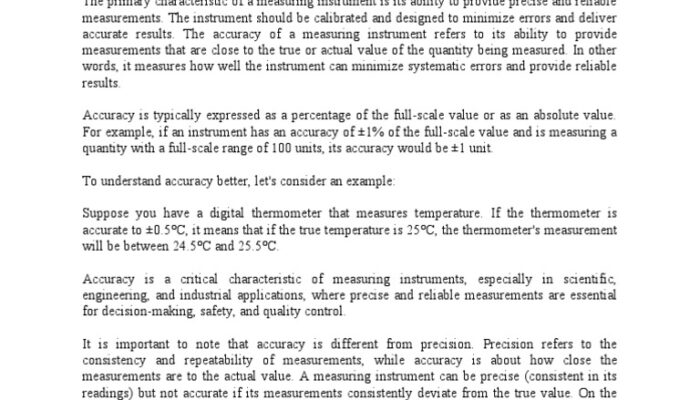
Measuring instruments are essential tools in empirical science, serving as the means by which we quantify and understand the physical characteristics of our environment. These devices transform intangible phenomena into measurable data, enabling scientists to explore and explain natural laws. Their role is pivotal across diverse scientific disciplines, providing the foundation for accurate observation and experimentation.
Types of Common Measuring Instruments and Their Functions
Ruler: The Basic Tool for Length Measurement
The ruler is a fundamental instrument used to determine linear distances. Constructed from materials such as wood, plastic, or metal, rulers come in various sizes and degrees of precision. Beyond simply measuring length, rulers cultivate an understanding of scale and accuracy, which are critical to scientific methodology. This straightforward device underpins many geometric analyses and spatial reasoning tasks.
Caliper: Precision in Dimensional Measurement
Calipers are specialized tools designed to measure both internal and external dimensions with high accuracy. Available in vernier, dial, and digital formats, calipers operate through adjustable jaws that grip the object being measured. Their capability to provide measurements down to fractions of a millimeter is vital in fields like mechanical engineering and manufacturing, where exact dimensions are crucial to component functionality and safety.
Balance: Measuring Mass with Accuracy
The balance is a classic instrument for determining mass, evolving from the ancient beam balance to modern electronic versions that use electromagnetic force restoration. The principle of equilibrium, where weights balance on either side of a beam, reflects fundamental physical concepts of balance and stability. Accurate mass measurement is indispensable in laboratory settings, particularly for chemical stoichiometry and material characterization.
Thermometer: Quantifying Temperature
Thermometers measure temperature by detecting changes in thermal expansion or electrical resistance. They are indispensable across numerous fields, including meteorology, medicine, and physics. Understanding temperature variations is key to studying thermodynamics, the science of energy and heat transfer. Precise temperature readings are critical, as errors can lead to flawed scientific conclusions or even medical risks.
Barometer: Atmospheric Pressure Measurement
The barometer gauges atmospheric pressure, a vital parameter for weather forecasting and altitude determination. It operates on the principle that fluctuations in air pressure correspond to changes in weather conditions. Historically, barometers have been instrumental in humanity’s efforts to anticipate and adapt to environmental changes, underscoring our desire to mitigate the unpredictability of nature.
Anemometer: Measuring Wind Speed
Anemometers assess wind velocity, typically using rotating cups or blades that respond to airflow. This measurement is crucial in meteorology, aviation, and renewable energy sectors, especially for optimizing wind turbine performance. By quantifying wind, anemometers contribute to ecological studies and the advancement of sustainable energy solutions, reflecting a growing emphasis on environmental stewardship.
Multimeter: Versatile Electrical Measurement
The multimeter is a multifunctional device that measures electrical properties such as voltage, current, and resistance. Digital multimeters are widely used for diagnosing and troubleshooting electrical circuits, providing essential data for engineers and technicians. This instrument exemplifies the integration of multiple measurement capabilities into a single tool, facilitating the management of complex electronic systems.
Oscilloscope: Visualizing Electrical Signals
Oscilloscopes graphically display electrical waveforms, plotting voltage against time. This visualization allows detailed analysis of signal behavior, including periodic and transient phenomena. Oscilloscopes are indispensable in electronics and telecommunications, bridging theoretical electrical concepts with practical applications and enabling advancements in circuit design and signal processing.
How Measuring Instruments Operate
Each measuring instrument functions based on specific physical principles tailored to the property it measures. For example, rulers rely on fixed scales for length, calipers use mechanical jaws for dimensional accuracy, and balances depend on equilibrium physics. Thermometers exploit thermal expansion or electrical resistance changes, while barometers measure pressure variations through fluid displacement or electronic sensors. Anemometers convert wind force into rotational motion, multimeters detect electrical parameters via internal circuitry, and oscilloscopes translate electrical signals into visual waveforms. Together, these mechanisms convert physical phenomena into interpretable data.
Mathematical and Physical Principles Behind Measuring Instruments
- Ruler:
Measurement is based on a linear scale marked in units such as centimeters or inches. - Caliper:
Dimensional measurement involves precise mechanical displacement, often read via vernier scales or digital displays. - Balance:
Equilibrium condition: ( sum tau = 0 ), where torques on either side of the beam balance out. - Thermometer:
Thermal expansion formula: ( Delta L = alpha L_0 Delta T ), where ( alpha ) is the coefficient of linear expansion. - Barometer:
Atmospheric pressure ( P = rho g h ), where ( rho ) is fluid density, ( g ) is gravitational acceleration, and ( h ) is fluid column height. - Anemometer:
Wind speed derived from rotational velocity: ( v = r omega ), where ( r ) is radius and ( omega ) is angular velocity. - Multimeter:
Uses Ohm’s law ( V = IR ) to measure voltage (V), current (I), and resistance (R). - Oscilloscope:
Displays voltage as a function of time, ( V(t) ), enabling analysis of waveform characteristics.
Practical Applications of Measuring Instruments
Measuring instruments are integral to numerous real-world scenarios:
- Rulers are used in education, construction, and design to ensure accurate dimensions.
- Calipers are critical in manufacturing for quality control of mechanical parts.
- Balances enable precise mass measurements in chemical laboratories and pharmaceutical production.
- Thermometers monitor patient health, weather conditions, and industrial processes.
- Barometers assist meteorologists in forecasting weather and pilots in altitude determination.
- Anemometers optimize wind turbine placement and ensure safe aviation operations.
- Multimeters are essential for electrical maintenance and troubleshooting in homes and industries.
- Oscilloscopes facilitate the development and repair of electronic devices and communication systems.
Common Misunderstandings About Measuring Instruments
- Misconception: Rulers can measure curved surfaces accurately.
Correction: Rulers are designed for straight-line measurements; flexible measuring tapes are better suited for curves. - Misconception: All calipers provide the same precision.
Correction: Precision varies among vernier, dial, and digital calipers, with digital often offering the highest accuracy. - Misconception: Thermometers measure heat directly.
Correction: Thermometers measure temperature, which is related to heat but not the same physical quantity. - Misconception: Barometers can predict exact weather events.
Correction: Barometers indicate pressure trends that help forecast weather but cannot predict specific events with certainty. - Misconception: Multimeters can measure any electrical parameter without adjustment.
Correction: Multimeters require proper setting selection to measure voltage, current, or resistance accurately.
Significance of Measuring Instruments in Science and Technology
Measuring instruments are foundational to scientific progress and technological innovation. They enable precise data collection, which is essential for hypothesis testing, quality assurance, and system optimization. In everyday life, these tools support health monitoring, environmental assessment, and infrastructure development. Their evolution reflects humanity’s relentless pursuit of knowledge and mastery over the natural world, driving advancements that improve safety, efficiency, and sustainability.
FAQ
What is a measuring instrument?
It is a tool that quantifies physical properties like length, mass, temperature, and pressure.
How do measuring instruments work?
They operate based on specific physical principles tailored to the property being measured.


Leave a Reply