
Short Answer
Definition of Quarks
Quarks are fundamental particles that serve as the essential building blocks of protons, neutrons, and other hadrons. Unlike composite particles, quarks are elementary, meaning they are not made up of smaller components. They come in six distinct types, known as “flavors”: up, down, charm, strange, top, and bottom. Each flavor exhibits unique characteristics, including differences in mass and electric charge, which influence the properties of the particles they form.
- Up Quark:
Carries a fractional electric charge of +2/3 and is one of the lightest quark flavors. - Down Quark:
Has a charge of -1/3 and, along with the up quark, forms the core of nucleons. - Charm, Strange, Top, Bottom Quarks:
Heavier quarks that contribute to a variety of particles beyond protons and neutrons, playing key roles in high-energy physics.
Quarks Within Nucleons
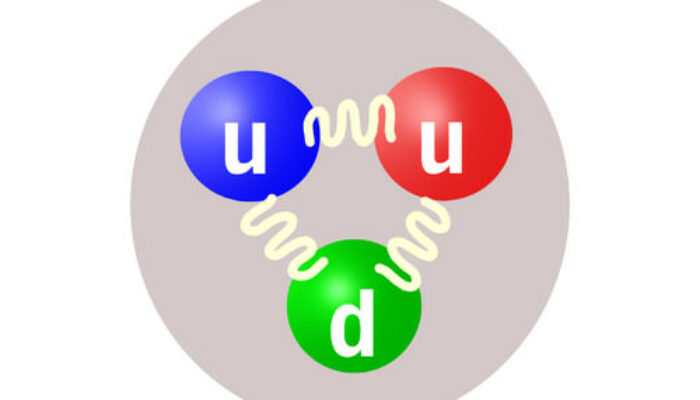
Protons and neutrons, collectively called nucleons, are primarily composed of up and down quarks. A proton consists of two up quarks and one down quark, resulting in a net positive charge of +1. Conversely, a neutron contains one up quark and two down quarks, which balance out to an electrically neutral particle. The fractional charges of individual quarks combine to produce the overall charge of these nucleons.
Strong Interaction and Quark Confinement
Quarks are never found in isolation due to a phenomenon known as quark confinement. This is a direct consequence of the strong interaction, one of the four fundamental forces, which binds quarks together inside hadrons. The force is mediated by gluons-massless bosons that carry the “color charge,” a property analogous to electric charge but existing in three types: red, green, and blue.
- Color Charge:
Quarks possess one of three color charges, and gluons facilitate the exchange of these charges, effectively “gluing” quarks together. - Confinement Mechanism:
Attempting to separate quarks increases the energy between them until new quark-antiquark pairs are created, preventing free quarks from existing.
Mass of Nucleons and Energy Contributions
Interestingly, the mass of protons and neutrons is not simply the sum of the masses of their constituent quarks. Instead, the majority of nucleon mass arises from the energy associated with the strong force that confines quarks, as described by Einstein’s mass-energy equivalence principle (E=mc²). This means that the dynamic interactions and binding energy within nucleons contribute significantly to their effective mass.
Quark Combinations Beyond Nucleons
Quarks combine in various configurations to form a wide array of particles:
- Baryons:
Particles made of three quarks, including protons and neutrons. - Mesons:
Composed of quark-antiquark pairs, mesons play a crucial role in mediating strong interactions between baryons.
These combinations are extensively studied in particle accelerators, where high-energy collisions reveal the rich spectrum of hadronic matter.
Antiquarks and Their Role
Each quark flavor has a corresponding antiquark, which shares the same mass but carries opposite electric charge and color charge. The interaction between quarks and antiquarks is fundamental to the formation of mesons and contributes to the understanding of antimatter. This relationship also sheds light on the asymmetry between matter and antimatter observed in the universe.
Exotic States: Quark-Gluon Plasma
Under extreme conditions of temperature and density, such as those present shortly after the Big Bang, quarks and gluons are believed to exist in a free, unconfined state known as quark-gluon plasma. This exotic phase of matter provides critical insights into the early universe and the behavior of fundamental particles under extreme energy scales.
Exploration of Heavy Quarks
Beyond the up and down quarks, the heavier charm and bottom quarks are subjects of intense research. Studying these quarks helps physicists probe the symmetries and forces within atomic nuclei, offering potential breakthroughs in understanding particle interactions and the fundamental laws of physics.
Why Understanding Quarks Is Crucial
The study of quarks is central to modern particle physics, as it deepens our comprehension of matter’s fundamental structure. Insights into quark behavior and interactions not only elucidate the composition of everyday matter but also inform cosmological models and the evolution of the universe. This knowledge continues to drive advancements in technology and theoretical physics, positioning quark research at the forefront of scientific discovery.
FAQ
What are quarks?
Quarks are fundamental particles that combine to form protons and neutrons, which are the building blocks of atomic nuclei.
How many types of quarks are there?
There are six types of quarks, known as flavors: up, down, charm, strange, top, and bottom.
What is quark confinement?
Quark confinement is the phenomenon where quarks are never found in isolation, due to the strong interaction that binds them together within hadrons.
What is the significance of understanding quarks?
Studying quarks is crucial for understanding the fundamental structure of matter, particle interactions, and the evolution of the universe.





Leave a Reply