
Short Answer
Definition of Cosmic Rays
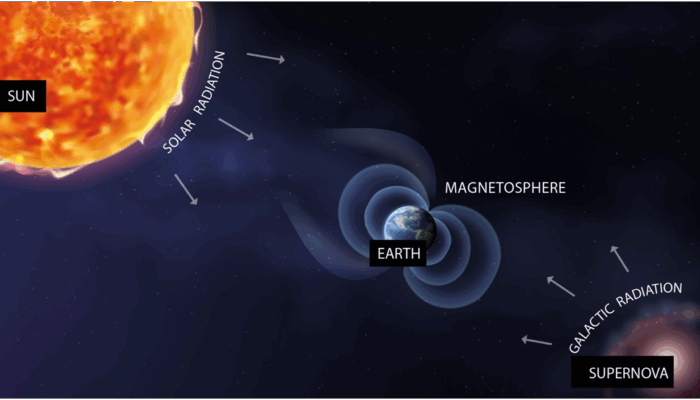
Cosmic rays are highly energetic particles that originate from sources beyond Earth’s atmosphere. These particles, primarily consisting of protons, alpha particles, and heavier atomic nuclei, travel at velocities approaching the speed of light. Upon entering the Earth’s atmosphere, cosmic rays interact with atmospheric molecules, generating cascades of secondary particles. This phenomenon has significant implications across various scientific fields, including astrophysics, particle physics, and environmental science.
Composition and Characteristics
- Primary Constituents:
The majority of cosmic rays are protons, followed by alpha particles (helium nuclei), with a smaller fraction composed of heavier nuclei from elements such as carbon, oxygen, and iron. - Energy Levels:
These particles possess extremely high energies, often exceeding those achievable by human-made accelerators, enabling unique opportunities for scientific exploration. - Interaction with Atmosphere:
When cosmic rays collide with atmospheric atoms, they produce showers of secondary particles, which are crucial for studying fundamental particle interactions.
Scientific Significance of Cosmic Rays
Advancements in Astrophysics and Cosmology
The investigation of cosmic rays has significantly enriched our understanding of cosmic phenomena. By examining their energy spectra and elemental composition, researchers gain insights into energetic events such as supernova explosions and the activity of galactic nuclei. The detection of ultra-high-energy cosmic rays challenges existing astrophysical theories, prompting the development of new models to explain their origins and the mechanisms driving cosmic energy production.
Contributions to Particle Physics
Cosmic rays act as natural particle accelerators, providing access to energy scales beyond current laboratory capabilities. This allows physicists to study rare particle interactions and fundamental processes, including matter-antimatter asymmetry and neutrino oscillations. Such research deepens our comprehension of the standard model and may pave the way for novel theoretical breakthroughs.
Technological Innovations Inspired by Cosmic Ray Research
The methodologies developed for detecting cosmic rays have influenced advancements in radiation detection technologies. These innovations have practical applications in medical fields, such as enhancing imaging techniques and improving radiation therapy. Ongoing research into cosmic ray interactions with materials holds promise for refining safety protocols and therapeutic efficacy in healthcare settings.
Potential Influence on Earth’s Climate
Emerging studies suggest that cosmic rays might affect cloud nucleation processes, thereby influencing weather patterns and climate variability. Understanding this relationship could lead to improved climate models and more accurate predictions of atmospheric behavior, highlighting the interconnectedness of cosmic phenomena and terrestrial ecosystems.
Challenges and Risks Associated with Cosmic Rays
Health Risks for High-Altitude and Space Personnel
Exposure to cosmic radiation poses significant health concerns for aviators and astronauts, who operate at altitudes where atmospheric shielding is reduced. The ionizing nature of cosmic rays increases the risk of cancer and other radiation-induced conditions, necessitating stringent monitoring and protective measures within the aviation and space industries.
Impact on Electronic and Technological Systems
Cosmic rays can disrupt electronic devices by causing single-event upsets (SEUs), which lead to data corruption and hardware malfunctions. This vulnerability is particularly critical in aerospace, nuclear, and other high-reliability sectors, driving the development of robust engineering solutions to enhance system resilience against radiation-induced errors.
Environmental Effects of Cosmic Ray Interactions
The secondary particles generated by cosmic ray interactions with the atmosphere may alter atmospheric chemistry, potentially affecting ozone concentration and other vital components. Understanding these environmental impacts is essential for informed policy-making and environmental management aimed at mitigating adverse effects.
Complexities in Data Analysis
The diverse origins and interactions of cosmic rays complicate the interpretation of observational data. Researchers must employ sophisticated theoretical models and cross-disciplinary approaches to unravel the complexities and reduce uncertainties, ensuring accurate scientific conclusions.
Mathematical Framework and Detection
The study of cosmic rays involves analyzing their energy distribution, flux, and interaction cross-sections. The energy spectrum of cosmic rays typically follows a power-law distribution:
J(E) = J_0 E^{-gamma}
- J(E): Differential flux of cosmic rays at energy E
- J_0: Normalization constant
- E: Energy of the cosmic ray particle
- γ (gamma): Spectral index, typically around 2.7 for galactic cosmic rays
Detection methods include ground-based observatories using scintillators and Cherenkov detectors, as well as satellite instruments that measure cosmic ray composition and energy before atmospheric interaction.
Practical Applications and Real-World Examples
Cosmic ray research has led to practical applications such as:
- Medical Imaging and Therapy:
Techniques derived from cosmic ray detection improve the precision of radiation treatments and diagnostic imaging. - Space Mission Safety:
Radiation shielding designs for spacecraft are informed by cosmic ray studies to protect astronauts during long-duration missions. - Climate Science:
Incorporating cosmic ray effects into climate models enhances the understanding of cloud formation and atmospheric dynamics.
Common Misconceptions About Cosmic Rays
Cosmic rays are harmful only in space.
While exposure is higher in space, cosmic rays also affect high-altitude flights and can influence terrestrial environments.
Cosmic rays are a form of electromagnetic radiation.
Cosmic rays are primarily charged particles, not electromagnetic waves like X-rays or gamma rays.
Cosmic rays have no impact on technology.
They can cause significant disruptions in electronic systems, necessitating protective engineering measures.
Importance of Cosmic Rays in Science and Technology
Understanding cosmic rays is vital for multiple reasons. They provide a natural laboratory for studying high-energy particle physics beyond human-made accelerators, contribute to our knowledge of cosmic events shaping the universe, and influence Earth’s atmospheric and environmental systems. Additionally, addressing the challenges posed by cosmic rays is crucial for safeguarding human health and ensuring the reliability of modern technological infrastructure, especially in aerospace and medical fields. Continued research into cosmic rays fosters innovation and enhances our ability to navigate the complexities of both space and terrestrial environments.
FAQ
What are cosmic rays?
Cosmic rays are high-energy particles from space, primarily protons and atomic nuclei, that interact with Earth's atmosphere.
What are the health risks of cosmic rays?
Exposure to cosmic rays can increase the risk of cancer and other radiation-related conditions, especially for those at high altitudes or in space.
How do cosmic rays affect technology?
Cosmic rays can disrupt electronic devices and systems, causing data corruption and hardware failures.






Leave a Reply