
Short Answer
Definition of Quarks
Quarks are fundamental particles that serve as the essential building blocks of matter at the subatomic level. Unlike atoms, which were once considered the smallest indivisible units, quarks reside within protons and neutrons, the components of an atom’s nucleus. These particles are elementary constituents in particle physics, meaning they are not composed of smaller parts.
- Elementary Particles:
Quarks are among the basic particles that form the foundation of matter, alongside leptons such as electrons. - Building Blocks of Hadrons:
Quarks combine to form hadrons, which include protons, neutrons, and mesons.
Structure of Matter: From Atoms to Quarks
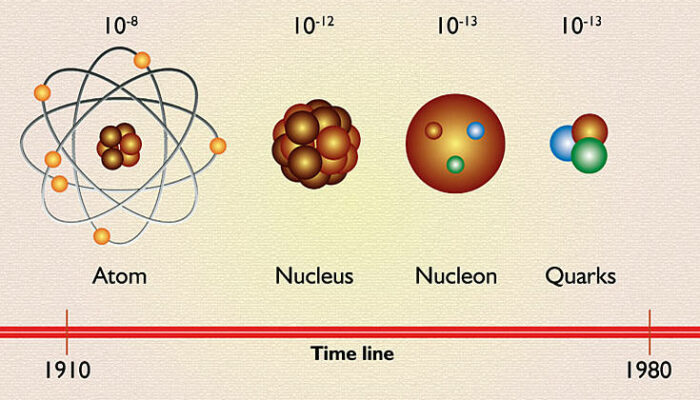
To appreciate the role of quarks, it is important to understand the hierarchical structure of matter. Atoms consist of a nucleus surrounded by electrons. The nucleus itself is made up of protons and neutrons, which are not elementary but composite particles formed by quarks. This layered composition challenges the classical notion of atoms as the smallest units of matter.
Types and Properties of Quarks
Quarks come in six distinct varieties, known as “flavors,” each with unique characteristics such as electric charge, mass, and spin. These flavors are up, down, charm, strange, top, and bottom. Among these, the up and down quarks are the most significant in everyday matter, as they constitute protons and neutrons.
- Up Quark:
Carries a charge of +2/3 and is found twice in a proton and once in a neutron. - Down Quark:
Has a charge of -1/3 and appears twice in a neutron and once in a proton. - Other Flavors:
Charm, strange, top, and bottom quarks are heavier and typically appear in high-energy environments or particle collisions.
Color Charge and the Strong Interaction
One of the defining features of quarks is their “color charge,” a property unrelated to visual color but crucial for their interactions. Quarks carry one of three color charges-red, green, or blue-and combine in ways that produce color-neutral particles. This mechanism underpins the strong nuclear force, which is responsible for binding quarks together inside hadrons.
- Color Neutrality:
Quarks combine so that their color charges cancel out, similar to how primary colors combine to form white light. - Gluons:
These are the force carriers that mediate the strong interaction, holding quarks tightly within protons and neutrons.
Quantum Chromodynamics (QCD): The Theory Behind Quark Interactions
Quantum Chromodynamics is the fundamental theory describing the strong force and the behavior of quarks and gluons. It explains how quarks interact through color charge and why they remain confined within hadrons. QCD is a cornerstone of the Standard Model of particle physics, providing a framework for understanding the forces that govern subatomic particles.
Quark Confinement and Its Implications
A remarkable aspect of quarks is that they have never been observed in isolation. This phenomenon, known as confinement, means quarks are perpetually bound within composite particles. The strong force becomes stronger as quarks attempt to separate, preventing their free existence. This property remains a significant theoretical challenge and a subject of ongoing research.
Experimental Exploration of Quarks
Modern particle accelerators, such as the Large Hadron Collider (LHC), enable scientists to study quarks by recreating conditions similar to those just after the Big Bang. High-energy collisions produce a quark-gluon plasma, a state of matter where quarks and gluons exist freely for a brief moment. Investigating this plasma offers valuable insights into the early universe and the fundamental nature of matter.
Real-World Examples of Quark Phenomena
While quarks themselves are not directly observable, their effects manifest in various physical phenomena:
- Atomic Stability:
The arrangement of up and down quarks within protons and neutrons determines the charge and stability of atoms. - Particle Collisions:
Experiments at particle colliders reveal the behavior of quarks under extreme energy conditions. - Cosmic Formation:
The strong force mediated by quarks and gluons enables the formation of atomic nuclei, which are essential for stars and galaxies.
Common Misconceptions About Quarks
Quarks can exist freely outside of particles.
Quarks are always confined within hadrons due to the strong force, and free quarks have never been observed.
Color charge refers to actual colors.
Color charge is a quantum property unrelated to visible color, used to describe the strong interaction.
Atoms are the smallest units of matter.
Atoms are composed of smaller particles, including quarks, which are more fundamental.
Significance of Quarks in Science and Technology
Understanding quarks is vital for advancing knowledge in physics, cosmology, and material science. They provide insight into the fundamental forces shaping the universe and the origin of matter. Research into quarks and their interactions drives technological innovations in particle detection, accelerator design, and quantum computing, influencing both theoretical and applied sciences.
Conclusion: The Ongoing Quest to Understand Quarks
Quarks represent a profound layer of reality beneath the familiar world of atoms and molecules. Their study challenges scientists to unravel the complexities of the universe at its most fundamental level. As research progresses, the story of quarks continues to evolve, promising new discoveries that could reshape our understanding of matter, energy, and the cosmos itself.
FAQ
What are quarks?
Quarks are fundamental particles that combine to form protons, neutrons, and other hadrons.
How many types of quarks exist?
There are six types or 'flavors' of quarks: up, down, charm, strange, top, and bottom.
Why can't quarks be observed individually?
Because of quark confinement, the strong force prevents quarks from existing in isolation; they are always bound within hadrons.
What is the significance of color charge?
Color charge is a property of quarks that relates to the strong nuclear force, ensuring quarks combine in color-neutral states to form particles.
What experiments help study quarks?
Particle colliders like the Large Hadron Collider recreate high-energy environments to study quark behavior and quark-gluon plasma.





Leave a Reply