
Short Answer
Definition of Atomic Nuclei
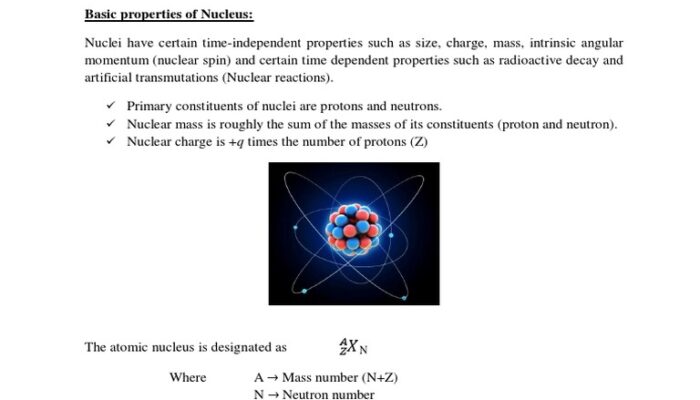
Atomic nuclei are the dense central cores of atoms, serving as the fundamental units of matter at the subatomic scale. Far from being simple components, nuclei embody complex structures and interactions that reveal the foundational principles of physics and the forces shaping the universe. Understanding nuclei involves exploring their composition, properties, and the forces that govern their behavior.
Composition and Structure of the Nucleus
The nucleus consists primarily of two types of particles: protons and neutrons, collectively called nucleons. Protons possess a positive electric charge, whereas neutrons are electrically neutral. These nucleons are tightly bound together by the strong nuclear force, one of the four fundamental forces in nature. This force is extraordinarily powerful but acts only over extremely short distances, effectively overcoming the electromagnetic repulsion between positively charged protons to maintain nuclear cohesion.
- Protons:
Positively charged particles that determine the chemical identity of an element through their count, known as the atomic number. - Neutrons:
Neutral particles that contribute to the nucleus’s mass and influence its stability by moderating the repulsive forces among protons.
Atomic Number, Isotopes, and Nuclear Stability
The number of protons in a nucleus defines the element, a property termed the atomic number. For example, hydrogen has one proton, while carbon contains six. Neutrons, although uncharged, play a crucial role in stabilizing the nucleus. Variations in neutron number produce isotopes-different forms of the same element with distinct nuclear properties.
Some isotopes are stable, maintaining their structure indefinitely, while others are unstable and undergo radioactive decay, emitting radiation as they transform into more stable forms. This radioactive behavior is fundamental to numerous applications, including medical diagnostics, radiometric dating, and nuclear energy production.
Binding Energy and Nuclear Stability
Binding energy is a key concept that quantifies the energy required to disassemble a nucleus into its individual protons and neutrons. It serves as a direct measure of nuclear stability: the higher the binding energy per nucleon, the more stable the nucleus. This explains why nuclei heavier than iron tend to be less stable and more susceptible to radioactive decay, as their binding energy per nucleon decreases with increasing atomic mass.
Nuclear Reactions: Fusion and Fission
Nuclear physics extends beyond static nuclei to dynamic processes known as nuclear reactions, primarily categorized into fusion and fission.
- Nuclear Fusion:
This process involves the merging of light nuclei to form a heavier nucleus, releasing vast amounts of energy. Fusion powers stars, including our sun, and represents a promising avenue for sustainable energy generation on Earth. - Nuclear Fission:
In contrast, fission splits a heavy nucleus into smaller fragments, accompanied by energy release and the emission of neutrons. These neutrons can trigger further fission events, creating a chain reaction harnessed in nuclear reactors to produce electricity.
The Role of Fundamental Forces in Nuclear Processes
Besides the strong nuclear force, other fundamental interactions influence nuclear behavior. The weak nuclear force, for instance, governs processes like beta decay, where a neutron transforms into a proton while emitting an electron and an antineutrino. This transformation exemplifies the interplay between fundamental forces and their collective impact on nuclear phenomena.
Nucleosynthesis and Cosmic Evolution
Nuclear processes are central to cosmology through nucleosynthesis-the formation of elements in the universe. Shortly after the Big Bang, nuclear fusion produced the lightest elements, such as hydrogen and helium, setting the stage for the formation of stars and the synthesis of heavier elements within stellar cores. This cosmic alchemy explains the elemental diversity observed today and the ongoing evolution of matter in the universe.
Quantum Mechanical Perspectives on the Nucleus
The behavior of nucleons within the nucleus is governed by quantum mechanics, which introduces concepts such as quantized energy levels and probabilistic particle behavior. The nuclear shell model, analogous to electron orbitals in atoms, describes nucleons as occupying discrete energy shells. Certain configurations, known as magic numbers, correspond to exceptionally stable nuclei, highlighting the quantum nature of nuclear structure.
Common Misconceptions About Nuclei
The nucleus is simply a static cluster of protons and neutrons.
The nucleus is a dynamic system governed by quantum mechanics, with nucleons occupying energy levels and interacting via fundamental forces.
Nuclear reactions are only destructive.
While nuclear reactions can be hazardous, they also enable beneficial technologies such as medical imaging, energy production, and scientific research.
Significance of Nuclear Science
The study of atomic nuclei is pivotal for advancing our understanding of matter, energy, and the universe. Insights into nuclear structure and reactions underpin technologies ranging from nuclear power and medical treatments to astrophysics and cosmology. Moreover, responsible management of nuclear knowledge is essential for harnessing its benefits while mitigating risks, emphasizing the profound impact of nuclear science on society and the natural world.
FAQ
What are atomic nuclei?
Atomic nuclei are the dense cores of atoms, composed of protons and neutrons, and are fundamental to understanding matter and nuclear phenomena.
What is nuclear fusion?
Nuclear fusion is the process of merging light nuclei to form a heavier nucleus, releasing energy, and is the process that powers stars.
What is the significance of binding energy?
Binding energy quantifies the stability of a nucleus; the higher the binding energy per nucleon, the more stable the nucleus.






Leave a Reply