
Short Answer
Definition of the Ising Model
The Ising model is a fundamental theoretical framework in statistical mechanics used to analyze phase transitions and critical phenomena. It represents a lattice composed of discrete spins, each of which can be in one of two possible states: up or down. This model captures the microscopic interactions between neighboring spins, providing a simplified yet powerful depiction of complex physical systems. Essentially, it serves as a conceptual tool to understand how local interactions can lead to emergent global behaviors.
Historical Background and Development
Originally introduced by Ernst Ising in 1925 during his study of ferromagnetism, the model was first applied to one-dimensional lattices. Although the one-dimensional case did not exhibit phase transitions, later extensions to two-dimensional and higher-dimensional lattices revealed rich phenomena, including spontaneous magnetization below a critical temperature. The two-dimensional square lattice, in particular, became a landmark example demonstrating phase transitions, highlighting the model’s broader applicability beyond magnetism to fields such as biology and social sciences.
Core Principles and Mechanisms
The Ising model is built upon discrete spin variables arranged on a lattice, where each spin interacts only with its nearest neighbors. These interactions tend to align spins, fostering order, while thermal fluctuations promote disorder. The competition between these forces governs the system’s behavior, leading to various phases characterized by different degrees of spin alignment. The collective flipping of spins can be viewed as a dynamic interplay between randomness and coherence, analogous to a pendulum oscillating under external influences.
Mathematical Formulation: The Hamiltonian
The energy of a spin configuration in the Ising model is described by the Hamiltonian function:
H = -J ∑⟨i,j⟩ s_i s_j – h ∑_i s_i
- H: Total energy of the system
- J: Interaction strength between neighboring spins
- s_i, s_j: Spin variables at lattice sites i and j, each taking values ±1
- h: External magnetic field
- ∑⟨i,j⟩: Summation over all pairs of nearest neighbors
This expression encapsulates the balance between spin-spin interactions and the influence of an external magnetic field, reflecting the tension between ordering tendencies and thermal agitation.
Phase Transitions and Critical Phenomena
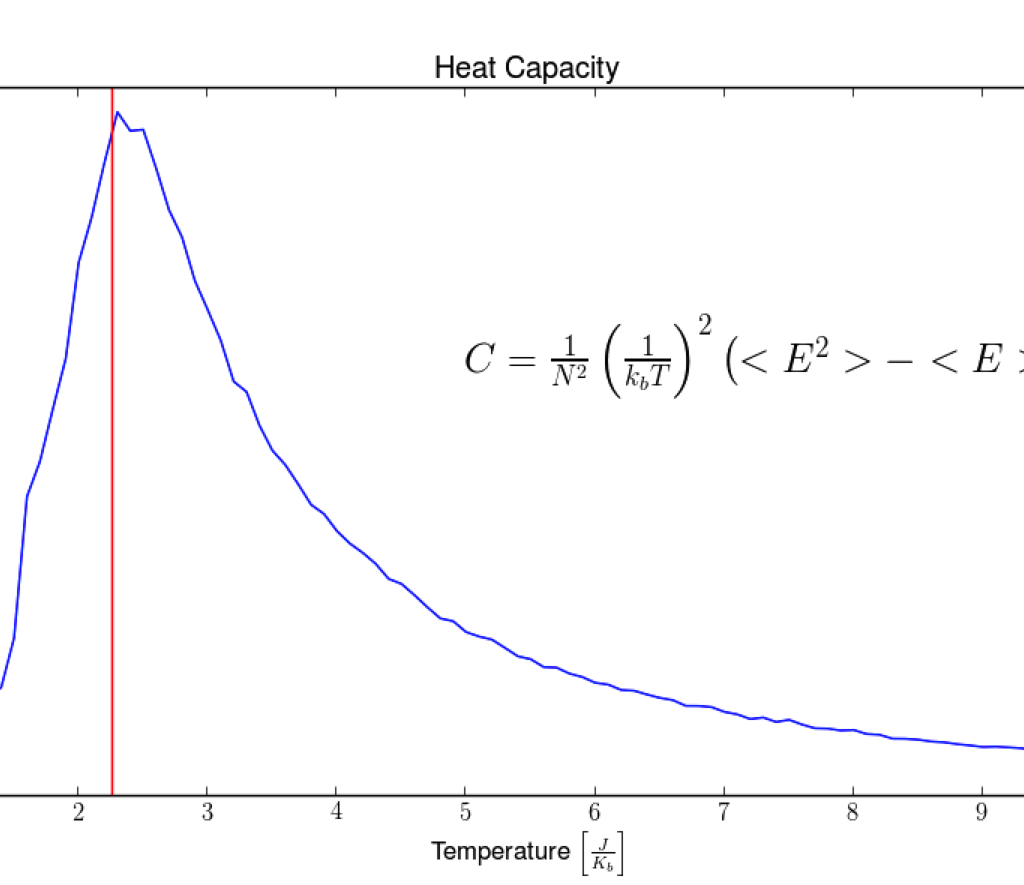
One of the most intriguing features of the Ising model is its ability to exhibit phase transitions. As the temperature approaches a critical value, the system undergoes a dramatic transformation from a disordered to an ordered state, characterized by spontaneous magnetization. Near this critical point, spin fluctuations become highly correlated over long distances, producing universal scaling laws and critical exponents that apply to a wide range of physical systems. This universality makes the Ising model a cornerstone in the study of critical phenomena.
Thermodynamic Limit and Symmetry Breaking
When extended to infinitely large lattices, known as the thermodynamic limit, the Ising model reveals phenomena such as long-range order and spontaneous symmetry breaking. These concepts describe how a system can settle into a stable phase with a preferred spin orientation, despite the underlying symmetry of the governing equations. Phase diagrams graphically represent these states, illustrating how variables like temperature and external magnetic fields influence the system’s equilibrium and phase stability.
Computational Approaches: Monte Carlo Simulations
Advances in computational methods have significantly enhanced the study of the Ising model. Monte Carlo simulations, which use random sampling techniques to explore the vast configuration space of spin arrangements, allow researchers to investigate dynamic and non-equilibrium behaviors. These simulations provide detailed insights into the temporal evolution of spin systems, validating theoretical predictions and uncovering complex phenomena beyond analytical reach.
Applications Beyond Physics
The versatility of the Ising model extends into diverse disciplines such as network theory and social dynamics. In these contexts, spins can represent individual opinions or states, and their interactions mimic social influence and consensus formation. This analogy helps explain how collective behaviors emerge from local interactions, shedding light on processes like polarization and group decision-making. Thus, the Ising model serves as a valuable framework for interpreting complex systems across scientific fields.
Common Misconceptions
The Ising model only applies to magnetic materials.
While originally developed for ferromagnetism, the model’s principles are applicable to a wide range of systems, including biological, social, and computational networks.
The model is too simplistic to capture real-world complexity.
Despite its simplicity, the Ising model reveals fundamental insights into phase transitions and critical phenomena, serving as a foundational tool in theoretical and applied research.
Significance and Impact
The Ising model holds a pivotal role in advancing our understanding of how microscopic interactions give rise to macroscopic phenomena. It bridges quantum mechanics and classical thermodynamics, offering a clear illustration of emergent behavior in complex systems. Its influence permeates various scientific domains, inspiring ongoing research and fostering a deeper appreciation of the intricate patterns governing natural and social worlds.
FAQ
What is the Ising model used for?
The Ising model is used to study phase transitions and critical phenomena in statistical mechanics, particularly in systems of discrete spins.
Is the Ising model applicable outside of physics?
Yes, the Ising model's principles can be applied to various fields such as biology and social sciences, where local interactions lead to collective behaviors.



Leave a Reply