
Short Answer
Definition of the Higgs Boson
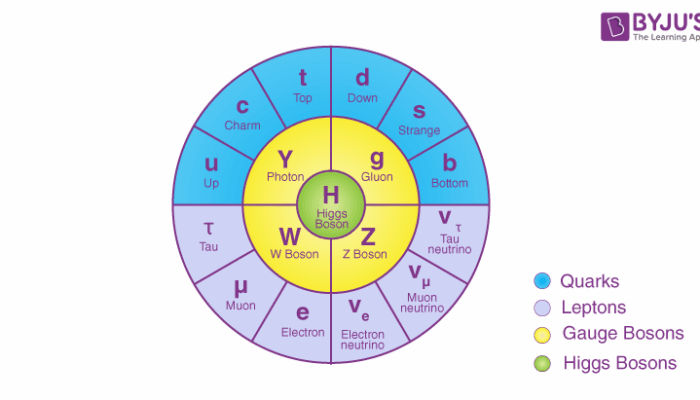
The Higgs boson is a fundamental particle integral to the Standard Model of particle physics. It represents a quantized excitation of the Higgs field, an all-pervasive field that exists throughout the universe. This particle is essential for explaining how elementary particles acquire mass, a cornerstone concept in understanding the composition and behavior of matter.
The Higgs Field: Foundation of Mass
Conceived in the 1960s by physicist Peter Higgs and his colleagues, the Higgs field is a universal field that interacts with fundamental particles. Without this field, particles such as electrons and quarks would remain massless, preventing the formation of atoms and, consequently, all matter. The Higgs field thus provides the mechanism by which particles gain mass, making it a vital element in the structure of the universe.
The Higgs Mechanism Explained
The process by which particles obtain mass is known as the Higgs mechanism. Particles interact with the Higgs field, and the strength of this interaction determines their mass. For example, particles like the W and Z bosons, which mediate the weak nuclear force, acquire mass through this interaction, whereas the photon, responsible for electromagnetic force, remains massless due to its lack of coupling with the Higgs field.
Discovery and Experimental Confirmation
In 2012, the discovery of the Higgs boson at the Large Hadron Collider (LHC) marked a pivotal moment in physics. This particle’s detection confirmed the existence of the Higgs field, validating decades of theoretical work. The Higgs boson itself is highly unstable, decaying almost instantaneously into other particles, which necessitates advanced experimental techniques to observe its indirect effects.
Properties and Ongoing Research
Following its discovery, scientists have focused on measuring the Higgs boson’s characteristics, including its mass, spin, and interaction patterns. Current data places its mass at approximately 125 giga-electronvolts (GeV), consistent with theoretical predictions. However, this mass value also raises questions about potential physics beyond the Standard Model, suggesting the possibility of undiscovered particles or forces.
Cosmological Significance of the Higgs Boson
The Higgs field and its associated boson have profound implications beyond particle physics, influencing our understanding of the early universe. During the universe’s infancy, phase transitions involving the Higgs field contributed to symmetry breaking, which differentiated fundamental forces and enabled the formation of cosmic structures. Thus, the Higgs boson plays a crucial role in the evolution and fabric of the cosmos.
Theoretical Extensions and Broader Implications
Physicists have proposed various theories extending beyond the Standard Model that incorporate the Higgs boson. For instance, superstring theory aims to unify gravity with quantum mechanics and suggests interactions between the Higgs particle and extra spatial dimensions. Additionally, hypotheses about dark matter and dark energy often involve the Higgs field, indicating its potential role in explaining these mysterious components of the universe.
Impact on Particle Physics and Technology
The discovery of the Higgs boson has revitalized experimental particle physics, prompting precise measurements and searches for new phenomena. Investigations into subtle deviations in Higgs boson behavior may reveal new physics. Moreover, the technological innovations developed for Higgs research, such as advanced detectors and computational methods, have found applications in fields like medical imaging, materials science, and data processing, demonstrating the broader benefits of fundamental research.
Common Misconceptions About the Higgs Boson
The Higgs boson is the particle that gives everything mass.
The Higgs boson is a manifestation of the Higgs field, which imparts mass to certain fundamental particles, but not all mass in the universe arises from this mechanism (e.g., most of the mass of protons and neutrons comes from strong force interactions).
The Higgs boson is a stable particle.
The Higgs boson is extremely short-lived, decaying almost immediately after its creation, which is why it can only be detected indirectly through its decay products.
Why Understanding the Higgs Boson Is Crucial
The Higgs boson is central to our comprehension of the fundamental laws governing matter and energy. It bridges theoretical physics and experimental evidence, enhancing our grasp of mass generation and the universe’s evolution. Beyond pure science, the pursuit of knowledge about the Higgs boson drives technological progress and inspires future scientific breakthroughs, underscoring its significance in both academic and practical realms.
FAQ
What is the Higgs mechanism?
The Higgs mechanism describes how particles gain mass through their interaction with the Higgs field.
How was the Higgs boson discovered?
It was discovered at the Large Hadron Collider in 2012, confirming decades of theoretical predictions.






Leave a Reply