
Short Answer
Definition of Phonons
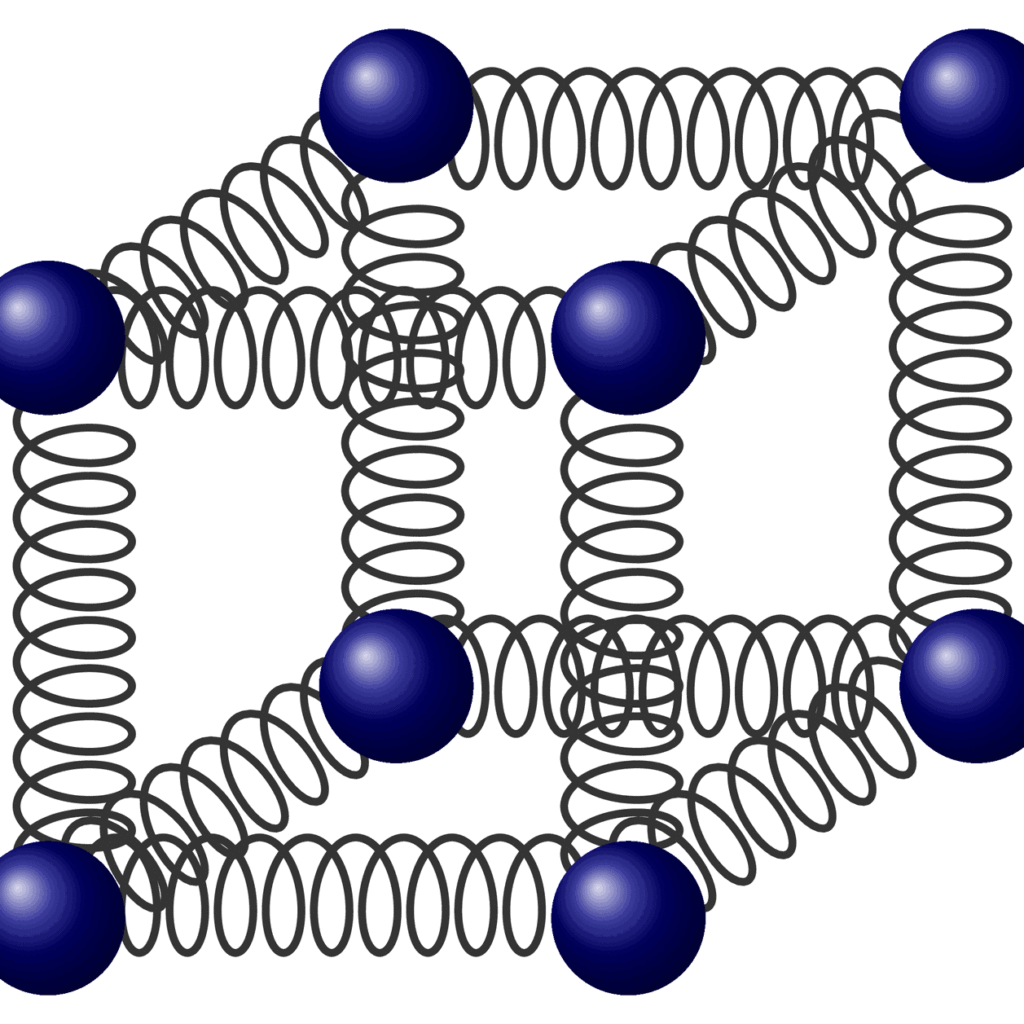
Phonons are quantized vibrational modes that occur within the atomic lattice of crystalline solids. They represent discrete packets of vibrational energy, analogous to how photons are quanta of electromagnetic radiation. These vibrational quanta arise from collective oscillations of atoms in a solid, and their behavior fundamentally influences the physical properties of materials such as metals, semiconductors, and insulators.
- Phonons as Quasiparticles:
Phonons are considered quasiparticles because they emerge from the collective motion of atoms rather than existing as independent particles. - Types of Phonons:
They are broadly categorized into acoustic phonons, which correspond to low-frequency vibrations similar to sound waves, and optical phonons, which involve higher-frequency oscillations where atoms in the basis move relative to each other.
Fundamental Role of Phonons in Solids
Phonons are central to understanding many physical phenomena in solid materials. Their presence governs how heat and electricity are transported, how materials respond to temperature changes, and even how certain exotic states like superconductivity arise. By studying phonons, scientists gain insight into the microscopic mechanisms that dictate macroscopic material behavior.
Phonons and Thermal Conductivity
One of the primary functions of phonons is facilitating heat transfer within solids. Thermal conductivity depends heavily on how effectively phonons can propagate vibrational energy through the lattice.
- In Metals:
Both free electrons and phonons contribute to heat conduction, resulting in relatively high thermal conductivity. - In Insulators:
Without free electrons, phonons are the sole carriers of thermal energy, often leading to lower thermal conductivity. - Phonon Scattering:
As phonons move, they scatter off each other and lattice imperfections, which can reduce heat flow and create complex thermal behaviors.
Impact of Lattice Defects on Phonon Behavior
Imperfections within a crystal lattice-such as grain boundaries, dislocations, and impurities-significantly influence phonon dynamics. These defects act as scattering centers, disrupting phonon transport and thereby modifying the thermal and electrical properties of the material.
- Defect-Induced Scattering:
Scattering reduces phonon mean free paths, diminishing thermal conductivity. - Material Engineering:
By intentionally introducing or controlling defects, scientists can tailor phonon scattering to optimize materials for specific applications, such as thermoelectric devices.
Phonon Dispersion and Classification
The behavior of phonons can be described by their dispersion relations, which link phonon frequency to their wave vector. This relationship helps classify phonons and predict how they respond under varying conditions like temperature and pressure.
- Acoustic Phonons:
These involve atoms oscillating in phase, producing sound-like waves that propagate through the lattice. - Optical Phonons:
These arise when atoms in the basis oscillate out of phase, typically at higher frequencies, influencing optical and electronic properties.
Phonon-Phonon Interactions and Advanced Phenomena
Phonons do not exist in isolation; they interact with one another in complex ways that affect material properties. These interactions can be constructive or destructive, influencing thermal conductivity and enabling phenomena such as thermal runaway and superconductivity.
- Thermal Conductivity Modulation:
Phonon-phonon scattering can limit heat flow, impacting material performance. - Superconductivity:
The coupling between electrons and phonons is a key mechanism behind conventional superconductivity, where electrical resistance drops to zero below a critical temperature.
Applications of Phonon Research in Modern Technology
Understanding and manipulating phonons is crucial for advancing technologies in various fields, including quantum computing, nanoelectronics, and energy conversion.
- Phonon Engineering:
Techniques to control phonon transport at the nanoscale enable improved thermal management in miniaturized devices. - Quantum Computing:
Managing phonon interactions helps reduce decoherence, enhancing qubit stability. - Thermoelectric Materials:
Optimizing phonon scattering improves the efficiency of devices that convert heat into electricity, contributing to sustainable energy solutions.
Mathematical Description of Phonons
Phonons are mathematically described using lattice dynamics and quantum mechanics. The dispersion relation, ω(k), expresses the phonon frequency (ω) as a function of the wave vector (k), capturing how vibrational energy propagates through the crystal lattice.
- Dispersion Relation:
ω = ω(k), where ω is the angular frequency and k is the wave vector. - Phonon Energy:
E = ħω, where ħ is the reduced Planck constant, representing the quantized energy of a phonon.
Common Misconceptions About Phonons
Phonons are actual particles like electrons.
Phonons are quasiparticles representing collective atomic vibrations, not independent particles.
Only electrons conduct heat in solids.
In insulators, phonons are the primary heat carriers, as free electrons are absent.
Significance of Phonons in Science and Technology
Phonons are fundamental to the understanding and development of materials with tailored thermal and electrical properties. Their study enables innovations in electronics, energy conversion, and quantum technologies, making them indispensable in both theoretical research and practical applications.
By mastering phonon behavior, scientists can design materials that efficiently manage heat, improve energy storage, and pave the way for next-generation devices that address global challenges in sustainability and technology.
FAQ
What are phonons?
Phonons are quantized vibrations representing the energy of lattice waves in solids.
How do phonons influence material properties?
They affect thermal and electrical conductivity by transporting vibrational energy and interacting with defects.
What is the difference between acoustic and optical phonons?
Acoustic phonons relate to low-frequency sound waves, while optical phonons involve higher-frequency atomic vibrations.
Why are phonons important in superconductivity?
Phonons mediate electron pairing, enabling zero resistance in superconductors.
Can phonons be engineered for technology?
Yes, phonon engineering aims to control heat and electrical transport in nanoscale devices.



Leave a Reply