
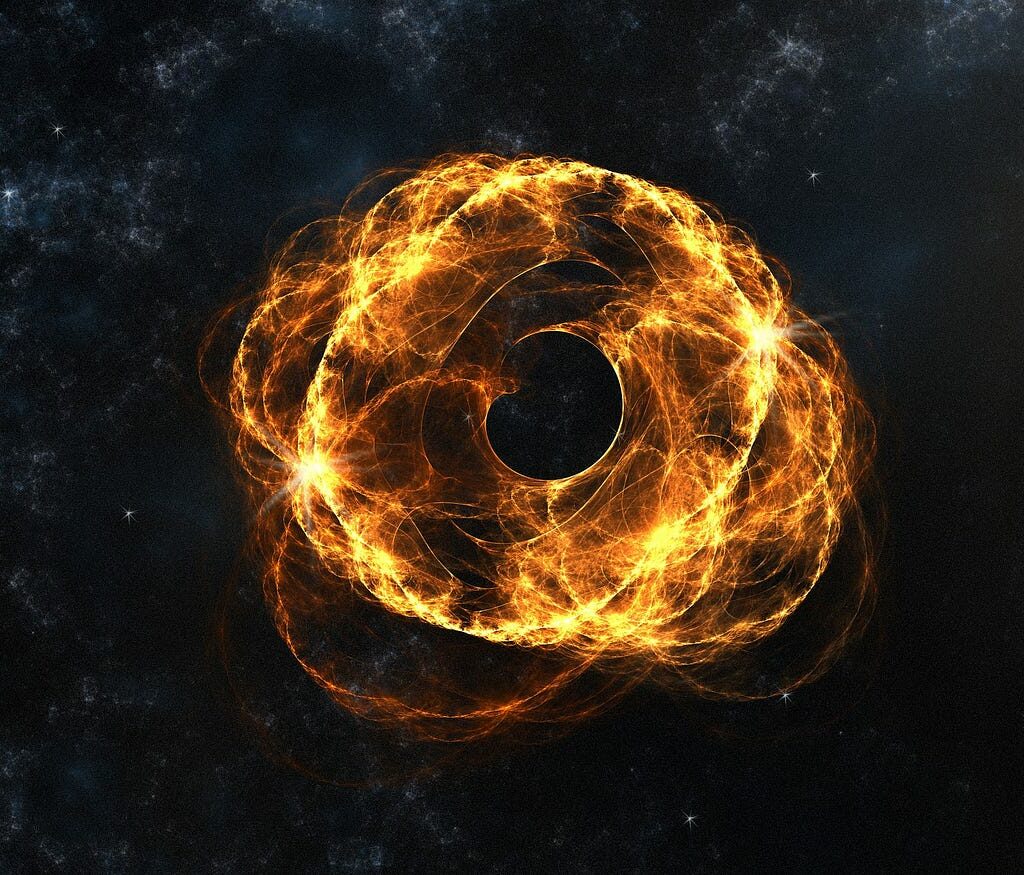
Short Answer
Understanding Gravitational Waves and Space-Time
The universe, with its immense and often unfathomable nature, inspires deep reflection and inquiry beyond everyday comprehension. Among the most intriguing phenomena are gravitational waves-ripples that traverse the fabric of space-time. These waves captivate scientists and enthusiasts alike, not only because of their mysterious origin but also due to the profound questions they raise: What medium allows these waves to travel? Is space-time itself the dynamic entity that carries these gravitational oscillations? Addressing these questions requires a thorough examination of the universe’s structure and the intricate relationship between gravity and geometry.
Definition of Gravitational Waves and Space-Time
Gravitational waves are disturbances in the curvature of space-time, predicted by Albert Einstein’s General Theory of Relativity. Unlike traditional waves that travel through a physical medium, gravitational waves are fluctuations in the very geometry of the four-dimensional continuum that combines three spatial dimensions with time.
- Gravitational Waves:
Ripples in space-time generated by massive accelerating bodies, such as merging black holes or neutron stars. - Space-Time:
A unified, flexible continuum that integrates space and time into a single geometric framework.
Historical Context and Theoretical Foundations
Initially, gravitational waves were a theoretical prediction emerging from Einstein’s equations, regarded as mathematical curiosities without direct observational evidence. They were understood as perturbations traveling at the speed of light through the vacuum of space. This concept challenged classical ideas of force transmission, differing fundamentally from electromagnetic waves, which are oscillations of electric and magnetic fields that propagate through empty space without requiring a medium.
How Gravitational Waves Propagate
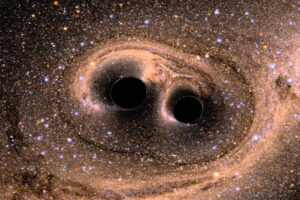
In Einstein’s framework, gravity is not a force acting at a distance but a manifestation of space-time curvature caused by mass and energy. Objects move along geodesics-natural paths determined by this curvature. When colossal cosmic events occur, such as the collision of black holes or neutron stars, they generate gravitational waves. These waves spread outward like ripples on a pond, but crucially, the “pond” is the fabric of space-time itself. Thus, gravitational waves are not traveling through space-time; they are oscillations of space-time.
Is Space-Time a Medium?
Traditional waves, such as sound, require a medium composed of particles to travel. Space-time, however, is not made of particles in the classical sense, making it fundamentally different from conventional media like air or water. Instead, space-time serves as the geometric stage where all physical phenomena unfold. The ripples detected are changes in this geometry, moving at the universal speed limit and carrying information about distant astrophysical events.
Visualizing Gravitational Waves
One helpful analogy is to imagine space-time as a stretched fabric. When a gravitational wave passes, it causes tiny distortions-stretching and compressing distances in perpendicular directions. These minuscule oscillations, smaller than a proton’s diameter, have been measured by observatories such as LIGO and Virgo, confirming that space-time is dynamic and capable of vibration, rather than being a static backdrop.
Modern Perspectives and Quantum Considerations
Despite the analogy, many physicists hesitate to label space-time as a “medium” to avoid confusion with outdated concepts like the luminiferous ether. Einstein’s theory eliminated the need for such a medium by describing gravity as geometry rather than a force transmitted through a carrier. However, contemporary research in quantum gravity explores whether space-time might have a discrete, granular structure at the Planck scale, resembling a medium composed of fundamental quanta. This quantum perspective could bridge the wave-like nature of gravity with an underlying “medium-like” foundation.
Philosophical and Scientific Implications
The idea that space-time might be emergent-similar to a quantum fluid or condensate-opens new avenues for understanding the universe. Gravitational waves thus serve not only as signals from dramatic cosmic events but also as probes into the fundamental nature of reality, touching on themes of unification, information, and causality.
Significance of Gravitational Wave Detection
The observation of gravitational waves resonates beyond technical achievement; it evokes a profound sense of wonder. Witnessing the universe’s fabric flex and vibrate reveals a cosmos alive with subtle rhythms, challenging the notion of empty, inert space. This discovery expands our conceptual framework, pushing us beyond classical physics into a richer understanding of the universe’s dynamic nature.
Summary: The Dual Role of Space-Time and Gravitational Waves
Gravitational waves provide compelling evidence that space-time is not a passive stage but an active participant in cosmic phenomena. They are intrinsic oscillations of space-time itself, making space-time both the medium and the wave. This duality blurs traditional distinctions between environment and entity, medium and wave, observer and observed, highlighting the elegant complexity of the cosmos.
Future Directions and Cosmic Insights
Each new detection of gravitational waves offers fresh insights into the universe’s hidden workings. These signals invite humanity to delve deeper into the mysteries of existence, revealing the intricate lattice of reality and inspiring ongoing quests to comprehend our place within the vast cosmic tapestry.
FAQ
What are gravitational waves?
Gravitational waves are disturbances in the curvature of space-time caused by massive accelerating bodies.
Does space-time act as a medium?
Space-time is not a medium in the traditional sense, but rather a geometric framework where gravitational waves propagate.
How are gravitational waves detected?
Gravitational waves are detected using sensitive instruments like LIGO and Virgo that measure tiny changes in distance caused by these waves.
Leave a Reply