
Short Answer
Definition of Boron and Metalloid Classification
Boron is an element positioned in group 13 of the periodic table, notable for its intriguing classification as a metalloid. Metalloids are elements that exhibit a combination of metallic and nonmetallic traits, placing them in a unique category between metals and nonmetals. These elements typically display semi-conductive behavior, moderate electronegativity, and a blend of physical and chemical properties from both groups. Boron exemplifies this duality, making it a subject of considerable scientific interest.
- Boron:
A group 13 element with properties intermediate between metals and nonmetals. - Metalloids:
Elements that share characteristics of both metals and nonmetals, often semiconductors.
Physical Characteristics of Boron
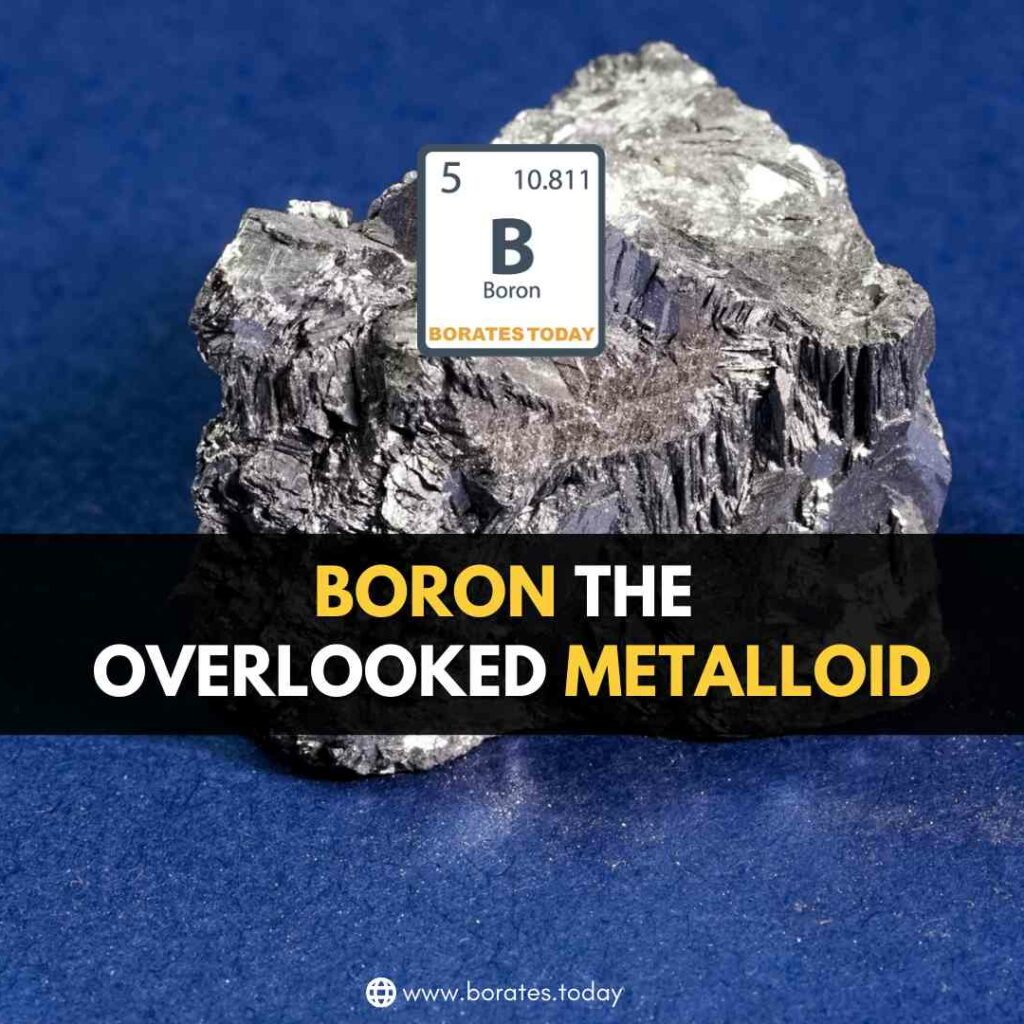
Boron’s physical attributes highlight its metalloid nature through a combination of metallic luster and nonmetallic coloration. It typically appears grayish-black with a shiny surface reminiscent of metals. One of its most remarkable physical properties is its exceptionally high melting point, approximately 2075°C, which ranks it among the most heat-resistant elements. This thermal stability makes boron valuable in applications requiring materials that withstand extreme temperatures.
- Appearance:
Lustrous gray-black solid. - Melting Point:
Around 2075°C, indicating high thermal resistance.
Electrical Properties and Semiconductor Role
Electrically, boron functions as a semiconductor, conducting electricity more efficiently than typical nonmetals but less so than metals. This intermediate conductivity is crucial in the electronics industry, where boron is widely used as a dopant in silicon semiconductors. By introducing boron atoms into silicon, the electrical properties of the material are enhanced, enabling the production of more efficient electronic devices. This semi-conductive behavior further blurs the line between metallic and nonmetallic classifications.
- Semiconductor:
Boron’s ability to conduct electricity moderately well. - Doping Agent:
Used to modify electrical properties of silicon in electronics.
Chemical Behavior and Bonding Patterns
From a chemical standpoint, boron tends to form covalent bonds rather than ionic ones, distinguishing it from typical metals that lose electrons to form cations. It frequently shares electrons with other nonmetals, resulting in compounds such as boron trifluoride (BF₃) and boric acid (H₃BO₃). These compounds illustrate boron’s preference for complex covalent bonding, reinforcing its intermediate position on the periodic table and its classification as a metalloid.
- Covalent Bonding:
Boron shares electrons rather than losing them. - Common Compounds:
Boron trifluoride and boric acid demonstrate its chemical versatility.
Applications of Boron in Industry and Agriculture
Boron’s unique properties translate into diverse practical uses across multiple fields. In the manufacture of borosilicate glass, boron oxide is incorporated to enhance thermal resistance and durability, making the glass ideal for laboratory equipment and cookware. This application leverages boron’s ability to improve resistance to thermal shock, a direct consequence of its metalloid characteristics.
In agriculture, boron compounds serve as essential micronutrients that support plant growth. Boron facilitates critical physiological processes such as cell wall synthesis and reproductive development, making it indispensable for crop health and productivity. Its role in agriculture contributes to sustainable farming practices and food security worldwide.
- Borosilicate Glass:
Boron oxide improves thermal shock resistance in glass products. - Agricultural Micronutrient:
Boron compounds aid plant growth and development.
Boron in Nuclear Chemistry and Advanced Technologies
Boron’s neutron-absorbing properties are exploited in nuclear reactors to regulate neutron flux, enhancing safety and efficiency in nuclear energy production. Materials containing boron are integral to controlling nuclear reactions, underscoring the element’s importance in high-technology environments.
Beyond nuclear applications, boron is at the forefront of research in nanotechnology and materials science. Boron-based nanomaterials exhibit exceptional strength, lightweight characteristics, and remarkable thermal stability. These advancements suggest promising future roles for boron in sustainable energy solutions and next-generation computing technologies.
- Neutron Absorption:
Boron controls neutron flux in nuclear reactors. - Nanotechnology:
Boron nanomaterials offer enhanced mechanical and thermal properties.
Historical and Scientific Perspectives on Boron’s Classification
Historically, boron was initially categorized as a nonmetal until further research revealed its hybrid properties. This evolution in understanding challenges the traditional binary classification of elements into metals and nonmetals, highlighting the complexity of metalloids like boron. The ongoing scientific discourse encourages a more nuanced approach to element classification, reflecting the diverse behaviors observed in elements such as boron.
Common Misconceptions About Boron
Boron is strictly a nonmetal.
Boron exhibits both metallic and nonmetallic properties, classifying it as a metalloid.
Boron’s only use is in glass manufacturing.
Boron has diverse applications including agriculture, nuclear technology, and electronics.
Significance of Boron in Science and Technology
Boron’s multifaceted nature and broad range of applications make it a critical element in modern science and technology. Its unique combination of physical, chemical, and electrical properties enables innovations in materials science, electronics, agriculture, and nuclear energy. Understanding boron’s role as a metalloid not only enriches fundamental chemistry but also drives technological advancements that impact everyday life and future scientific endeavors.
FAQ
Is boron considered a metalloid?
Yes, boron is classified as a metalloid because it exhibits physical and chemical properties intermediate between metals and nonmetals.
What are common applications of boron?
Boron is used in borosilicate glass manufacturing, as a micronutrient in agriculture, as a dopant in semiconductors, and in nuclear reactors for neutron absorption.
How does boron conduct electricity?
Boron functions as a semiconductor, conducting electricity more efficiently than nonmetals but less so than metals.
What compounds does boron commonly form?
Boron commonly forms covalent compounds such as boron trifluoride (BF₃) and boric acid (H₃BO₃).
Why is boron important in nuclear chemistry?
Boron has neutron-absorbing properties that help regulate neutron flux in nuclear reactors, enhancing safety and efficiency.




Leave a Reply