
Short Answer
Definition of Protons
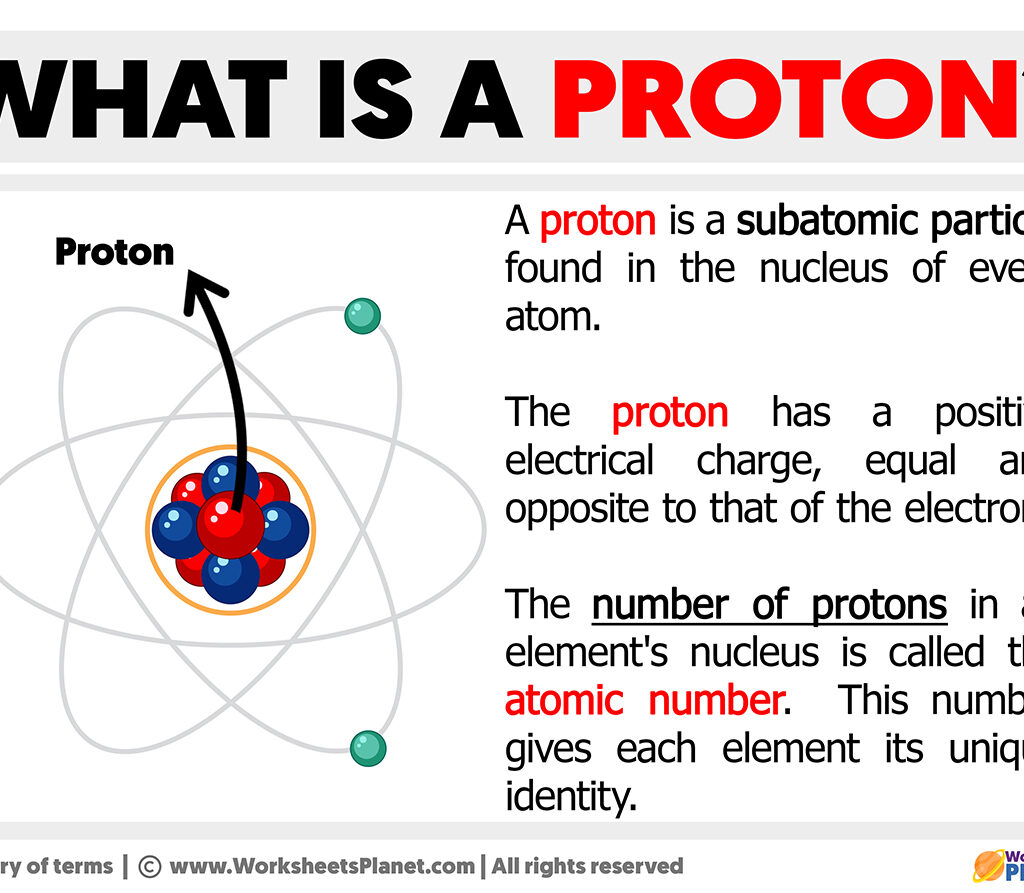
Protons are subatomic particles that play a crucial role in the composition of atomic nuclei. Often perceived simply as tiny carriers of positive electric charge, protons are far more complex entities. They are not elementary particles but rather composite structures made up of smaller fundamental components. Understanding the nature of protons requires delving into the field of particle physics, where their internal composition and interactions are studied in detail.
Composition and Structure
Contrary to the notion of being indivisible, protons consist of three valence quarks held together by the strong nuclear force. These quarks are elementary particles themselves, primarily of two types or “flavors”: up quarks and down quarks. The strong force, mediated by particles called gluons, binds these quarks tightly, creating a stable particle that forms the core of atomic nuclei.
- Valence Quarks:
The three quarks (two up quarks and one down quark) define the proton’s quantum numbers and overall charge. - Gluons:
These force carriers facilitate the strong interaction, effectively “gluing” the quarks together inside the proton.
Quantum Chromodynamics and Proton Dynamics
Quantum Chromodynamics (QCD) is the theory that describes the interactions between quarks and gluons. Within this framework, protons are dynamic systems where quarks constantly exchange gluons, creating a complex internal environment. This dynamic interplay is often likened to a finely woven tapestry, illustrating the intricate and ever-changing nature of the proton’s internal structure.
Mass and Energy Relationship
The mass of a proton is significantly greater than the sum of the masses of its constituent quarks. This discrepancy arises because most of the proton’s mass originates from the energy of the strong force interactions binding the quarks, as described by Einstein’s mass-energy equivalence principle (E=mc²). This highlights a fundamental concept in particle physics: mass can emerge from the energy of force fields, not just from the mass of particles themselves.
Proton Stability and Lifespan
Protons are remarkably stable particles, with lifetimes that exceed the age of the universe under normal conditions. This stability contrasts with other composite particles, such as neutrons, which decay when free. The enduring nature of protons makes them essential building blocks of matter, present in every atom and fundamental to the structure of the observable universe.
Role in Nuclear and Stellar Processes
Beyond their structural role in atoms, protons are key participants in nuclear reactions, especially those powering stars. In stellar cores, protons undergo fusion processes, combining under extreme temperatures and pressures to form heavier elements. These nuclear reactions are the engines of energy production in stars and are fundamental to the cosmic synthesis of matter.
Protons in the Standard Model of Particle Physics
Within the Standard Model, particles are categorized as either elementary or composite. Quarks and leptons are elementary particles, while protons are composite, formed from quarks. This classification underscores a paradox: protons are indispensable to matter’s fabric yet are not elementary themselves. They exemplify how complex structures arise from simpler fundamental constituents.
Analogies to Understand Proton Composition
To conceptualize the proton’s nature, one can compare it to a complex machine. While the machine’s individual gears (quarks) are elementary parts, the machine (proton) itself exhibits properties and functions that cannot be attributed to any single gear alone. This analogy helps illustrate how composite particles possess unique characteristics emerging from the interactions of their components.
Common Misconceptions About Protons
Protons are elementary particles.
Protons are composite particles made of quarks and gluons.
The mass of a proton is simply the sum of its quarks’ masses.
Most of the proton’s mass comes from the energy of the strong force binding the quarks.
Protons are unstable like neutrons.
Protons are highly stable and do not decay under normal conditions.
Why Understanding Protons Is Important
Protons are fundamental to the existence of matter and the universe as we know it. Their composite nature reveals the complexity underlying seemingly simple particles and provides insight into the forces that govern the subatomic world. Studying protons enhances our understanding of atomic structure, nuclear reactions, and the fundamental laws of physics, bridging the gap between the microscopic quantum realm and the macroscopic universe.
FAQ
What are protons made of?
Protons are made of three quarks (two up quarks and one down quark) and are held together by gluons.
Are protons elementary particles?
No, protons are composite particles, meaning they are made up of smaller fundamental particles.
Why are protons important in the universe?
Protons are essential for the formation of atomic nuclei and play a critical role in nuclear reactions and the synthesis of elements in stars.






Leave a Reply