
Short Answer
Definition of Impedance and Impedance Matching
Impedance refers to the measure of opposition that a system presents to the flow of energy, particularly in the context of wave propagation and signal transmission. It is a fundamental concept that spans multiple disciplines, including physics, electronics, acoustics, and optics. Impedance matching is the process of adjusting the impedance of different components or media to ensure maximum energy transfer and minimal reflection or loss.
- Electrical Impedance:
In alternating current (AC) circuits, impedance is defined as the ratio of voltage to current, encompassing both resistance and reactance. - Acoustic Impedance:
In acoustics, it describes the relationship between sound pressure and particle velocity within a medium, influencing how sound waves transmit, reflect, or are absorbed. - Optical and Electromagnetic Impedance:
In optics and telecommunications, impedance characterizes how electromagnetic waves interact with different materials or transmission lines.
Fundamental Principles of Impedance Matching
When a wave traveling through one medium encounters a boundary with another medium of different impedance, part of the wave is reflected back, and part is transmitted forward. The proportion of reflected versus transmitted energy depends on the degree of impedance mismatch between the two media. Effective impedance matching minimizes reflections, thereby maximizing energy transfer and system efficiency.
Reflection and Transmission at Interfaces
The reflection coefficient quantifies the fraction of wave energy reflected at an interface, which increases with greater impedance disparity. Conversely, the transmission coefficient measures the portion of energy passing through. This interplay is critical in designing systems where wave propagation is essential, such as musical instruments, electronic circuits, and communication networks.
Impedance Matching in Acoustics
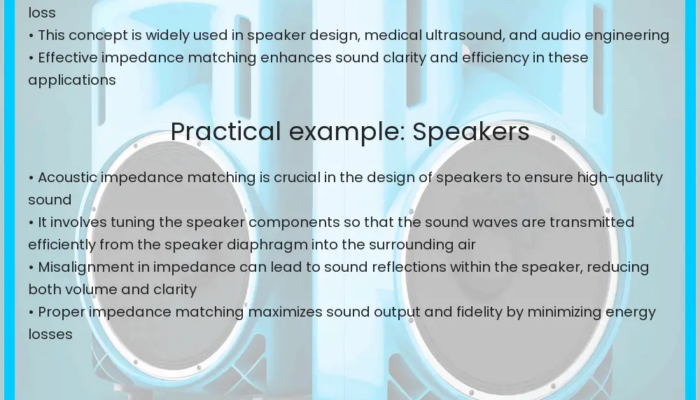
In the realm of sound, impedance matching plays a vital role in optimizing how sound waves move between different materials. For example, the interface between a musical instrument’s strings and its body must be carefully tuned to enhance resonance and tonal richness. Similarly, in medical ultrasound imaging, matching acoustic impedances between the transducer and body tissues improves image clarity by reducing signal reflection.
Electrical Impedance Matching and Circuit Efficiency
In electronics, impedance matching is crucial for ensuring that signals pass between components with minimal loss. A mismatch can cause signal reflections, power dissipation as heat, and even damage to circuit elements. This is especially important in high-frequency applications such as radio frequency (RF) systems, where signal integrity is paramount. Engineers use devices like transformers, matching networks, and transmission line stubs to achieve optimal impedance conditions.
Role of Impedance Matching in Telecommunications
Modern communication infrastructures rely heavily on impedance matching to maintain signal quality across complex networks. Transmission lines, fiber optics, and antenna systems each have characteristic impedances that must be aligned to prevent signal degradation. Techniques such as quarter-wave transformers and stub matching are employed to fine-tune impedance, ensuring efficient data transmission and reducing losses in cellular networks, internet backbones, and satellite communications.
Advanced Applications: Metamaterials and Emerging Technologies
Recent advances in materials science have introduced metamaterials-engineered composites with tailored electromagnetic properties-that enable unprecedented control over impedance profiles. By designing materials with specific impedance characteristics, researchers are developing innovative devices such as invisibility cloaks and superlenses. These breakthroughs demonstrate how precise impedance manipulation can open new frontiers in optics, telecommunications, and beyond.
Challenges in Achieving and Maintaining Impedance Matching
Despite its benefits, achieving perfect impedance matching is often complex and resource-intensive. Variations in environmental conditions like temperature and pressure can alter impedance values, complicating stability over time. Additionally, the need for sophisticated equipment and deep theoretical understanding can limit practical implementation. Ongoing research into adaptive impedance matching systems aims to create responsive technologies capable of real-time adjustments, enhancing reliability and performance in dynamic environments.
Why Impedance Matching Is Essential
Impedance matching is a cornerstone concept that bridges theoretical physics and practical engineering, enabling efficient energy transfer across diverse systems. Its importance spans from improving sound quality in musical instruments to ensuring the clarity and speed of modern communication networks. By harmonizing impedance differences, engineers and scientists unlock enhanced system performance, foster innovation, and drive technological progress.
Common Misconceptions About Impedance Matching
Impedance matching is only relevant in electrical circuits.
While critical in electronics, impedance matching is equally important in acoustics, optics, and other fields involving wave propagation.
Perfect impedance matching is always achievable.
Due to environmental factors and material limitations, ideal matching is often challenging, requiring adaptive solutions.
Impedance matching only affects power transfer.
It also influences signal integrity, noise reduction, and system longevity.
Summary
Impedance matching exemplifies the synergy between physics and engineering, facilitating optimal energy transfer and signal fidelity across various domains. From enhancing acoustic resonance to safeguarding electronic communications, its principles underpin many technological advancements. As research progresses, adaptive and metamaterial-based impedance matching promise to revolutionize how we control wave interactions, heralding a new era of innovation and efficiency.
FAQ
What is impedance matching?
Impedance matching is the process of adjusting the impedance of different components or media to ensure maximum energy transfer and minimal reflection or loss.
Why is impedance matching important in electronics?
It ensures signals pass between components with minimal loss, preventing signal reflections, power dissipation, and potential damage, especially in high-frequency applications.
Can impedance matching be applied outside of electrical circuits?
Yes, it is important in acoustics, optics, and telecommunications, influencing how waves transmit and reflect in various media.
What challenges affect impedance matching?
Environmental variations, such as temperature and pressure changes, material limitations, and the complexity of achieving real-time adaptive matching pose challenges.




Leave a Reply