
Short Answer
Definition of the Central Atom in Molecules
The central atom in a molecule serves as the primary anchor point around which other atoms are arranged, forming the core framework of the molecular structure. Identifying this atom is essential for comprehending the molecule’s chemical properties, bonding patterns, and reactivity. The central atom typically connects multiple atoms, influencing the overall shape and behavior of the compound.
Key Factors Influencing the Identification of the Central Atom
Valency: The Bonding Capacity
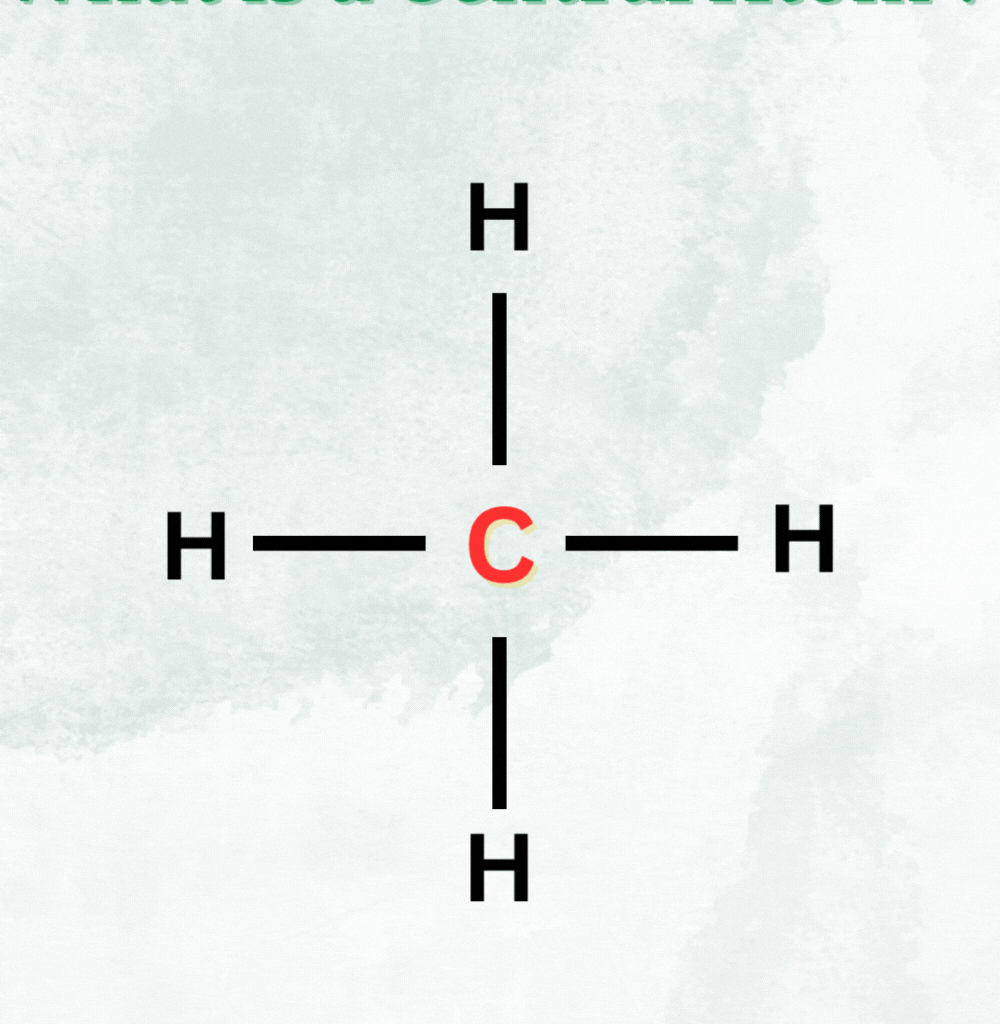
Valency refers to the number of chemical bonds an atom can form, determined by the electrons in its outermost shell. Atoms with higher valency often act as central atoms because they can bond with several other atoms simultaneously. For example, carbon, with a valency of four, frequently occupies the central position in organic molecules due to its ability to form four stable covalent bonds. Conversely, atoms like hydrogen, which typically form only one bond, rarely serve as central atoms but instead complete the molecular structure by bonding to the central atom.
Electronegativity and Atomic Radius
Electronegativity measures an atom’s tendency to attract electrons within a bond. Atoms with moderate electronegativity often become central atoms because they balance electron sharing effectively among bonded atoms. Extremely electronegative atoms tend to attract electrons too strongly, making them less likely to serve as central atoms. Additionally, atomic size influences central atom selection; smaller atoms can accommodate multiple bonds more efficiently due to better orbital overlap, while larger atoms may face steric hindrance that limits bonding capacity. Carbon’s moderate size and electronegativity make it an ideal central atom in many molecules.
Molecular Geometry and Its Role in Central Atom Determination
The three-dimensional arrangement of atoms around the central atom is described by molecular geometry, which is governed by the repulsion between electron pairs in the valence shell. The Valence Shell Electron Pair Repulsion (VSEPR) theory provides a framework to predict these shapes. For instance, a central atom bonded to four atoms typically adopts a tetrahedral geometry, as seen in methane (CH₄). The presence of lone electron pairs on the central atom can distort this geometry, as in water (H₂O), where the oxygen atom’s lone pairs create a bent shape. Recognizing these geometric patterns aids in pinpointing the central atom within diverse molecular structures.
Impact of Functional Groups and Hybridization on Central Atom Selection
Functional Groups
Functional groups are specific clusters of atoms that confer distinct chemical properties and reactivity to molecules. In complex organic compounds, the presence and nature of functional groups can influence which atom serves as the central atom, especially when multiple potential central atoms exist. These groups often dictate the molecule’s behavior and help clarify the molecular framework.
Hybridization States
Hybridization involves the combination of atomic orbitals to form new hybrid orbitals, which determine the bonding patterns and molecular geometry. For example, an sp³ hybridized carbon atom forms four equivalent bonds arranged tetrahedrally, while sp² hybridization leads to a trigonal planar shape. Understanding hybridization provides insight into why certain atoms are favored as central atoms based on their bonding versatility and spatial arrangement.
Summary: Integrating Multiple Criteria to Identify the Central Atom
Determining the central atom in a molecule requires a holistic evaluation of several interrelated factors: valency, electronegativity, atomic size, molecular geometry, functional groups, and hybridization. This comprehensive approach not only clarifies the central atom’s identity but also deepens the understanding of the molecule’s chemical characteristics and reactivity. Mastery of these concepts reveals the fundamental relationship between molecular structure and function, a cornerstone of chemical science.
FAQ
What is the central atom in a molecule?
The central atom is the main atom in a molecule around which other atoms are arranged, forming the core framework of the molecule.
How does valency affect the choice of the central atom?
Atoms with higher valency tend to be central atoms because they can form multiple bonds with other atoms.
Why is electronegativity important in identifying the central atom?
Atoms with moderate electronegativity often become central atoms because they effectively balance electron sharing among bonded atoms.
How does molecular geometry help determine the central atom?
Molecular geometry, predicted by VSEPR theory, describes the spatial arrangement of atoms around the central atom, helping identify it based on bonding patterns and shape.
What role do functional groups play in identifying the central atom?
Functional groups influence which atom serves as the central atom in complex molecules by affecting chemical properties and bonding.






Leave a Reply