
Short Answer
Understanding the Higgs Boson
The Higgs boson is a fundamental particle that plays a crucial role in the universe by helping other particles acquire mass. Although it is a complex concept in particle physics, it can be explained in a way that is accessible and engaging, even for young learners. This article aims to clarify the nature and significance of the Higgs boson, using simple analogies and clear explanations to spark curiosity and deepen understanding.
Definition and Basic Concepts
The universe is made up of countless tiny particles, which are the basic building blocks of everything around us. These particles include quarks and electrons, which combine in various ways to form matter such as plants, animals, and even humans. Think of these particles as small LEGO pieces that can be assembled to create anything from a toy car to a whole city.
- Elementary Particles:
The smallest units of matter, including quarks and electrons, which form the foundation of all physical objects. - Mass:
A property that determines how heavy or light an object is, influencing how it interacts with forces like gravity. - Higgs Field:
An invisible energy field that exists throughout the universe, interacting with particles to give them mass. - Higgs Boson:
A particle that is a ripple or disturbance in the Higgs field, confirming the field’s existence.
The Role of the Higgs Boson in Mass Generation
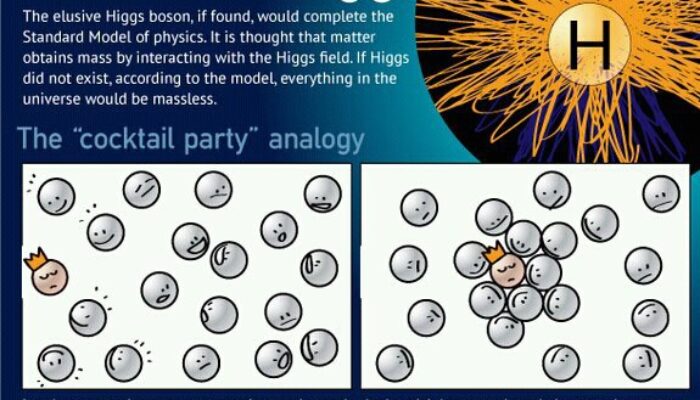
Not all particles naturally have mass. To understand how mass arises, imagine swimming in a pool. As you move through the water, it pushes back against you, making movement harder. Similarly, particles moving through the Higgs field experience resistance, which gives them mass. Without this interaction, particles would travel at the speed of light and could not form the matter that makes up stars, planets, and living beings.
The Higgs boson itself is not the field but a manifestation of it-like a wave in the water. Its discovery in 2012 at CERN was a landmark achievement, confirming a theory that had been proposed decades earlier and solidifying the Standard Model of particle physics, which explains how fundamental particles and forces interact.
The Higgs Mechanism and Fundamental Forces
The Higgs mechanism is a process that endows certain particles, such as the W and Z bosons, with mass. These bosons are responsible for the weak nuclear force, one of the four fundamental forces in nature. Without the Higgs mechanism, these particles would be massless and unable to mediate this force effectively, which would drastically alter the behavior of matter and the universe.
Fundamental forces like gravity and electromagnetism govern how particles move and interact. Mass is essential for these forces to create complex structures. Without mass, particles would zip around freely, preventing the formation of atoms, molecules, and larger cosmic bodies.
Analogies to Simplify the Concept
Using relatable examples can help make the Higgs boson easier to grasp. Imagine a crowded playground where popular swings attract many children. The children represent particles gaining mass, as their presence slows down movement. The swing itself symbolizes the Higgs boson, facilitating interactions and creating a dynamic environment where particles can connect and form matter.
Significance of the Higgs Boson in the Universe
The Higgs boson is a vital piece in the cosmic puzzle, ensuring that particles have mass and that the universe has structure and order. Without it, the universe would be a chaotic place with particles moving at light speed, unable to form stars, planets, or life. The discovery of the Higgs boson has deepened our understanding of the universe’s fundamental workings and opened new avenues for exploring its mysteries.
Future Implications and Scientific Exploration
The Higgs boson is not just a scientific curiosity but a key to unlocking further secrets of the universe. Its discovery raises questions about other unknown particles and the origins of the cosmos. Scientists continue to study the Higgs boson to uncover new physics beyond the Standard Model, potentially revealing insights into dark matter, the early universe, and the fundamental nature of reality.
Common Misconceptions About the Higgs Boson
The Higgs boson is the Higgs field itself.
The Higgs boson is a particle that arises from disturbances in the Higgs field, not the field itself.
The Higgs boson gives mass to everything.
It primarily gives mass to fundamental particles like W and Z bosons; other mass contributions come from different mechanisms.
The Higgs boson is a magical particle.
It is a natural part of the universe’s structure, explained by well-established physics theories.
Why Understanding the Higgs Boson Matters
Grasping the role of the Higgs boson is essential for comprehending how the universe functions at its most fundamental level. It explains why matter has mass, enabling the formation of everything from atoms to galaxies. This knowledge is foundational for advances in physics, technology, and our broader quest to understand the cosmos. By inspiring curiosity and learning, the Higgs boson also encourages future generations to explore science and contribute to humanity’s collective knowledge.
FAQ
What is the Higgs boson?
The Higgs boson is a fundamental particle that is a ripple in the Higgs field, responsible for giving mass to other fundamental particles.
Why is the Higgs boson important in physics?
It confirms the existence of the Higgs field and explains how particles acquire mass, which is essential for the formation of matter.
When and where was the Higgs boson discovered?
It was discovered in 2012 at the Large Hadron Collider at CERN.
Is the Higgs boson the same as the Higgs field?
No, the Higgs boson is a particle that arises from disturbances in the Higgs field, not the field itself.
Does the Higgs boson give mass to all particles?
It mainly gives mass to fundamental particles like the W and Z bosons; other particles gain mass through different mechanisms.





Leave a Reply