
Short Answer
Overview of the James Webb Space Telescope
Envision attempting to spot the flicker of a candle on the Moon’s surface from Earth-an almost impossible feat. Yet, astronomers manage to capture detailed images of galaxies billions of light-years away. This extraordinary capability is made possible by the James Webb Space Telescope (JWST), a pinnacle of contemporary astronomical technology. But how does this massive and complex instrument function without overwhelming us with technical jargon? Let’s explore the inner mechanisms and innovative features that enable JWST to unlock the secrets of the cosmos.
Design and Structure
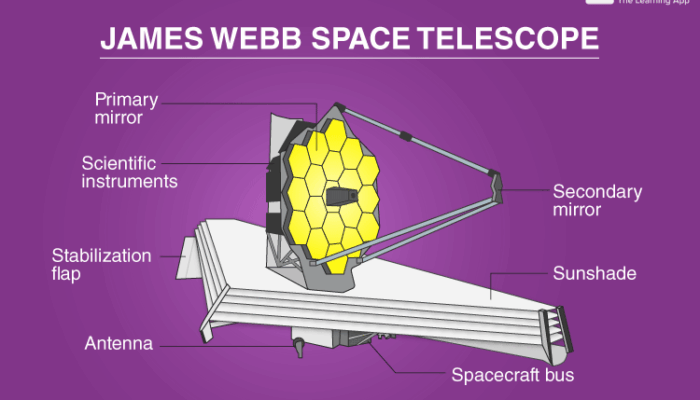
The JWST’s appearance is striking, often likened to a golden spider due to its expansive segmented mirror and sunshield that resemble delicate petals. This unique architecture is not merely aesthetic but fundamental to its superior observational power. Central to the telescope is its primary mirror, composed of 18 hexagonal segments, each roughly the size of a coffee table. These segments are precisely aligned to operate as a single, enormous mirror, capable of collecting faint light from the farthest corners of the universe.
Segmented Mirror Technology
Constructing a single, monolithic mirror large enough to capture the dim light of ancient galaxies is impractical for space deployment. To overcome this, engineers designed the mirror in modular segments that fold to fit inside the rocket’s nosecone during launch. Once deployed in space, these segments unfold and are finely adjusted with nanometer precision to form a flawless optical surface. This self-assembling mirror system is akin to a sophisticated space-age puzzle that autonomously configures itself.
Infrared Observation Capabilities
Unlike traditional telescopes that observe visible light, JWST is optimized to detect infrared radiation-the heat emitted by celestial bodies. This focus is essential because the universe’s expansion stretches visible light from distant galaxies into longer infrared wavelengths by the time it reaches Earth. Therefore, to observe the earliest galaxies, JWST must be sensitive to this infrared spectrum.
Thermal Management and Sunshield
Infrared detectors require extremely low temperatures to function effectively; otherwise, the telescope’s own heat would mask the faint cosmic signals. To address this, JWST is equipped with a five-layer sunshield made from ultra-thin Kapton material coated with aluminum and silicon. This sunshield blocks intense sunlight and cools the telescope’s instruments to temperatures as low as -447°F (-266°C). Essentially, it acts as a cosmic sunscreen and freezer, enabling the telescope to detect subtle infrared signals.
Light Collection and Data Processing
After capturing infrared light, the primary mirror reflects it to a smaller secondary mirror, which then directs the light into an array of scientific instruments. These instruments analyze various properties of the light, such as shape, intensity, and wavelength, functioning like a team of detectives piecing together clues. The collected data is transformed into images and spectra, providing insights into the composition, temperature, distance, and movement of celestial objects.
Orbital Position and Autonomy
JWST operates nearly a million miles from Earth at the second Lagrange point (L2), a location where the gravitational forces of the Earth and Sun balance, allowing the telescope to maintain a stable orbit with minimal fuel use. This remote position, however, introduces communication delays of about 1.5 seconds each way. Consequently, JWST is designed with advanced autonomous systems capable of performing routine adjustments and operations without immediate input from Earth.
Stability and Precision Control
The telescope must contend with various disturbances such as mechanical vibrations, temperature changes, and micrometeoroid impacts, all of which can disrupt its delicate measurements. To counter these, JWST incorporates sophisticated isolation and control mechanisms that stabilize the mirror segments and instruments with remarkable accuracy. These systems function like invisible, gentle hands-computerized to detect and correct even the slightest movements instantaneously.
Contributions to Exoplanet Research
JWST is revolutionizing the study of exoplanets-planets orbiting stars beyond our solar system. By examining the light that passes through these planets’ atmospheres during transits, the telescope can identify chemical signatures such as water vapor, carbon dioxide, and methane. This capability brings humanity closer to answering the profound question of whether life exists elsewhere in the universe, effectively serving as a distant cosmic weather station.
Building a Miniature JWST: A Thought Experiment
Imagining a scaled-down version of JWST for backyard astronomy highlights the telescope’s core principles. Such a model would require a mirror or lens system to gather and focus light, mechanisms to block stray light to reduce glare, and cooling systems for infrared detection. While a miniature version cannot capture the faint light from distant galaxies, this exercise underscores the elegant integration of optics, thermal engineering, and autonomous control that defines JWST’s success.
Significance and Legacy
The James Webb Space Telescope represents a harmonious blend of cutting-edge technology and fundamental physics. It serves as a portal to the ancient universe, meticulously engineered to overcome the formidable challenges of space observation. Each image and dataset it returns not only resolves longstanding cosmic mysteries but also ignites new questions, fueling human curiosity and wonder. JWST stands as a testament to human innovation, extending our sensory reach and imagination far beyond the night sky.
FAQ
What is the main purpose of the James Webb Space Telescope?
The JWST is designed to observe the universe in infrared wavelengths, allowing for the study of distant galaxies and exoplanets.
How does the JWST manage to capture faint light from distant objects?
It uses a segmented mirror that collects light and has advanced thermal management systems to minimize interference from its own heat.



Leave a Reply