

Short Answer
Definition of 2D and 3D Shapes
Shapes form the fundamental elements of both the physical world and abstract mathematical concepts. Two-dimensional (2D) shapes are flat figures defined by length and width, existing solely on a plane. Common examples include circles, squares, and triangles. In contrast, three-dimensional (3D) shapes extend beyond this plane by incorporating depth, resulting in solids such as cubes, spheres, and polyhedra. This dimensional progression represents not just an increase in measurement but a qualitative transformation that introduces volume and spatial perception.
Dimensional Relationships and Interactions
The connection between 2D and 3D shapes can be understood through several geometric principles, including projections and cross-sections, which illustrate how these dimensions interact and overlap.
Projections: Translating 3D to 2D
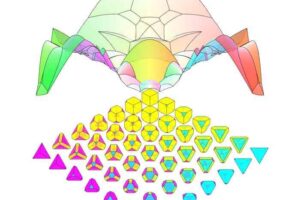
Projection involves representing a three-dimensional object onto a two-dimensional surface. For instance, when a multifaceted crystal is illuminated, it casts intricate shadows on a flat plane. These shadows serve as 2D representations of the 3D form, simplifying complex spatial structures into understandable outlines. This process highlights how dimensionality can be condensed while preserving essential characteristics of the original shape.
Cross-Sections: Slicing Through Dimensions
Cross-sections occur when a 3D object is intersected by a 2D plane, producing various 2D shapes depending on the angle and position of the cut. For example, slicing a cylinder at different orientations can yield circles, ellipses, or even lines. This phenomenon demonstrates how 2D shapes naturally emerge from their 3D counterparts, revealing a continuum between dimensions.
Constructing 3D Shapes from 2D Figures
The formation of three-dimensional solids often begins with two-dimensional shapes as foundational elements. Through geometric operations such as extrusion and revolution, flat figures transform into volumetric objects:
- Extrusion:
Extending a 2D shape along a perpendicular axis to create a prism-like solid. For example, extruding a square produces a cube. - Revolution:
Rotating a 2D shape around an axis to generate a symmetrical 3D object, such as revolving a circle to form a sphere.
These methods underscore the intrinsic link between planar shapes and their spatial counterparts, emphasizing the interdependence of dimensions in geometric construction.
Aesthetic and Philosophical Dimensions of Shapes
Beyond their mathematical properties, shapes possess aesthetic qualities that resonate with human perception and artistic expression. The contrast between a square and a cube, for instance, reflects not only geometric precision but also principles of harmony and balance found in nature and art. Curved forms like circles evoke fluidity and continuity, while angular shapes such as triangles suggest stability and dynamism. This interplay invites philosophical reflection on how dimensionality influences our understanding of form, space, and existence.
Applications Across Disciplines
The relationship between 2D and 3D shapes extends into numerous practical fields, where understanding dimensional transitions is crucial:
- Engineering and Architecture:
Professionals rely on 2D blueprints to design and construct 3D structures, ensuring that plans translate into stable, functional buildings and machines. - Computer Graphics and Virtual Reality:
Digital environments are created by manipulating 2D shapes to form immersive 3D models, enhancing interactive experiences. - Art:
Artists use 2D shapes in paintings and drawings, while sculptors work with 3D forms, both engaging with dimensionality to convey meaning and evoke emotion.
Mathematical Theories and Dimensionality
From a theoretical standpoint, the study of shapes transcends their physical dimensions. Topology, for example, investigates properties of shapes that remain unchanged under continuous transformations, focusing on intrinsic characteristics rather than size or dimension. Concepts such as homotopy and continuity explore how 2D and 3D forms relate on a deeper mathematical level, positioning shapes as abstract entities that embody fundamental principles of the universe.
Common Misconceptions About Dimensions
2D and 3D shapes are entirely separate categories.
They are interconnected, with 2D shapes often serving as cross-sections or projections of 3D objects, illustrating a continuum rather than a strict division.
Adding a dimension only increases size.
Introducing a new dimension changes the nature of the shape, adding volume and altering perception, not just scale.
Significance of Understanding 2D and 3D Shapes
Grasping the relationship between two- and three-dimensional shapes is vital across scientific, technological, and artistic domains. It enhances spatial reasoning, informs design and construction processes, and enriches creative expression. Moreover, this understanding fosters a deeper appreciation of the mathematical structures that underpin our visual and physical reality, bridging abstract theory with tangible experience.
FAQ
What is the significance of understanding 2D and 3D shapes?
Understanding the relationship between 2D and 3D shapes enhances spatial reasoning, informs design processes, and enriches creative expression.
What are some methods for constructing 3D shapes from 2D figures?
Methods include extrusion, where a 2D shape is extended into a 3D object, and revolution, where a 2D shape is rotated around an axis.




Leave a Reply