
Short Answer
Definition of Atomic Light Emission
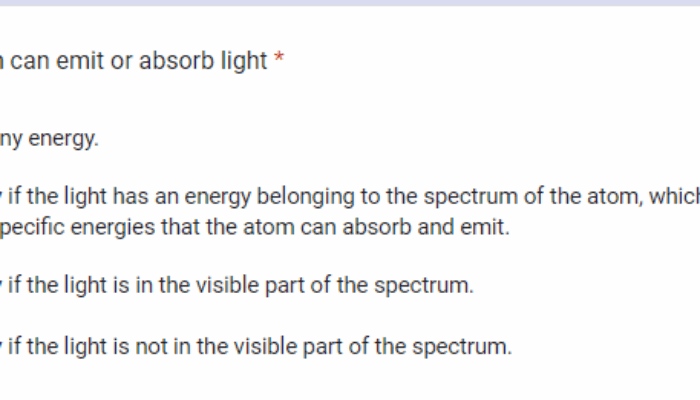
Atomic light emission refers to the process by which atoms release light as a result of electronic transitions between discrete energy levels. This phenomenon is a direct consequence of quantum mechanical principles governing the behavior of electrons within atoms. When an atom transitions from an excited state back to a lower energy state, it emits photons, producing visible or other forms of electromagnetic radiation.
Atomic Structure and Energy Levels
Atoms consist of a central nucleus surrounded by electrons arranged in specific energy shells or levels. These energy levels are quantized, meaning electrons can only occupy certain allowed states. The interaction between electrons and these quantized energy levels is fundamental to understanding how atoms emit light.
- Energy Levels:
Electrons reside in defined shells with fixed energy values. - Electron Configuration:
The arrangement of electrons in these shells determines the atom’s properties and its light emission characteristics.
Excitation: The Prerequisite for Light Emission
For an atom to emit light, it must first absorb energy to elevate an electron from a lower energy level to a higher one, a process known as excitation. This energy uptake can occur through various means:
- Photon Absorption:
The atom absorbs a photon whose energy matches the gap between two energy levels. - Thermal Energy:
Heat can provide sufficient energy to excite electrons. - Particle Collisions:
Interactions with other particles can transfer energy to electrons.
The energy absorbed must precisely correspond to the difference between the initial and final energy states, reflecting the discrete nature of atomic energy levels.
Mechanisms of Light Emission
Once excited, electrons do not remain in higher energy states indefinitely. They return to lower energy levels, releasing energy in the form of light or other forms. The primary mechanisms include:
- Spontaneous Emission:
Electrons return to the ground state randomly, emitting photons with energy equal to the difference between the two states. - Stimulated Emission:
An incoming photon induces the electron to drop to a lower energy level, emitting a photon identical to the stimulating one. This principle underlies laser technology. - Non-Radiative Transitions:
Energy is dissipated as heat or transferred to the environment without photon emission.
Quantum Mechanical Principles Behind Emission
The emission process is governed by quantum mechanics, particularly the concept of quantized energy states. Electrons can only transition between these fixed levels by absorbing or emitting exact quanta of energy. This selectivity explains the discrete spectral lines observed in atomic emission spectra.
Influence of External Conditions on Emission
External factors such as temperature, pressure, and electromagnetic fields can significantly impact the excitation and emission processes:
- Temperature:
Higher temperatures increase atomic kinetic energy, enhancing collision rates and excitation probability. - Pressure:
Elevated pressure can alter atomic energy landscapes, modifying emission spectra. - Electromagnetic Fields:
Fields can shift energy levels (Stark and Zeeman effects), affecting emission characteristics.
Characteristic Emission Spectra of Elements
Each element has a unique electron configuration, resulting in distinct emission spectra. When excited, atoms emit light at specific wavelengths, producing characteristic colors. For example:
- Noble Gases:
Neon emits bright red-orange light, while argon produces blue-violet hues. - Other Elements:
Different elements display unique spectral lines used in spectroscopic identification.
Applications and Significance
The study of atomic light emission is crucial in various scientific and technological fields:
- Spectroscopy:
Enables identification of elements and analysis of atomic structure. - Laser Technology:
Utilizes stimulated emission for coherent light sources. - Astrophysics:
Helps determine the composition of stars and interstellar matter. - Material Science:
Assists in understanding material properties through emission characteristics.
Common Misconceptions About Atomic Light Emission
Atoms emit light continuously.
Light emission occurs in discrete quanta during electron transitions between specific energy levels.
Any absorbed energy causes light emission.
Some absorbed energy dissipates non-radiatively as heat without producing light.
Summary: The Quantum Dance of Light and Matter
The emission of light by atoms exemplifies the intricate interplay of quantum mechanics and energy transformations. Through precise energy absorption and electron transitions, atoms convert energy into photons, illuminating the microscopic world. This process not only enriches our understanding of atomic behavior but also drives innovations across multiple scientific disciplines, highlighting the profound connection between fundamental physics and practical technology.
FAQ
What is atomic light emission?
Atomic light emission is the process by which atoms release light during electronic transitions between energy levels.
What must happen for an atom to emit light?
An atom must absorb energy to excite an electron to a higher energy level before it can emit light.
What are the mechanisms of light emission?
The main mechanisms include spontaneous emission, stimulated emission, and non-radiative transitions.




Leave a Reply