
Short Answer
Understanding the Qubit: A Fundamental Unit of Quantum Information
At the heart of quantum computing lies the qubit, the essential building block of quantum information. The term “qubit” merges “quantum” and “bit,” reflecting its dual identity: it functions similarly to a classical bit yet embodies the unique and often counterintuitive principles of quantum mechanics. This article explores the nature and scale of the qubit, highlighting its minuscule physical size alongside its transformative impact on technology and computation.
Definition and Core Properties of a Qubit
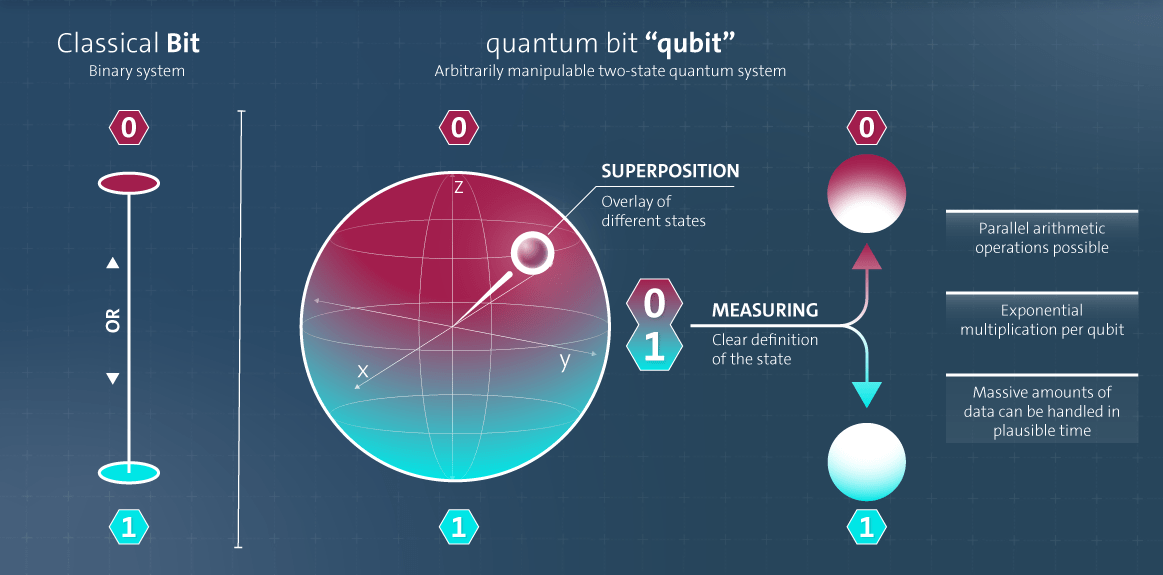
A qubit differs fundamentally from a classical bit by virtue of its ability to exist in a superposition of states rather than being confined to a binary 0 or 1. This superposition allows qubits to represent and process a vast array of information simultaneously, a feature that underpins the extraordinary computational potential of quantum computers.
- Superposition:
Unlike classical bits, qubits can be in multiple states at once, enabling parallel computation. - Entanglement:
Qubits can become entangled, meaning the state of one qubit is directly related to the state of another, regardless of distance. - Quantum coherence:
The maintenance of quantum states over time, essential for reliable quantum computation.
Physical Realization and Scale of Qubits
Qubits are implemented using various quantum systems, each operating at scales imperceptible to the human eye but critical in quantum mechanics:
- Superconducting circuits:
These qubits are fabricated on microchips and typically measure just a few micrometers, bridging the quantum and macroscopic worlds. - Photonic qubits:
Represented by single photons, these qubits can maintain entangled states over long distances, highlighting their small size yet extensive reach. - Atomic and ion-based qubits:
Utilizing individual atoms or ions trapped and manipulated with lasers, these qubits operate at the atomic scale.
Beyond the size of individual qubits, the architecture of quantum processors involves densely packed arrays of qubits on microchips, enabling complex entanglement and exponentially increasing computational power.
Operational Principles of Qubits
The power of qubits arises from their quantum mechanical properties, which allow them to perform computations in ways classical bits cannot. Superposition enables a qubit to encode multiple possibilities simultaneously, while entanglement links qubits so that their states are interdependent. These phenomena allow quantum computers to explore many solutions at once, vastly accelerating certain types of calculations.
Mathematical Framework of Qubits
Mathematically, a qubit’s state is described as a vector in a two-dimensional complex Hilbert space:
|ψ⟩ = α|0⟩ + β|1⟩
- |0⟩ and |1⟩: Basis states analogous to classical bits 0 and 1.
- α and β: Complex probability amplitudes, where |α|² + |β|² = 1, representing the likelihood of measuring the qubit in each state.
This representation captures the probabilistic nature of quantum measurement and the superposition principle.
Applications and Impact of Qubits in Technology
The unique capabilities of qubits open new frontiers across multiple domains:
- Cryptography:
Quantum algorithms like Shor’s algorithm threaten classical encryption by efficiently factoring large numbers, prompting the development of quantum-resistant cryptographic methods. - Optimization:
Quantum annealing leverages qubits to find optimal solutions in complex problem landscapes, benefiting logistics, finance, and machine learning. - Material science and drug discovery:
Simulating quantum interactions at the molecular level enables the design of novel materials and pharmaceuticals with enhanced precision.
Challenges in Qubit Development
Despite their promise, qubits face significant hurdles that must be overcome to realize practical quantum computing:
- Decoherence:
Qubits are highly sensitive to environmental disturbances, which can cause loss of quantum information. - Scalability:
Building large-scale, error-corrected quantum computers requires integrating vast numbers of qubits while maintaining coherence and control. - Error correction:
Quantum error correction protocols are essential but resource-intensive, posing engineering and theoretical challenges.
Philosophical and Scientific Significance of Qubits
Beyond their technological applications, qubits provoke deep questions about the nature of reality. The phenomena of superposition and entanglement challenge classical notions of determinism and locality, inviting reconsideration of fundamental physical laws and the structure of the universe itself.
Conclusion: The Dual Scale of Qubits
In summary, the qubit is both an extraordinarily small physical entity and a monumental catalyst for change in computation and science. Its microscopic scale belies its vast potential to revolutionize information processing, cryptography, optimization, and scientific discovery. As research advances, qubits continue to illuminate new pathways toward solving problems once thought insurmountable, underscoring their profound significance in shaping the future.
FAQ
What is a qubit?
A qubit is the fundamental unit of quantum information, capable of existing in multiple states simultaneously due to superposition.
How does a qubit differ from a classical bit?
Unlike a classical bit, which can be either 0 or 1, a qubit can exist in a superposition of both states.
What are the applications of qubits?
Qubits enable advancements in cryptography, optimization, and material science, among other fields.






Leave a Reply