
Short Answer
Definition
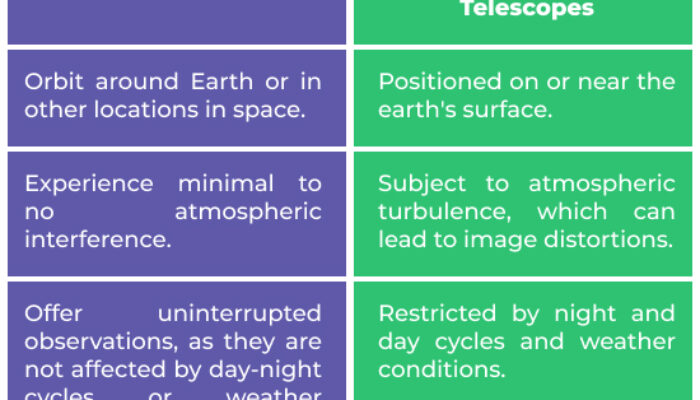
Telescopes are optical instruments designed to observe distant celestial objects by collecting and magnifying electromagnetic radiation. They come in two primary forms: ground-based telescopes, which are installed on Earth’s surface, and space telescopes, which operate beyond the Earth’s atmosphere. Both types serve the fundamental purpose of enhancing our understanding of the universe, yet they differ significantly in design, capabilities, and observational conditions.
Historical and Technological Background of Ground-Based Telescopes
For centuries, ground-based telescopes have been the cornerstone of astronomical research. Positioned often on elevated mountain sites to minimize atmospheric interference, these observatories utilize large mirrors and lenses to gather faint light from stars, planets, and other cosmic phenomena. Technological advancements such as adaptive optics have been integrated to counteract atmospheric distortions, enabling clearer and more detailed images than ever before.
Challenges Posed by Earth’s Atmosphere
Despite their sophistication, ground-based telescopes face inherent limitations due to the Earth’s atmosphere. The atmospheric layer, essential for sustaining life, introduces turbulence that causes the familiar twinkling of stars, scientifically termed “seeing.” This turbulence distorts incoming light waves, reducing image sharpness and clarity. Additionally, atmospheric conditions such as temperature fluctuations, humidity, and air currents further degrade observational quality. Crucially, the atmosphere absorbs significant portions of the electromagnetic spectrum-including ultraviolet, X-ray, and infrared wavelengths-restricting the range of observable phenomena from the ground.
Space Telescopes: Operating Beyond Atmospheric Constraints
Space telescopes circumvent the limitations imposed by the atmosphere by operating in orbit around Earth or at strategic points in space, such as Lagrange points. Freed from atmospheric distortion and absorption, these instruments achieve superior angular resolution and sensitivity. They can detect wavelengths invisible to ground-based observatories, allowing astronomers to study phenomena like the cosmic microwave background radiation, star formation processes, and the atmospheric composition of exoplanets with exceptional precision.
Advantages and Limitations of Space-Based Observatories
- Advantages:
Unobstructed access to the full electromagnetic spectrum, higher image clarity, and the ability to observe faint and distant cosmic events without atmospheric interference. - Limitations:
Size constraints due to launch vehicle capacities, high costs, complex deployment, and limited opportunities for maintenance or upgrades once in orbit.
Comparative Analysis: Ground-Based vs. Space Telescopes
While space telescopes offer unparalleled clarity and spectral access, ground-based telescopes provide unique benefits that sustain their critical role in astronomy. The largest ground observatories feature mirrors spanning tens of meters, far surpassing the size limitations of space telescopes. This allows them to collect more light, enabling the study of extremely faint and distant objects. Furthermore, adaptive optics technology has significantly reduced atmospheric distortion effects, allowing some ground-based telescopes to achieve resolutions comparable to or exceeding those of space telescopes in visible and near-infrared wavelengths.
Maintenance and Upgrade Considerations
Ground-based telescopes benefit from easier access for repairs, technological upgrades, and instrument replacements, facilitating continuous improvement and adaptation to new scientific goals. In contrast, space telescopes generally must operate autonomously for extended periods, with limited or no physical servicing options-Hubble being a notable exception due to astronaut servicing missions.
Cost and Accessibility Factors
Constructing and launching space telescopes involves substantial financial investment, long development timelines, and significant risk. Ground-based observatories, by contrast, can be built incrementally and upgraded modularly, making them more accessible to a wider range of scientific institutions and fostering international collaboration.
Synergy Between Ground and Space Observatories
Modern astronomy relies on the complementary strengths of both ground-based and space telescopes. Ground observatories excel in conducting detailed spectral analyses, long-term monitoring, and extensive sky surveys due to their size and adaptability. Space telescopes, meanwhile, reveal cosmic phenomena obscured or inaccessible from Earth, such as high-energy events and subtle signals filtered by the atmosphere. Together, they provide a comprehensive and multifaceted view of the universe.
Philosophical and Scientific Significance
The pursuit of enhanced cosmic observation reflects humanity’s enduring desire to transcend sensory limitations and explore the unknown. Whether through terrestrial lenses perched on mountain summits or sophisticated instruments orbiting in space, telescopes embody our curiosity and imagination. They not only facilitate scientific discovery but also inspire profound reflection on our place within the vast cosmos.
Conclusion: A Unified Vision for Cosmic Exploration
The question of which telescope “sees more” transcends technical comparison, touching on the broader human quest for knowledge. Ground-based and space telescopes are not competitors but collaborators, each offering unique perspectives that enrich our understanding of the universe. Their combined efforts continue to push the boundaries of observation, transforming distant points of light into detailed narratives of cosmic history and structure.
FAQ
What are the main differences between ground-based and space telescopes?
Ground-based telescopes operate within Earth’s atmosphere and face limitations due to atmospheric interference, while space telescopes operate in space, providing clearer images and access to a broader range of electromagnetic wavelengths.
Why are space telescopes generally more expensive than ground-based telescopes?
Space telescopes require significant financial investment for construction, launch, and complex technology, alongside limited opportunities for maintenance once in orbit.


Leave a Reply