
Short Answer
Definition of Gravity and Its Traditional Interpretation
Gravity is commonly understood as an invisible force that draws objects toward one another, fundamentally shaping the structure and motion of celestial bodies such as planets, stars, and galaxies. This classical view, rooted in everyday experience and Newtonian physics, describes gravity as an attractive force acting between masses. However, modern physics challenges this straightforward notion by exploring whether gravity is truly a pulling force or if the effects we attribute to it might instead arise from the properties of space itself exerting a pushing influence.
Classical and Relativistic Perspectives on Gravity
In classical mechanics, gravity is defined by Newton’s law of universal gravitation, which states that every mass attracts every other mass with a force proportional to the product of their masses and inversely proportional to the square of the distance between them. This model effectively explains planetary orbits and many terrestrial phenomena but does not address the fundamental nature of gravity.
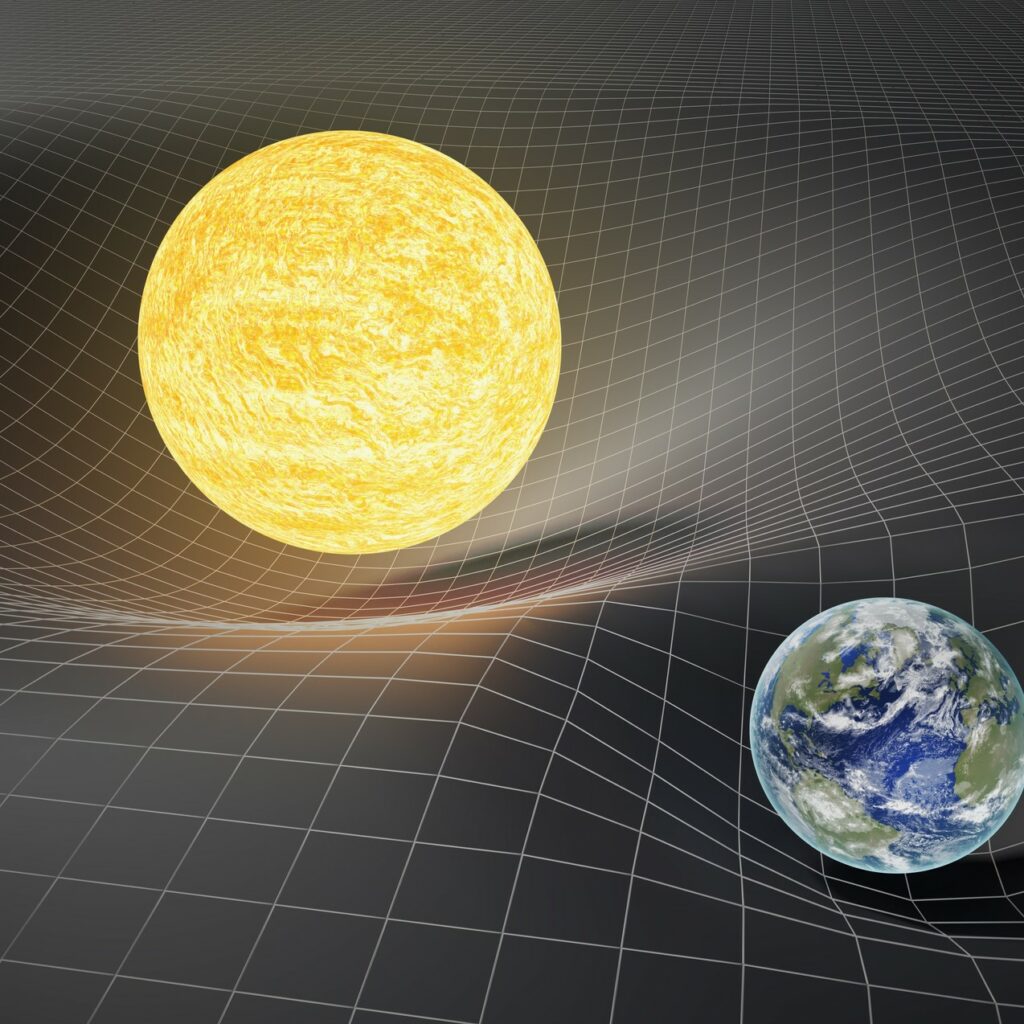
Einstein’s General Relativity revolutionized this understanding by describing gravity not as a force but as the curvature of spacetime caused by mass and energy. Objects follow geodesics-paths that represent the shortest distance in curved spacetime-resulting in motion that appears as gravitational attraction. This geometric framework accounts for complex phenomena such as gravitational lensing and time dilation near massive objects, yet it still conceptualizes gravity as an attractive effect produced by the warping of spacetime.
Exploring the Idea of Space Exerting a Push
Contrary to the traditional pull-based view, some theories propose that gravity-like effects might emerge from space exerting a pushing pressure. Historically, Le Sage’s theory suggested that invisible particles bombard objects, pushing them together, but this idea was discarded due to conflicts with thermodynamics and observations.
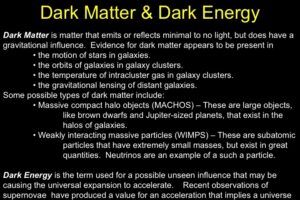
Contemporary physics revisits this concept in more nuanced ways. The accelerating expansion of the universe, driven by dark energy, demonstrates that space itself can exert a repulsive force on cosmic scales, causing galaxies to move apart. This reveals that space is an active, dynamic entity capable of both expansive and contractive influences depending on its energy composition.
At the quantum level, vacuum fluctuations and zero-point energy imbue empty space with intrinsic activity, generating subtle pressures that affect particles and fields. While these quantum vacuum pressures do not directly explain everyday gravitational attraction, they highlight the complex interactions between spacetime and quantum phenomena that may contribute to gravitational effects.
The Role of Pressure and Energy in Spacetime Geometry
General Relativity incorporates not only mass-energy density but also pressures and stresses within the stress-energy tensor, meaning that pressures-whether from matter or vacuum energy-affect gravitational behavior. Negative pressure or tension, for example, can produce effects resembling repulsive gravity or “anti-gravity.”
The cosmological constant (Λ), associated with dark energy, represents a uniform pressure permeating space that accelerates the universe’s expansion, counteracting the familiar inward pull of gravity on large scales. Thus, while gravity dominates locally, the expansive pressure of space’s energy content becomes significant on cosmological distances.
Emergent gravity theories propose that gravity may arise from the entropic properties of space, where gravitational attraction results from gradients in information density or entropy rather than a fundamental force. This perspective suggests that space could collectively “push” matter through the organization and flow of microscopic information.
Mechanisms Behind Gravity and Space Dynamics
Gravity’s manifestation as acceleration and trajectory changes can be interpreted through both attraction and compression of spacetime. Gravitational waves-ripples in spacetime detected by observatories like LIGO and Virgo-demonstrate that spacetime is a dynamic medium capable of complex interactions.
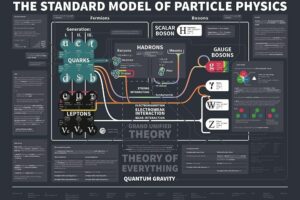
Quantum gravity research, including the search for gravitons, aims to clarify whether gravity arises from particle exchanges producing a pulling force or from more subtle quantum and geometric effects that might resemble pushing mechanisms. These investigations seek to unify gravity with quantum mechanics and deepen our understanding of its true nature.
Real-World Examples of Gravitational Phenomena
- Planetary Orbits:
Newtonian gravity accurately predicts the elliptical orbits of planets around the Sun, illustrating gravity as an attractive force between masses. - Gravitational Lensing:
Light bending around massive objects, explained by General Relativity, shows how spacetime curvature guides the path of photons, reinforcing the geometric interpretation of gravity. - Cosmic Expansion:
Observations of distant galaxies moving away from each other at accelerating rates reveal the repulsive effect of dark energy, highlighting space’s active role in cosmic dynamics. - Gravitational Waves:
Detected ripples in spacetime from colliding black holes confirm that spacetime itself is dynamic and responsive to mass-energy changes.
Common Misconceptions About Gravity
Gravity is always an attractive force.
While gravity appears attractive on small scales, dark energy causes a repulsive effect on cosmic scales, showing gravity’s behavior depends on context.
Space is a passive backdrop.
Modern physics reveals space as an active, dynamic entity with energy and pressure that influence matter and cosmic evolution.
Gravity is a fundamental force like electromagnetism.
Some theories suggest gravity may be emergent from underlying quantum or entropic processes rather than a fundamental interaction.
Significance of Understanding Gravity and Space Dynamics
Comprehending whether gravity acts as a pull or if space exerts a push is crucial for advancing physics, cosmology, and our grasp of the universe’s structure. This knowledge impacts technologies relying on gravitational principles, such as satellite navigation and astrophysical modeling. Moreover, it informs the quest for a unified theory that reconciles gravity with quantum mechanics, potentially unlocking new physics beyond the Standard Model.
As research progresses, the nuanced interplay between spacetime geometry, energy densities, pressures, and quantum effects continues to reshape our understanding of gravity. This evolving perspective underscores the complexity and elegance of the cosmos, inspiring ongoing exploration into the fundamental forces that govern existence.
FAQ
What is gravity?
Gravity is a force that attracts two bodies towards each other, traditionally viewed as a pull between masses.
Can space exert a push?
Some theories suggest that effects attributed to gravity might instead arise from space pushing against objects.
How does dark energy relate to gravity?
Dark energy causes a repulsive effect on cosmic scales, counteracting the gravitational attraction between masses.
Leave a Reply