
Short Answer
Definition of Atoms and Molecules in Dalton’s Theory
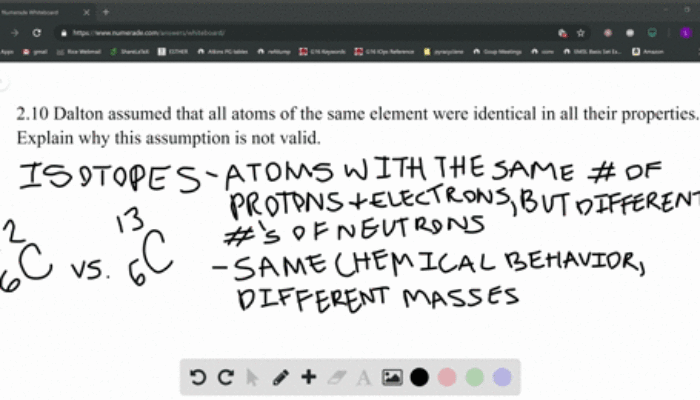
John Dalton, a seminal figure in the development of atomic theory, distinguished clearly between atoms and molecules in his scientific framework. Atoms, according to Dalton, are the indivisible, fundamental units of matter, each element consisting of identical atoms with specific masses and properties. Molecules, on the other hand, are defined as combinations of these atoms, representing the smallest units of compounds that retain their chemical identity.
- Atom:
The smallest indivisible particle of an element, uniform in mass and characteristics within that element. - Molecule:
An assembly of atoms bonded together, forming the minimal unit of a compound that preserves its chemical properties.
Historical Context and Foundations of Dalton’s Atomic Theory
In the early 19th century, Dalton revolutionized the scientific understanding of matter by proposing that all substances are composed of atoms-tiny, indivisible particles. His theory emphasized the uniformity of atoms within a single element, which was a groundbreaking concept that helped explain the conservation of mass and the concept of atomic weight. This framework laid the foundation for modern chemistry by linking microscopic particles to observable chemical phenomena.
Dalton’s Perspective on Molecules Versus Modern Views
Unlike contemporary science, which often treats atoms and molecules as points along a continuum, Dalton maintained a strict separation between the two. He viewed atoms as ultimate particles that could not be broken down further, while molecules were considered aggregates formed by the union of atoms. This distinction was critical in his explanation of chemical compounds and reactions, where molecules represented specific combinations of atoms arranged in defined ratios.
Dalton’s Contributions to Chemical Compounds and Laws
Dalton’s law of multiple proportions exemplifies his understanding of molecular formation. It states that elements combine in fixed, simple ratios to form compounds, highlighting the discrete nature of atoms and their combinations into molecules. This principle underscored the different roles atoms and molecules play: atoms as the fundamental building blocks, and molecules as structured assemblies that exhibit unique chemical behaviors.
Symbolism and Representation in Dalton’s Chemistry
Dalton introduced symbolic representations for atoms, which helped clarify the distinction between individual atoms and molecular assemblies. These symbols provided a visual and conceptual framework for understanding chemical reactions, emphasizing that molecules are not singular atoms but rather specific groupings of atoms with distinct properties. This symbolic system was foundational for the development of chemical notation and stoichiometry.
Impact on Scientific Thought and Ontology
Dalton’s atomic theory initiated a profound shift in scientific inquiry by combining empirical evidence with theoretical models. His differentiation between atoms and molecules enabled the development of concepts such as molecular weight and valency, which are essential for understanding chemical bonding and reactions. This ontological shift paved the way for later scientists like Avogadro and Mendeleev to refine atomic models and expand the periodic classification of elements.
Relevance to Stoichiometry and Chemical Equations
Dalton’s framework allowed chemists to approach chemical reactions quantitatively, recognizing molecules as distinct entities formed from specific numbers of atoms. This understanding is crucial for balancing chemical equations and calculating reactant and product quantities, reinforcing the importance of both atomic and molecular perspectives in chemical analysis.
Modern Interpretations and Legacy of Dalton’s Ideas
While modern atomic theory has evolved beyond Dalton’s initial definitions, revisiting his work offers valuable insights into the historical development of chemistry. Contemporary science integrates quantum mechanics and molecular complexity, yet Dalton’s clear distinction between atoms and molecules remains a foundational concept. His legacy continues to influence research in fields such as nanotechnology, where the behavior of atoms and molecules in novel environments challenges classical distinctions.
Broader Implications for Scientific Classification
Dalton’s approach highlights the ongoing tension in science between simplification and complexity. His clear categorization of atoms and molecules serves as a reminder that scientific progress often involves balancing discrete classifications with the nuanced realities of natural phenomena. This perspective encourages continuous inquiry and adaptation in the face of new discoveries.
Summary and Enduring Influence
In conclusion, John Dalton’s recognition of atoms and molecules as distinct yet interconnected entities laid the groundwork for modern chemistry. His insistence on the unique properties of atoms and their combinations into molecules fosters an enduring dialogue about the nature of matter. Dalton’s pioneering work not only transformed 19th-century science but also continues to inspire contemporary exploration into the fundamental building blocks of the universe.
FAQ
Did John Dalton believe atoms and molecules were the same?
No, Dalton distinguished atoms as indivisible particles and molecules as combinations of atoms that form compounds.
What is Dalton's law of multiple proportions?
It states that elements combine in specific ratios to form compounds, supporting the distinction between atoms and molecules.
How did Dalton represent atoms and molecules?
Dalton used symbolic representations to differentiate atoms and molecules in chemical reactions.




Leave a Reply