
Short Answer
Definition of Topological Quantum Computing
Topological quantum computing is an advanced approach within the field of quantum computation that fundamentally differs from traditional quantum and classical computing models. It harnesses the mathematical framework of topology to encode and manipulate quantum information in a way that is inherently resistant to errors caused by local disturbances. This method aims to exploit the topological properties of quantum states to achieve more stable and fault-tolerant quantum operations.
Fundamental Concepts and Principles
Topology and Quantum States
Topology is a branch of mathematics focused on properties of space that remain unchanged under continuous deformations such as stretching or bending, but not tearing or gluing. In topological quantum computing, quantum information is stored in global, non-local topological features of the system rather than in local qubit states. This non-local encoding ensures that the quantum information is protected from local noise and perturbations, which are common sources of errors in quantum systems.
Anyons: Exotic Quasiparticles
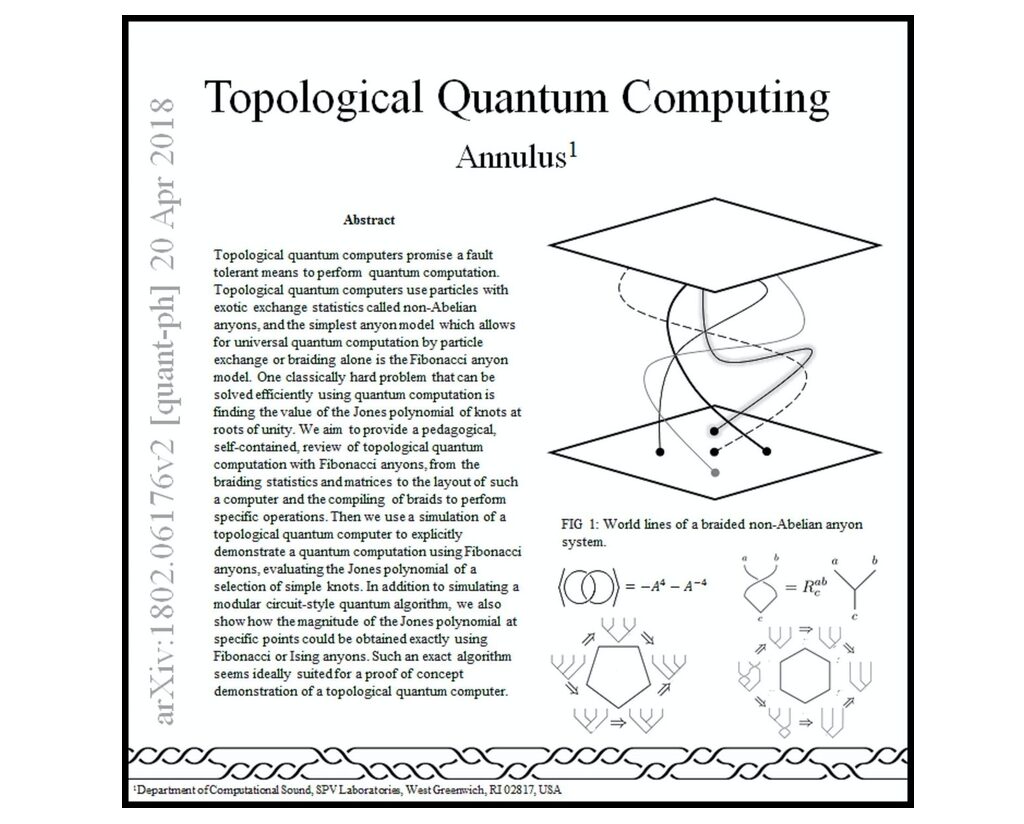
Central to topological quantum computing is the concept of anyons, which are quasiparticles that exist exclusively in two-dimensional systems. Unlike fermions and bosons, anyons exhibit unique statistical behaviors that are neither purely fermionic nor bosonic. The manipulation of anyons through braiding operations-where their worldlines intertwine in space-time-forms the basis for quantum gate operations. The outcome of these braids depends solely on their topological configuration, making the encoded quantum information intrinsically robust.
Physical Realization of Topological Quantum Computing
Topological Insulators and Majorana Fermions
Implementing topological quantum computing requires physical systems capable of supporting anyonic excitations. Topological insulators are promising candidates; these materials conduct electricity on their surfaces while remaining insulating in their bulk. Within such systems, Majorana fermions-zero-energy quasiparticles that are their own antiparticles-can emerge. These Majorana zero modes are particularly attractive for quantum computing because they can form non-Abelian anyons, which are essential for fault-tolerant quantum operations.
Experimental Platforms and Techniques
Current experimental efforts focus on hybrid systems combining superconducting circuits with topological materials to generate and control anyons. For example, nanowire-based setups with strong spin-orbit coupling and induced superconductivity are being investigated to realize and braid Majorana modes. Successfully demonstrating these braiding operations would represent a significant breakthrough toward practical topological quantum computers.
Mechanism of Topological Quantum Computing
The core mechanism involves encoding quantum information in the global topological state of anyons and performing quantum gates by braiding these anyons around each other. Because the quantum information depends on the topology of the braids rather than the precise local details, the system exhibits intrinsic fault tolerance. This means that small local errors or environmental noise do not easily corrupt the stored information, addressing one of the major challenges in quantum computation: decoherence.
Mathematical Framework and Fault Tolerance
Topological quantum computing relies on the mathematical description of anyons and their braiding statistics, often modeled using braid groups and topological quantum field theories. The fault tolerance arises because the quantum states correspond to topological invariants, which remain unchanged under continuous deformations. This property can be expressed as:
- Quantum State Encoding:
Quantum information is encoded in the fusion space of anyons, which depends on their collective topological charge. - Braid Operations:
Braiding anyons corresponds to unitary transformations on the encoded quantum states, represented mathematically by braid group representations. - Fault Tolerance:
Errors that do not alter the topological class of the braids cannot change the encoded information, providing inherent error protection.
Historical Context and Motivation
Topological quantum computing emerged as a response to the significant challenge of maintaining qubit coherence in conventional quantum systems, such as those based on superconducting circuits or trapped ions. These systems are highly susceptible to decoherence caused by environmental noise, limiting their practical scalability. By contrast, topological quantum states offer a natural shield against such noise, potentially enabling longer coherence times and more reliable quantum computations.
Applications and Real-World Implications
Once realized, topological quantum computers could revolutionize computational capabilities by efficiently solving problems that are intractable for classical computers. Examples include:
- Integer Factorization:
Breaking down large numbers into prime factors, which has implications for cryptography. - Quantum Simulations:
Modeling complex quantum systems in chemistry and materials science that are beyond classical computational reach.
These applications highlight the transformative potential of topological quantum computing in science, technology, and industry.
Challenges and Ongoing Research
Despite its promising theoretical foundation, topological quantum computing faces several practical hurdles:
- Anyons Realization:
Creating and manipulating anyons under controlled laboratory conditions remains experimentally demanding. - Environmental Control:
Maintaining the precise conditions necessary for topological states, such as ultra-low temperatures and clean materials, is complex. - Error Correction:
Developing error correction schemes tailored to topological systems is an active area of research.
Addressing these challenges requires interdisciplinary collaboration among physicists, mathematicians, and materials scientists.
Ethical and Societal Considerations
The advancement of topological quantum computing raises important ethical questions. Enhanced computational power could disrupt current cryptographic protocols, impacting cybersecurity and privacy. Additionally, the socio-economic effects of quantum technologies may reshape industries and labor markets, necessitating thoughtful policy and regulation to manage these changes responsibly.
Conclusion: The Future of Topological Quantum Computing
Topological quantum computing signifies a profound shift in quantum information science by leveraging the unique properties of anyons and topological states to achieve fault-tolerant quantum computation. The synergy between theoretical insights and experimental progress continues to drive this field forward, promising to redefine computational paradigms. As research advances, adapting to the technological and societal implications of this emerging quantum frontier will be crucial for harnessing its full potential.
FAQ
What is topological quantum computing?
Topological quantum computing is a model of quantum computation that encodes information in topological states, which are robust against local errors.
Why are anyons important in topological quantum computing?
Anyons enable braiding operations that manipulate quantum states based on topology, providing stability and fault tolerance.
How does topological quantum computing improve error resistance?
It stores information non-locally in topological properties, making it less susceptible to local noise and decoherence.






Leave a Reply