
Short Answer
Definition of Gravitational Wave Storms
Gravitational wave storms refer to complex, intense interactions of gravitational waves-ripples in the fabric of spacetime generated by massive cosmic events-that overlap and interact in a turbulent, storm-like manner. Unlike isolated gravitational wave signals from singular events, these storms represent a chaotic superposition of multiple waves, creating dynamic and nonlinear fluctuations in spacetime.
- Gravitational Waves:
Disturbances in spacetime caused by accelerating massive bodies, such as merging black holes or neutron stars. - Storm Concept:
A metaphor describing the turbulent, overlapping, and interacting nature of multiple gravitational waves, analogous to meteorological storms on Earth.
Fundamentals of Gravitational Waves
Predicted by Einstein’s general relativity, gravitational waves are distortions that propagate through spacetime itself, carrying energy away from cataclysmic astrophysical events. These waves are not disturbances traveling through a medium but are intrinsic fluctuations of spacetime geometry. When massive objects accelerate-especially during collisions or mergers-they generate these ripples, which then travel across the universe at the speed of light.
Mechanisms Behind Gravitational Wave Storms
To understand gravitational wave storms, one must move beyond the simple linear propagation model. When multiple gravitational waves intersect, they can superimpose and interact nonlinearly, exchanging energy and altering each other’s trajectories. This interaction can create complex patterns of spacetime oscillations, much like the turbulent interplay of wind currents in terrestrial storms.
- Wave Superposition:
Overlapping waves combine their effects, potentially amplifying or diminishing local spacetime distortions. - Nonlinear Interactions:
Unlike simple wave addition, these interactions can modify the curvature of spacetime, influencing subsequent wave behavior. - Localized Vortices:
Regions of intense spacetime twisting and oscillation may form, analogous to vortices in atmospheric storms.
Astrophysical Context and Formation
Gravitational wave storms are most likely to occur in environments with frequent, overlapping gravitational wave sources, such as dense galactic nuclei where multiple black hole mergers happen in close succession. The resulting waves interfere, creating a complex, fluctuating pattern of spacetime vibrations that can be viewed as a cosmic storm.
- Dense Galactic Nuclei:
Regions with high concentrations of massive objects producing overlapping gravitational waves. - Wave Interference:
The overlapping signals create a tapestry of spacetime oscillations with varying intensity and direction. - Storm Structure:
Analogous to a hurricane’s eye and storm clouds, gravitational wave storms may have zones of amplified strain surrounded by chaotic oscillations.
Nonlinear Feedback and Spacetime Dynamics
One hallmark of terrestrial storms is their unpredictable intensification through feedback loops. Similarly, gravitational wave storms may exhibit nonlinear feedback where the waves themselves alter spacetime curvature enough to affect subsequent wave propagation. This recursive process can generate localized distortions or vortices, where spacetime twists and oscillates with exceptional intensity, marking the storm’s most turbulent regions.
Distinguishing Features Compared to Terrestrial Storms
Unlike weather systems driven by fluid dynamics and thermal energy, gravitational wave storms arise purely from the geometry and dynamics of spacetime. This fundamental difference elevates them from familiar meteorological phenomena to profound cosmic events that reveal the raw nature of gravity and spacetime.
- Physical Basis:
Governed by general relativity and spacetime curvature rather than atmospheric physics. - Scale and Medium:
Occur on cosmic scales within the fabric of spacetime itself, not within a physical fluid medium. - Implications:
Offer insights into fundamental physics and the behavior of gravity under extreme conditions.
Detection Challenges and Technological Prospects
Current gravitational wave observatories like LIGO and Virgo detect transient signals from individual merger events. However, identifying and analyzing gravitational wave storms would require advanced detection methods capable of resolving overlapping, complex waveforms across a broad frequency spectrum. Future instruments and data analysis techniques may enable scientists to map these turbulent spacetime dynamics in unprecedented detail.
- Signal Complexity:
Storms produce overlapping frequencies and amplitudes, complicating signal extraction. - Data Analysis:
Requires novel algorithms to disentangle and interpret the chaotic wave patterns. - Next-Generation Detectors:
Enhanced sensitivity and resolution will be crucial for observing these phenomena.
Potential Impact on Cosmic Evolution
Gravitational wave storms might influence the large-scale structure of the universe by concentrating or dispersing energy in localized regions. This could affect matter distribution, dark matter behavior, and the formation of cosmic structures over time, suggesting a deep connection between gravitational wave dynamics and the universe’s evolutionary processes.
Metaphorical and Inspirational Significance
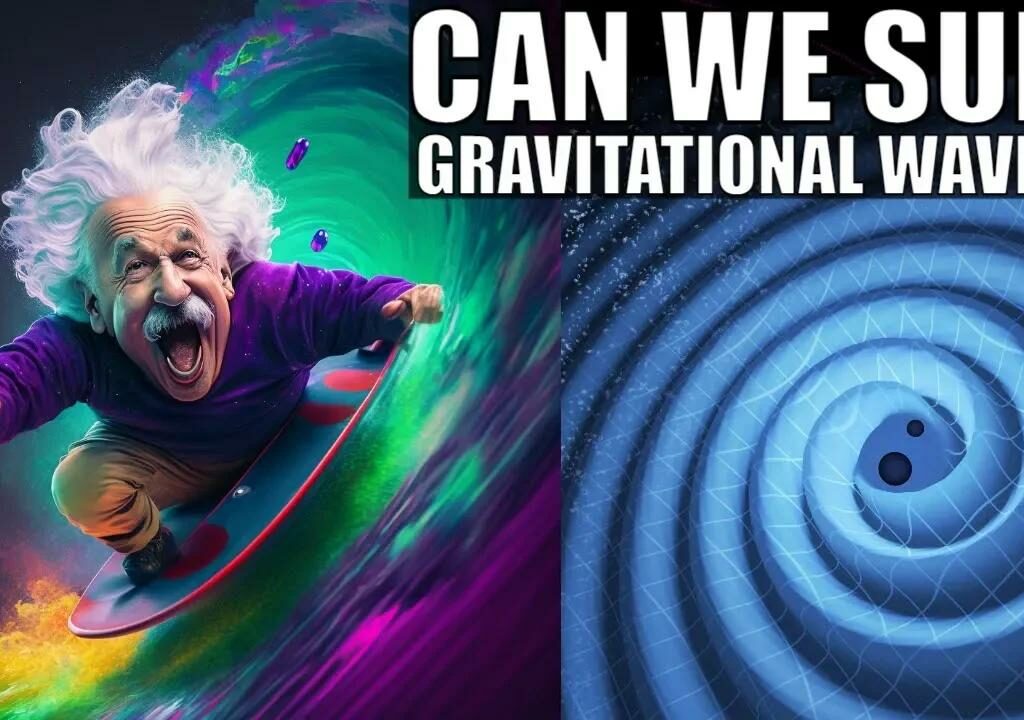
The idea of surfing gravitational waves, while fantastical, symbolizes humanity’s quest to understand and harness the universe’s most elusive forces. Imagining a cosmic surfer riding the crests of a gravitational tempest captures the blend of scientific curiosity and imaginative vision driving astrophysical exploration.
Conclusion: The Frontier of Gravitational Wave Storm Research
Gravitational wave storms represent a captivating frontier where physics and metaphor intersect. They challenge us to rethink wave dynamics as complex, intertwined phenomena rather than isolated events. As detection technologies and theoretical models advance, we may soon decode the intricate patterns of these spacetime cyclones, unveiling new layers of cosmic complexity and beauty.
Leave a Reply