
Short Answer
Definition of Chirality in Graphene
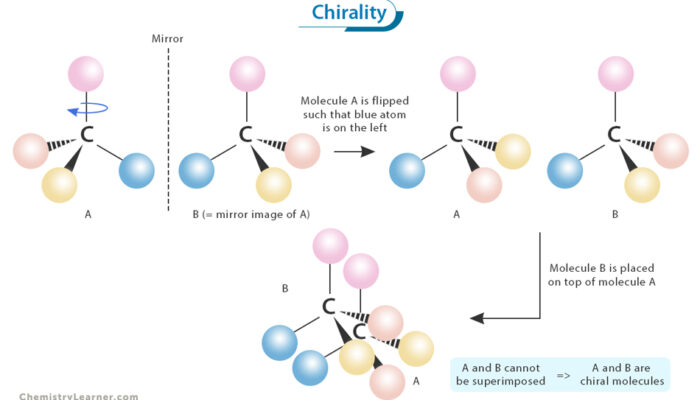
Chirality in graphene refers to the intrinsic asymmetry in the arrangement of carbon atoms within its two-dimensional lattice, which profoundly influences the behavior of electrons. This property arises from the unique geometric configuration of graphene’s honeycomb structure, composed of two interpenetrating sublattices, commonly labeled A and B. The concept of chirality here is closely tied to the phase relationship of electron wave functions associated with these sublattices, giving rise to a quantum property known as pseudospin.
- Graphene Structure:
A single atomic layer of carbon atoms arranged in a hexagonal lattice. - Sublattices:
Two distinct sets of carbon atoms (A and B) that form the basis for chirality. - Pseudospin:
A quantum number representing the electron’s wave function phase difference between sublattices, analogous to spin but related to lattice symmetry.
Electronic Properties and Chirality
Graphene’s electrons behave as massless Dirac fermions due to its linear energy-momentum relationship near the Dirac points in the band structure. This unique dispersion allows electrons to move with extremely high mobility and minimal scattering, akin to a high-performance vehicle smoothly navigating a complex terrain. Chirality plays a crucial role in this behavior by dictating how electrons propagate through the lattice, influencing transport phenomena and quantum effects.
Role of Pseudospin in Electron Dynamics
The pseudospin associated with chirality governs the electron’s phase coherence and interaction with potential barriers. This leads to remarkable phenomena such as suppressed backscattering and enhanced conductivity, which are not typically observed in conventional materials.
Fundamental Phenomena Arising from Chirality
One of the most striking manifestations of chirality in graphene is the Klein tunneling effect. This quantum mechanical phenomenon allows electrons to pass through potential barriers without reflection, defying classical expectations. The effect can be visualized as electrons “dancing” through obstacles without losing their wave-like nature, maintaining high transmission probabilities even at high barrier potentials.
Impact on Device Performance
Exploiting chirality and Klein tunneling, graphene-based transistors and nanoscale devices can achieve exceptional performance metrics, including ultra-low resistance and rapid electron mobility. These properties are pivotal for advancing next-generation electronics and high-speed data processing technologies.
Influence of External Perturbations on Chirality
Chirality in graphene is sensitive to external factors such as mechanical strain, magnetic fields, and impurities. These perturbations disrupt the inherent lattice symmetry, altering the electronic band structure and modifying electron transport characteristics. The resulting changes can be likened to a choreographer revising a well-rehearsed dance, introducing new patterns and dynamics that affect the overall performance.
Effects of Strain and Magnetic Fields
- Strain:
Distorts the lattice geometry, leading to shifts in Dirac points and modified electronic properties. - Magnetic Fields:
Induce Landau quantization and influence electron trajectories, impacting chirality-related phenomena.
Experimental Techniques for Studying Chirality
Advanced characterization methods have been instrumental in revealing the nuances of chirality in graphene. Scanning tunneling microscopy (STM), for example, provides detailed images of the local electronic structure and density of states, enabling direct observation of how chirality affects electron distribution and lattice distortions.
Local Density of States (LDOS) Analysis
By mapping the LDOS, researchers can visualize the interplay between chirality and electronic behavior at the atomic scale, transforming abstract theoretical concepts into tangible experimental evidence.
Applications in Quantum Technologies and Spintronics
Chirality in graphene extends its influence into emerging fields such as quantum computing and spintronics. Although electron spin is a separate quantum property, it is intricately connected to chirality through graphene’s band structure. This relationship enables the design of spintronic devices that utilize electron spin orientation for enhanced data storage and processing capabilities.
Spin-Chirality Interplay
Each electron spin can be viewed as having a directional “chirality,” similar to a compass needle aligning with a magnetic field. Harnessing this alignment in graphene-based systems opens pathways to innovative electronic components that surpass traditional charge-based devices.
Hybrid Systems and Future Prospects
The integration of graphene’s chirality with other advanced materials, such as topological insulators, promises to create multifunctional devices with novel electronic properties. These hybrid structures can support unidirectional edge states that are resistant to scattering, a highly desirable feature for quantum information processing and robust electronic applications.
Graphene and Topological Insulators
The combination of these materials forms a synergistic platform where the unique “dance” of electrons in graphene meets the protected surface states of topological insulators, enhancing device performance and stability.
Significance of Chirality in Graphene
Understanding chirality in graphene is essential not only for advancing fundamental physics but also for driving technological innovation. The interplay between geometric structure and electron dynamics offers profound insights into material behavior, enabling the development of cutting-edge electronic, spintronic, and quantum devices. As research progresses, the boundary between theoretical exploration and practical application continues to blur, positioning graphene as a pivotal material in the future of science and technology.
Summary
The study of chirality in graphene weaves together concepts of geometry, quantum mechanics, and material science into a cohesive narrative of discovery and innovation. From its foundational lattice asymmetry to its role in enabling extraordinary electronic phenomena, chirality shapes the behavior of electrons in ways that challenge conventional understanding. This ongoing exploration not only enriches scientific knowledge but also lays the groundwork for transformative technologies that could redefine electronic systems worldwide.
FAQ
What is chirality in graphene?
Chirality in graphene refers to the asymmetry in the arrangement of carbon atoms in its lattice, affecting electron behavior and properties.
How does chirality influence electron flow?
Chirality dictates how electrons propagate through graphene’s structure, impacting transport phenomena and quantum effects like Klein tunneling.
What are the applications of chirality in graphene?
Chirality in graphene enables advancements in quantum technologies, spintronics, and high-performance electronic devices.






Leave a Reply