Accelerating Universe Will Limit Technology: Cosmic Expansion’s Tech Toll

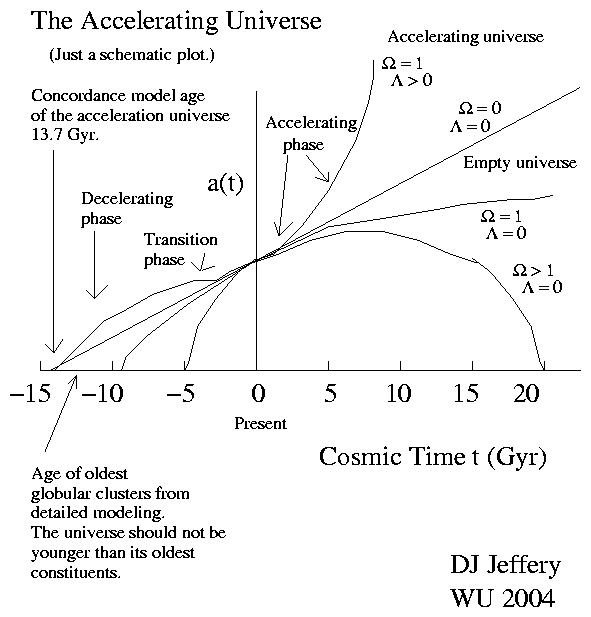
Understanding the Accelerating Expansion of the Universe Over the past several decades, astronomers have uncovered a remarkable cosmic phenomenon: the universe is not only expanding but doing so at an increasing pace. This discovery, supported by evidence such as observations of distant supernovae and measurements of the cosmic microwave background radiation, has profound implications that […]


Read More →

Debris from Distant Worlds: Watching Exoplanetary Wreckage

Definition of Exoplanetary Debris Exoplanetary debris refers to the fragments and remnants of celestial bodies orbiting stars beyond our solar system. These materials, ranging from tiny dust particles to large rocky fragments, are the byproducts of violent cosmic events such as collisions, fragmentation, and gravitational interactions. Studying this debris offers critical insights into the processes […]

Read More →

Eyes on the Future: Astronomers Plan for the Next Cosmic Era

Definition of Modern Astronomy and Its Expanding Horizons Astronomy, the scientific study of celestial objects and phenomena beyond Earth’s atmosphere, is entering a transformative phase marked by rapid technological progress and global cooperation. This evolving discipline seeks to unravel the mysteries of the universe, from the birth of galaxies to the search for extraterrestrial life, […]

Read More →

How Planets Are Born: Physics Closes In on the Origins of Worlds

Definition of Planetary Formation Planetary formation refers to the complex process through which planets originate and develop within a star system. This phenomenon involves the transformation of cosmic materials-primarily gas and dust-into solid planetary bodies. It is a multidisciplinary subject that integrates principles from astrophysics, thermodynamics, gravitational dynamics, and chemistry to explain how diverse planetary […]

Read More →

Planet Mania: Astronomers Are Seeing Worlds Everywhere

Understanding Planet Mania Planet Mania refers to the enthusiastic surge within the astronomical community sparked by the rapid discovery of planets beyond our solar system, known as exoplanets. This phenomenon highlights humanity’s expanding curiosity and the relentless pursuit to explore the vastness of the cosmos, revealing new worlds and challenging our previous conceptions of planetary […]

Read More →

What are the origins and causes of dark matter?

Understanding Dark Matter: A Comprehensive Overview Definition and Significance Dark matter is a mysterious form of matter that constitutes roughly 27% of the universe’s total mass-energy composition. Unlike ordinary matter, it neither emits nor absorbs light, making it invisible and detectable only through its gravitational effects. This elusive substance has intrigued scientists for decades, as […]

Read More →

Is the Earth 2D

Understanding Dimensionality Dimensionality refers to the number of independent directions or coordinates required to specify a point within a given space. In everyday physical experience, space is described by three dimensions: length, width, and height. These dimensions collectively define the volume and shape of objects and environments around us. Beyond this familiar framework, advanced physical […]

Read More →

Can we turn Dark Matter into energy?

Understanding Dark Matter Dark matter constitutes a mysterious and largely invisible component of the universe, accounting for roughly 27% of its total mass-energy composition. Unlike ordinary matter, it neither emits nor interacts with electromagnetic radiation, rendering it undetectable through conventional telescopic observations. Its presence is inferred primarily through gravitational effects on visible celestial bodies such […]

Read More →

Black Hole Eclipse Sheds Light on X-Ray Source Size

Definition of Black Hole Eclipses A black hole eclipse is an astronomical event where the X-ray emissions from a black hole’s accretion disk are temporarily obscured by another celestial object. This natural phenomenon offers a rare observational window into the structure and behavior of black holes and their surrounding environments, particularly the regions emitting high-energy […]

Read More →

What do you study in particle physics and astrophysics?

Overview of Particle Physics and Astrophysics Particle physics and astrophysics are two captivating branches of physics that explore the universe from vastly different scales yet remain deeply interconnected. While particle physics investigates the smallest building blocks of matter, astrophysics examines the grandest cosmic structures and phenomena. Together, these disciplines address fundamental questions about the universe’s […]

Read More →