
Short Answer
Definition
The International Space Station (ISS) is a large, human-made satellite orbiting Earth at an altitude of approximately 250 miles (400 kilometers). Traveling at an incredible speed of about 17,500 miles per hour (28,000 kilometers per hour), it completes an orbit roughly every 90 minutes. Despite its distance and velocity, the ISS is visible to the naked eye under suitable conditions, appearing as a bright, steady point of light moving across the sky.
Visibility and Observation Conditions
The ISS is among the brightest artificial objects observable in the night sky. Unlike stars, which twinkle and remain fixed in position, the ISS moves smoothly and steadily without flickering. Its visibility is limited to specific times-primarily during dawn and dusk-when the station is illuminated by sunlight while the observer is in relative darkness or twilight. This unique lighting condition allows the ISS to reflect sunlight vividly, making it appear as a luminous object swiftly crossing the celestial dome.
Orbital Mechanics and Viewing Windows
The station’s rapid orbit means it passes overhead multiple times each day, but it is only visible when the geometry between the sun, the ISS, and the observer aligns correctly. During full night, the ISS often falls into Earth’s shadow and becomes invisible. Twilight periods, when the sun is just below the horizon, provide the perfect balance for the ISS to catch sunlight and be seen from the ground. Observers must plan carefully to catch these fleeting appearances.
Tools for Tracking the ISS
Locating the ISS without optical aids requires knowledge of its trajectory and timing. Fortunately, numerous online platforms and smartphone applications offer real-time tracking and predictive data tailored to specific locations. These tools incorporate factors such as the station’s orbit, local weather, and sunlight angles to provide accurate sighting schedules, enhancing the chances of a successful observation.
Appearance and Brightness
To the unaided eye, the ISS looks like a bright, steady orb moving across the sky. It does not change color or flicker, distinguishing it from stars and planets. Its brightness often rivals that of Venus, one of the most luminous celestial bodies visible from Earth. This intense luminosity results from the vast solar panels on the station’s exterior, which reflect sunlight efficiently. Clear, dark skies with minimal atmospheric disturbance and low light pollution significantly improve visibility.
Using Optical Instruments
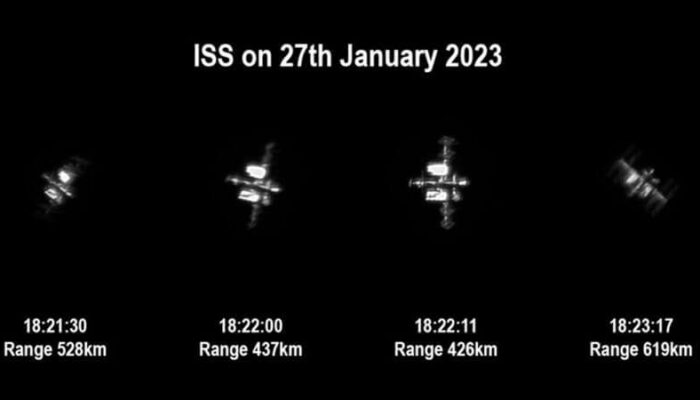
While the ISS can be seen without telescopes, optical devices can enhance the viewing experience by revealing structural details such as solar arrays and modules. However, the station’s high speed makes it challenging to track with conventional telescopes, often requiring specialized mounts or automated tracking systems. For casual skywatchers, spotting the ISS unaided offers a unique and rewarding connection to space exploration.
Scientific Context and Orbital Environment
The ISS orbits within the thermosphere, a layer of Earth’s atmosphere much closer than typical satellites. This proximity contributes to its bright reflection of sunlight. Unlike stars, which generate light through nuclear fusion, or planets, which reflect sunlight with a steady glow, the ISS’s rapid movement and closeness create a dynamic and distinctive spectacle in the night sky, showcasing human engineering in orbit.
Optimal Viewing Strategies
- Timing:
Aim to observe during twilight periods when the sun is just below the horizon. - Location:
Choose a site with minimal light pollution and an unobstructed view of the sky. - Preparation:
Use tracking apps or websites to determine precise flyover times and paths. - Patience:
Be ready to watch the sky within the predicted window, as the ISS crosses quickly.
Notable Celestial Alignments
Occasionally, the ISS passes near bright planets or stars, creating striking conjunctions visible to observers on Earth. These moments highlight the station’s presence against the backdrop of the cosmos, linking terrestrial viewers with the broader universe and the achievements of human spaceflight.
Significance of Naked-Eye ISS Observation
Observing the ISS without telescopic aid is a powerful reminder of humanity’s reach beyond Earth. It blends technology, astronomy, and curiosity, transforming the night sky into a live stage for space exploration. This experience fosters a personal connection to the vastness of space and the ongoing human endeavor to explore it, making the ISS a beacon of scientific progress and inspiration visible to all.
FAQ
How can I see the ISS without a telescope?
Look for the ISS during twilight periods when it is illuminated by the sun but the sky is dark. Use tracking apps to find the best times and directions.
Why does the ISS appear brighter than stars?
The ISS reflects sunlight off its large solar panels, making it one of the brightest objects in the night sky.
Can the ISS be seen at any time of night?
No, the ISS is only visible when it is illuminated by the sun and the observer's location is dark, typically at dawn or dusk.
What is the difference between ISS and stars in the sky?
The ISS moves steadily across the sky without twinkling, unlike stars that appear fixed and twinkle.
Are there any special devices needed to track the ISS?
Special devices are not necessary; many free apps and websites provide accurate real-time tracking to help observers.
Leave a Reply