
Short Answer
Understanding Gravity and Its Role on Mars
Gravity is the fundamental force that keeps humans anchored to Earth, influencing both our physical and psychological well-being. As humanity sets its sights on Mars-the mysterious Red Planet with its barren landscapes and potential for new beginnings-a critical question arises: is it possible to increase gravity on Mars to make it more suitable for human habitation? This inquiry extends beyond physics, encompassing the challenges of maintaining human health, the engineering feats required to modify planetary conditions, and the broader implications for our future in space exploration.
Definition of Gravity and Martian Gravity Characteristics
Gravity is the attractive force between two masses, dependent on their mass and the distance separating them. The gravitational pull experienced on a planet’s surface is primarily determined by the planet’s mass and radius.
- Earth’s Gravity:
Earth’s surface gravity is the standard reference, providing the force that sustains life as we know it. - Mars’ Gravity:
Mars has about 38% of Earth’s gravity due to its smaller mass-approximately one-tenth that of Earth-and roughly half its diameter. This reduced gravity significantly impacts human physiology and daily activities on the planet.
Physiological Effects of Low Gravity on Humans
Exposure to reduced gravity environments, such as that on Mars, poses serious health challenges. Astronauts returning from space missions often experience muscle weakening, bone density reduction, cardiovascular issues, and balance disorders caused by prolonged microgravity exposure. These effects raise concerns about the feasibility of long-term human settlement on Mars, where gravity is substantially weaker than on Earth.
Challenges in Increasing Mars’ Gravity
Altering Mars’ gravity involves either increasing the planet’s mass or creating artificial gravity environments. Increasing the planet’s mass to Earth-like levels is an extraordinary challenge:
- Mass Augmentation:
To raise Mars’ gravity, its mass would need to be significantly increased, potentially by importing material from asteroids or other celestial bodies. This approach demands immense resources, energy, and technological advancements far beyond current capabilities. - Planetary Stability:
Modifying Mars’ mass could disrupt its orbit, rotation, and overall habitability, posing risks to the planet’s environment and any future colonies.
Simulating Gravity: Rotating Habitats and Artificial Solutions
Given the impracticality of changing Mars’ gravity globally, scientists and engineers focus on localized methods to replicate Earth-like gravity:
- Centrifugal Force:
Rotating habitats generate centripetal acceleration that mimics gravity by pushing occupants toward the outer walls. This technique has been proposed for space stations and Martian colonies alike. - Design Considerations:
To minimize disorienting Coriolis effects, habitats must have large radii and carefully controlled rotation speeds, which complicates construction and increases costs. - Limitations:
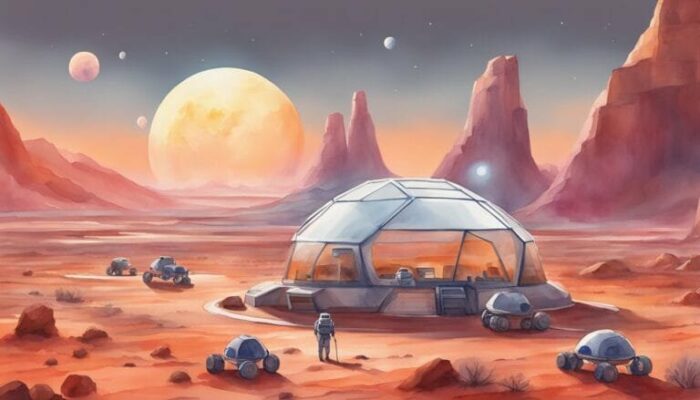
While spinning domes can preserve muscle and bone health within their confines, Mars’ open environment remains low gravity, requiring careful planning for activities outside these habitats.
Biotechnological and Advanced Material Approaches
Beyond mechanical solutions, emerging scientific fields offer alternative strategies:
- Genetic Adaptation:
Future settlers might be genetically engineered to better withstand low gravity’s effects, such as muscle atrophy and bone loss. However, this raises ethical questions and concerns about human identity. - Magnetic and Material Technologies:
Experimental concepts like magnetic levitation could potentially counteract some physiological impacts of low gravity, though these remain speculative and lack current practical application.
Psychological Implications of Altered Gravity
Gravity influences not only physical health but also mental well-being. On Earth, gravitational cues help orient spatial perception and cognitive function. Long-term exposure to reduced gravity environments may affect psychological health, making the design of simulated gravity habitats crucial for maintaining mental stability and reducing feelings of alienation among Martian settlers.
Current Strategies for Coping with Low Gravity on Mars
Since increasing Mars’ gravity on a planetary scale is beyond foreseeable technology, efforts concentrate on adapting human habitats and physiology to existing conditions:
- Rotating Habitats:
Creating artificial gravity zones within living spaces. - Supportive Technologies:
Use of exoskeletons and other assistive devices to mitigate muscle and bone degradation. - Health Interventions:
Nutritional plans, pharmaceuticals, and rigorous exercise regimens to counteract the effects of low gravity.
Why Addressing Gravity on Mars Is Crucial
Understanding and managing gravity’s impact is essential for the success of Martian colonization. It challenges our technological capabilities, biological adaptability, and philosophical perspectives on human existence beyond Earth. While Mars may never replicate Earth’s gravity, innovative solutions to simulate or adapt to its lower gravity environment embody humanity’s spirit of exploration and resilience.
Philosophical Perspectives on Human Adaptation to Martian Gravity
The quest to colonize Mars invites a profound reconsideration of what it means to be human in extraterrestrial settings. Rather than attempting to recreate Earth’s conditions perfectly, true colonization may involve embracing new forms of existence, reshaping human biology and culture to thrive under alien gravitational forces. This paradigm shift expands not only our physical horizons but also the essence of human identity in the cosmos.
FAQ
What is gravity?
Gravity is the attractive force between two masses, dependent on their mass and the distance separating them.
How does Mars' gravity compare to Earth's?
Mars has about 38% of Earth’s gravity due to its smaller mass.
What are the physiological effects of low gravity on humans?
Low gravity can cause muscle weakening, bone density reduction, and cardiovascular issues.
Can we increase Mars' gravity?
Increasing Mars’ gravity would require significant mass augmentation or the development of artificial gravity solutions.


Leave a Reply