
Short Answer
Understanding Black Holes and Light
At first consideration, the idea that light could escape a black hole appears contradictory. Black holes are traditionally defined by their immense gravitational pull, so strong that nothing-not even light-can break free once it crosses a certain boundary. This principle has been foundational in astrophysics for decades, influencing scientific theories and popular depictions of the universe. However, as research advances, some aspects of this understanding are being reexamined. Are there circumstances under which black holes might emit light or influence its behavior? Exploring this question reveals a complex and intriguing picture that challenges conventional wisdom about these cosmic enigmas.
Definition and Formation of Black Holes
Black holes form from the remnants of massive stars or through the gravitational collapse of dense matter. This process creates a region in spacetime where the gravitational force is so intense that the escape velocity exceeds the speed of light. The critical boundary marking this point of no return is known as the event horizon.
- Event Horizon:
The invisible surface surrounding a black hole beyond which nothing can escape, including light. - Singularity:
The core of a black hole, a point of infinite density where gravitational forces become infinitely strong.
Once an object crosses the event horizon, it is inevitably drawn toward the singularity. Because light cannot travel faster than the speed of light, it cannot escape this boundary, reinforcing the classical view that black holes are completely dark.
Light Emission Outside the Event Horizon
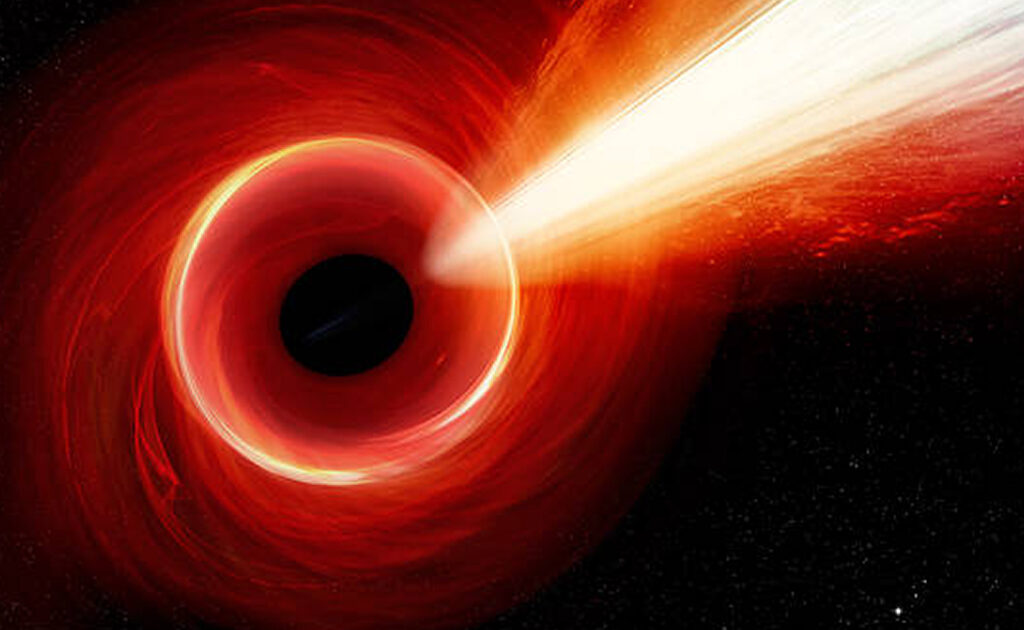
Although light cannot escape from inside the event horizon, black holes are often surrounded by luminous phenomena. One of the most significant is the accretion disk-a rotating disk of gas, dust, and stellar debris spiraling into the black hole. Friction and gravitational forces heat this material to extreme temperatures, causing it to emit vast amounts of electromagnetic radiation, including visible light, X-rays, and gamma rays.
- Accretion Disk:
A hot, glowing ring of matter orbiting just outside the event horizon, responsible for much of the light observed near black holes. - Electromagnetic Radiation:
Energy emitted by the accretion disk, which can be detected by telescopes across various wavelengths.
It is important to note that this light originates from matter outside the event horizon, not from within the black hole itself.
Quantum Effects: Hawking Radiation
In the 1970s, physicist Stephen Hawking introduced a groundbreaking concept that black holes are not entirely black. According to quantum theory, particle-antiparticle pairs can spontaneously form near the event horizon due to fluctuations in the vacuum of space. Occasionally, one particle falls into the black hole while the other escapes, creating the appearance that the black hole emits radiation.
- Hawking Radiation:
A faint emission of particles from the vicinity of the event horizon, caused by quantum effects. - Mass Dependence:
Smaller black holes emit more intense Hawking radiation, while larger ones emit less.
This radiation is extremely weak and does not represent light escaping from inside the black hole but rather a subtle leakage of energy and information, challenging the classical notion of absolute darkness.
Gravitational Lensing and Photon Orbits
The intense gravitational field near a black hole dramatically warps spacetime, affecting the path of light traveling nearby. This bending of light, known as gravitational lensing, can create striking visual phenomena such as Einstein rings and photon spheres.
- Photon Sphere:
A region just outside the event horizon where photons can orbit the black hole multiple times before either escaping or being captured. - Gravitational Lensing:
The distortion and bending of light paths caused by the black hole’s gravity, producing magnified or multiple images of background objects.
These effects generate intense light patterns and shadows, offering indirect glimpses into the extreme curvature of spacetime around black holes. The brightness observed in these regions arises from light traveling near, but not inside, the black hole.
Observational Evidence: Imaging Black Holes
Recent technological advances have enabled direct imaging of black holes, most notably by the Event Horizon Telescope (EHT). The EHT captured the first image of the supermassive black hole in the M87 galaxy, revealing a bright ring of light surrounding a dark central shadow.
- Bright Ring:
Emission from the accretion disk heated to billions of degrees, visible in X-ray and radio wavelengths. - Shadow:
The silhouette of the event horizon where light cannot escape, appearing as a dark region within the glowing ring.
These observations confirm that the visible light is generated by matter near the event horizon, not from within the black hole itself, providing unprecedented insight into black hole environments.
Theoretical Perspectives: Beyond Classical Boundaries
Some modern theories propose alternative models that challenge the traditional understanding of black holes. Concepts such as firewalls and fuzzballs suggest that the event horizon and singularity may not be as absolute or simple as once thought.
- Firewall Hypothesis:
Suggests a high-energy barrier at the event horizon that could affect how light and information interact with the black hole. - Fuzzball Theory:
Proposes that black holes are composed of tangled strings, eliminating the singularity and altering the nature of the event horizon.
While these ideas remain speculative and under active debate, they highlight ongoing efforts to reconcile general relativity with quantum mechanics and deepen our understanding of black hole physics.
Why the Question of Light Escaping Matters
The inquiry into whether light can escape a black hole touches on fundamental principles of physics, including the nature of gravity, quantum mechanics, and the speed of light. It also influences how we interpret astronomical observations and develop models of the universe.
Black holes are not merely cosmic vacuum cleaners that swallow all light indiscriminately; they are dynamic systems where light and matter interact in complex ways. Understanding these interactions helps scientists probe the limits of physical laws and explore the mysteries of spacetime.
Summary: A Nuanced Answer to a Complex Question
In summary, light cannot escape from within a black hole’s event horizon according to classical physics. However, the luminous phenomena surrounding black holes, the subtle quantum emissions of Hawking radiation, and the gravitational manipulation of light near the event horizon all contribute to a richer, more intricate picture.
This nuanced understanding invites us to appreciate black holes not only for what they conceal but also for the extraordinary and paradoxical brilliance they produce around their edges-a testament to the profound interplay between light and darkness in the cosmos.



Leave a Reply