
Short Answer
Definition of Nuclear Weapons
Nuclear weapons are among the most advanced and devastating technological inventions created by humanity, combining complex scientific principles with profound ethical challenges. These weapons derive their immense destructive power from nuclear reactions, specifically nuclear fission and fusion, which release vast amounts of energy by altering atomic nuclei. Understanding nuclear weapons involves exploring the physics behind these reactions, the engineering of explosive devices, and their strategic role in global security.
Fundamental Principles of Nuclear Reactions
At the heart of nuclear weaponry lies the atom, composed of protons, neutrons, and electrons. The nucleus, containing protons and neutrons, is the focal point of nuclear reactions where energy is unleashed by changing the structure of the nucleus.
- Nuclear Fission:
This process involves splitting heavy atomic nuclei such as uranium-235 or plutonium-239 into smaller fragments. The splitting releases a tremendous amount of energy, primarily kinetic energy carried by neutrons and fission fragments. The reaction follows Einstein’s mass-energy equivalence principle, expressed as E=mc², where a small amount of mass converts into a large amount of energy. Fission reactions can sustain a chain reaction, where neutrons from one fission event trigger further fission in nearby nuclei, exponentially increasing energy output. - Nuclear Fusion:
Fusion is the process of combining light atomic nuclei, typically isotopes of hydrogen like deuterium and tritium, to form heavier nuclei such as helium. Fusion reactions release even more energy than fission and are the same reactions that power the sun. In thermonuclear weapons, fusion is initiated by the extreme heat and pressure generated by an initial fission explosion.
Engineering Designs of Nuclear Weapons
The construction of nuclear weapons varies depending on whether they rely on fission or fusion reactions, with distinct mechanisms to achieve the critical conditions necessary for detonation.
- Fission Bombs (Atomic Bombs):
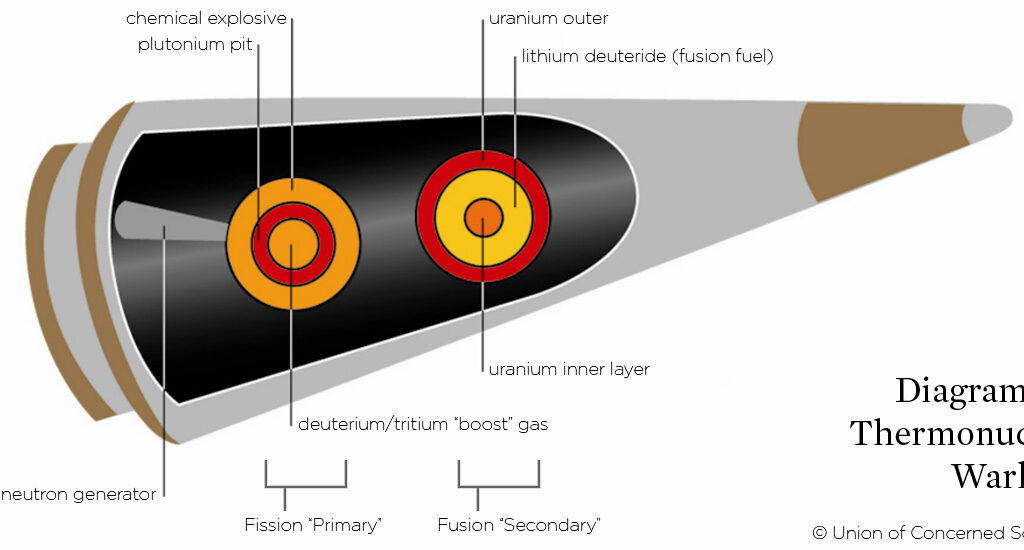
These weapons use either a “gun-type” or “implosion” design. The gun-type design propels one subcritical mass of fissile material into another to form a supercritical mass, triggering a chain reaction. The implosion design surrounds a subcritical core with conventional explosives that compress the material symmetrically, rapidly achieving supercriticality and initiating fission. - Fusion Bombs (Hydrogen or Thermonuclear Bombs):
Fusion bombs employ a two-stage process where a primary fission explosion generates the extreme temperature and pressure needed to ignite fusion in a secondary stage. This secondary stage contains fusion fuel, and sometimes additional fissile material, to amplify the explosive yield. The complexity of these devices requires precise engineering to synchronize the stages effectively.
Strategic Role and Deterrence Theory
Nuclear weapons have shaped international relations through their role in deterrence and geopolitical strategy. The doctrine of Mutually Assured Destruction (MAD) emerged during the Cold War, positing that the threat of reciprocal nuclear annihilation prevents direct conflict between nuclear-armed states. This precarious balance has maintained a tense peace but also fueled an arms race, as nations seek to maintain or enhance their nuclear capabilities to deter adversaries.
Ethical and Humanitarian Considerations
The use and possession of nuclear weapons raise profound ethical questions and humanitarian concerns. The catastrophic consequences of nuclear detonations, as witnessed in Hiroshima and Nagasaki, include massive loss of life, long-term radiation effects, and environmental devastation. These outcomes challenge the morality of nuclear armament, weighing national security against the preservation of human rights and global well-being.
Nuclear Proliferation and Global Security Challenges
The spread of nuclear weapons technology presents significant risks to international stability. Nations such as North Korea and Iran have heightened global tensions due to their nuclear ambitions. Preventing proliferation requires coordinated diplomatic and technical efforts to control the dissemination of nuclear materials and technology, underscoring the complexity of maintaining global peace in the nuclear age.
Why Understanding Nuclear Weapons Is Crucial
Grasping the scientific, technical, and geopolitical dimensions of nuclear weapons is essential for informed discourse on disarmament and security policies. These weapons embody a paradox: they serve as powerful deterrents against war while simultaneously posing existential threats to humanity. Recognizing this duality is vital for fostering international cooperation aimed at reducing nuclear risks and promoting a safer world.
Summary and Reflection
Nuclear weapons represent a convergence of advanced science, intricate engineering, and complex ethical and political issues. Their existence demands ongoing scrutiny and dialogue to balance the pursuit of peace with the realities of global power dynamics. As humanity navigates this precarious landscape, a comprehensive understanding of nuclear weapons is indispensable for shaping a future where the potential for destruction is met with a commitment to security and ethical responsibility.
FAQ
What is the difference between nuclear fission and fusion?
Nuclear fission splits heavy atomic nuclei into smaller fragments releasing energy, while nuclear fusion combines light atomic nuclei to form heavier nuclei, releasing even more energy.
How do nuclear weapons achieve a chain reaction?
In fission bombs, a chain reaction is achieved when neutrons released from one fission event trigger further fission in nearby nuclei, exponentially increasing energy output.
What is the role of nuclear weapons in international security?
Nuclear weapons act as deterrents through the doctrine of Mutually Assured Destruction, preventing direct conflict between nuclear-armed states but also fueling arms races.
What are the ethical concerns surrounding nuclear weapons?
Ethical concerns include the massive loss of life, long-term radiation effects, environmental devastation, and the moral implications of possessing and potentially using such weapons.
Why is controlling nuclear proliferation important?
Controlling proliferation is crucial to prevent the spread of nuclear weapons technology which could destabilize global peace and increase the risk of nuclear conflict.





Leave a Reply