

Short Answer
Definition of Dark Matter and Dark Matter Balls
Dark matter is a hypothesized form of matter that does not emit, absorb, or reflect light, making it invisible to current electromagnetic detection methods. It is believed to constitute about 27% of the universe’s total mass-energy content, playing a crucial role in the formation and behavior of cosmic structures. Within this framework, the concept of “dark matter balls” has emerged, describing dense, localized clumps of dark matter that may traverse space, potentially interacting with ordinary matter in dramatic ways.
- Dark Matter:
An unseen substance inferred from gravitational effects on visible matter, radiation, and the large-scale structure of the universe. - Dark Matter Balls:
Hypothetical compact aggregations of dark matter, possibly formed through gravitational collapse, that could move through space and interact explosively with normal matter.
Origins and Formation of Dark Matter Clumps
Traditional models depict dark matter as a diffuse halo enveloping galaxies, but recent theoretical advances propose that dark matter might also exist in more concentrated forms. These dense clumps, or dark matter balls, could arise from gravitational collapse processes similar to those that form stars, albeit governed by the unique properties of dark matter particles. This localized concentration challenges the conventional view of dark matter distribution and suggests a more complex cosmic architecture.
Mechanisms of Interaction Between Dark Matter Balls and Ordinary Matter
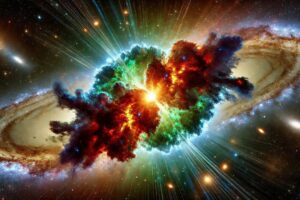
When dark matter balls encounter baryonic (ordinary) matter, their interactions could produce significant energetic events. The collision or passage of a dark matter ball through normal matter might trigger explosive phenomena, releasing energy on scales comparable to supernovae. These interactions stem from the kinetic energy and gravitational forces involved, potentially leading to observable cosmic explosions that have yet to be fully understood or detected.
Detecting Dark Matter Through Explosive Signatures
While dark matter itself remains invisible to direct observation, the explosive interactions of dark matter balls with ordinary matter could serve as indirect evidence of their existence. Astrophysical instruments monitoring cosmic background radiation, gravitational lensing, and galaxy distributions might be adapted to identify unique signatures indicative of such events. This approach could bridge the gap between theoretical predictions and empirical data, enhancing our ability to detect and study dark matter.
Implications for Cosmology and Particle Physics
The hypothesis of dark matter balls extends beyond astrophysics into fundamental particle physics. It encourages the exploration of new particle candidates that could compose dark matter, including supersymmetric particles, axions, or other exotic entities beyond the Standard Model. Understanding these particles and their interactions could revolutionize our knowledge of fundamental forces and the universe’s underlying structure.
Philosophical and Scientific Significance
The study of dark matter balls touches on profound questions about the nature of reality and the limits of human knowledge. These mysterious entities challenge our perceptions of observable phenomena and suggest that the universe is woven from complex, largely unseen forces. This inquiry not only advances scientific understanding but also reflects humanity’s enduring quest to comprehend the cosmos and our place within it.
Summary and Future Prospects
The concept of dark matter balls and their potential explosive interactions with ordinary matter introduces a rich, interdisciplinary field of study encompassing cosmology, particle physics, and philosophy. As research progresses, these ideas may lead to groundbreaking discoveries that reshape our understanding of the universe’s composition and dynamics. Continued investigation into dark matter’s nature promises to illuminate the hidden fabric of reality and inspire deeper appreciation for the complexities of existence.
FAQ
What are dark matter balls?
Dark matter balls are hypothetical dense clumps of dark matter that may interact explosively with ordinary matter.
How do dark matter balls interact with normal matter?
When dark matter balls encounter baryonic matter, they may trigger energetic events comparable to supernovae.
What is the significance of studying dark matter balls?
Studying dark matter balls may provide insights into the fundamental nature of the universe and the composition of dark matter.



Leave a Reply