
Short Answer
Definition of the Speed of Gravity
The speed of gravity refers to the rate at which changes in a gravitational field propagate through the fabric of spacetime. When a massive object moves or a gravitational event occurs, the resulting disturbance does not affect distant objects instantaneously; instead, it travels outward as gravitational waves. These waves carry information about the gravitational change, moving at a finite velocity.
- Gravitational waves:
Ripples in spacetime curvature generated by accelerating masses, such as merging black holes or neutron stars. - Propagation speed:
The velocity at which these gravitational disturbances travel, which modern physics equates to the speed of light.
Historical Perspectives on Gravity’s Speed
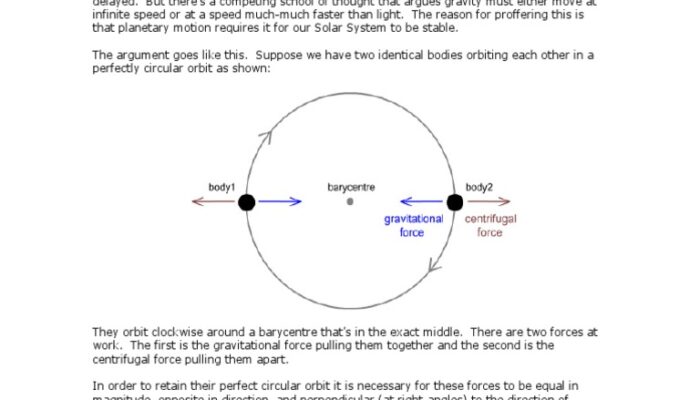
Historically, gravity was viewed through the lens of Newtonian physics as an instantaneous force acting across any distance. Newton’s law of universal gravitation described gravity as a force pulling objects together without any delay, a concept that sufficed for explaining planetary orbits and everyday celestial mechanics.
However, this instantaneous action conflicted with the principles of special relativity, introduced by Einstein, which established the speed of light as the ultimate speed limit for any signal or influence in the universe. This discrepancy necessitated a new understanding of gravity’s nature and its transmission speed.

General Relativity and the Nature of Gravitational Propagation
Einstein’s general theory of relativity revolutionized the concept of gravity by describing it not as a force but as the curvature of spacetime caused by mass and energy. Changes in this curvature propagate as gravitational waves, which travel at the speed of light-approximately 299,792 kilometers per second.
This framework resolves the paradox of instantaneous gravity by aligning gravitational influence with the universal speed limit, ensuring consistency with relativistic causality.
Empirical Evidence Supporting Gravity’s Speed
Recent advancements in gravitational wave astronomy have provided direct measurements of gravity’s propagation speed. The landmark detection by the Laser Interferometer Gravitational-Wave Observatory (LIGO) in 2015 of waves from colliding black holes marked a new era in observational physics.
Further, the 2017 observation of a neutron star merger, which emitted both gravitational waves and electromagnetic radiation, allowed scientists to compare arrival times of these signals. The near-simultaneous detection confirmed that gravitational waves travel at the speed of light within extremely tight margins.
Implications for Physics and Cosmology
The confirmation that gravity propagates at light speed has profound consequences for our understanding of the universe. It preserves the principle of causality, preventing paradoxes that would arise if gravitational effects could travel faster than light. This ensures that cause precedes effect, maintaining the logical structure of physical laws.
Moreover, the finite speed of gravity influences practical technologies such as satellite navigation and enhances our ability to predict celestial phenomena accurately. The study of gravitational waves also opens new observational windows into cosmic events inaccessible by traditional electromagnetic methods.
Speculative Theories and Open Questions
While current evidence supports gravity’s speed matching that of light, some theoretical models propose possible deviations under extreme or exotic conditions. These include hypotheses involving extra spatial dimensions or quantum gravity effects, which might alter gravitational propagation speed.
Such ideas remain speculative and await experimental verification. Additionally, questions persist about whether the geometry of spacetime or unknown particles could influence gravity’s speed in ways not yet understood.
Common Misconceptions About Gravity’s Speed
Gravity acts instantaneously across any distance.
Gravity propagates at a finite speed, equal to the speed of light, as confirmed by both theory and observation.
Gravitational waves are purely theoretical and have never been detected.
Gravitational waves have been directly observed by detectors like LIGO, providing empirical evidence of their existence and speed.
Why Understanding Gravity’s Speed Is Crucial
Grasping the speed at which gravity operates is essential for both fundamental physics and practical applications. It underpins the consistency of relativistic theories, ensuring that information and influence cannot travel faster than light, thus safeguarding causality.
Furthermore, the ability to detect and analyze gravitational waves enriches our knowledge of the universe’s most violent and enigmatic phenomena, from black hole mergers to the conditions of the early cosmos, expanding the horizons of modern astrophysics.


Leave a Reply