
Short Answer
Understanding Dark Matter and Dark Energy
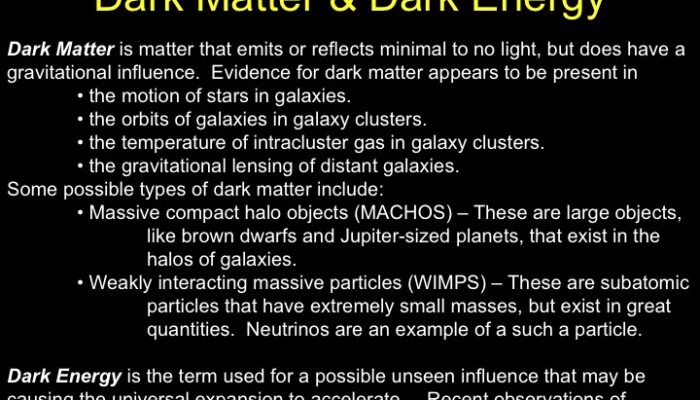
Imagine the universe as a vast cosmic stage where much of the action remains hidden from our direct view. Two of the most profound mysteries in astrophysics-dark matter and dark energy-compose the majority of the universe’s content, yet they elude direct detection. These enigmatic components are termed “dark” not simply because they are invisible, but because their true nature and behavior remain deeply obscure, woven into the very fabric of the cosmos.
Definition and Characteristics
Both dark matter and dark energy are invisible to electromagnetic radiation, meaning they do not emit, absorb, or reflect light or any other form of electromagnetic waves. This invisibility is the primary reason for their “dark” label, but the term also signifies the complexity and mystery surrounding their properties.
- Dark Matter:
Constitutes about 27% of the universe’s total mass-energy content. It acts as an unseen gravitational scaffold, influencing the formation and behavior of galaxies and galaxy clusters. - Dark Energy:
Makes up nearly 68% of the universe’s energy budget. It is responsible for the accelerated expansion of the universe, exerting a repulsive force that pushes galaxies apart.
The Role of Dark Matter in the Cosmos
Dark matter’s existence was first inferred through its gravitational effects rather than direct observation. Galaxies rotate at speeds that visible matter alone cannot explain, and galaxy clusters exhibit gravitational cohesion that suggests a substantial amount of unseen mass. This invisible mass influences the large-scale structure of the universe, including cosmic filaments and fluctuations in the cosmic microwave background.
Because dark matter does not interact with electromagnetic forces, astronomers detect it indirectly through phenomena such as gravitational lensing, where light from distant objects bends around massive, unseen structures. This “ghostly” presence shapes the universe’s architecture without emitting any detectable signals.
The Enigma of Dark Energy
Dark energy is even more mysterious than dark matter. It was discovered through observations that the universe’s expansion is accelerating, contradicting earlier expectations that gravity would slow this expansion over time. Dark energy is thought to be a pervasive energy field intrinsic to space itself, driving galaxies apart with a repulsive force.
Unlike matter, dark energy cannot be localized; it is a property of space that defies direct measurement and challenges existing physical theories. Its nature remains elusive, with hypotheses ranging from a cosmological constant-an unchanging vacuum energy-to dynamic fields like quintessence that evolve over cosmic timescales.
Scientific Theories and Hypotheses
Researchers propose various models to explain these dark components:
- Dark Matter Candidates:
Hypothetical particles such as Weakly Interacting Massive Particles (WIMPs), axions, or other unknown particles that interact gravitationally but not electromagnetically. - Dark Energy Models:
Concepts include Einstein’s cosmological constant, vacuum energy, or dynamic fields like quintessence that change over time.
Observational Evidence and Detection Methods
Despite their invisibility, dark matter and dark energy leave measurable imprints on the universe:
- Gravitational Lensing:
The bending of light by massive objects reveals the presence of dark matter. - Cosmic Microwave Background:
Fluctuations in this relic radiation provide clues about the distribution of dark matter and the influence of dark energy. - Galaxy Rotation Curves:
The unexpected rotational speeds of galaxies indicate additional unseen mass. - Supernova Observations:
Measurements of distant supernovae reveal the accelerating expansion driven by dark energy.
Scientists employ underground particle detectors, space telescopes, and sophisticated computer simulations to probe these phenomena, gradually refining our understanding.
Common Misconceptions About Dark Matter and Dark Energy
Dark matter and dark energy are the same.
They are distinct entities; dark matter exerts gravitational attraction, while dark energy causes cosmic expansion to accelerate.
“Dark” means these substances are black or absorb all light.
“Dark” refers to their invisibility to electromagnetic radiation, not their color or light absorption.
Dark matter and dark energy can be directly observed.
Their presence is inferred through indirect effects, as they do not emit or interact with light.
Significance in Modern Cosmology
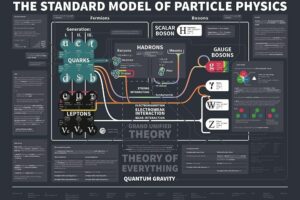
Dark matter and dark energy dominate the universe’s composition, shaping its structure and destiny. Their study challenges and extends fundamental physics, prompting new theories beyond the Standard Model and potentially revolutionizing our understanding of gravity, quantum mechanics, and space-time. These phenomena represent both a profound scientific puzzle and an opportunity for groundbreaking discoveries.
Conclusion: Embracing the Cosmic Mystery
The “darkness” of dark matter and dark energy symbolizes the vast unknowns that remain in our comprehension of the universe. Far from being mere gaps in knowledge, they are frontiers inviting exploration and deeper insight. As research advances, these cosmic enigmas continue to inspire wonder and drive humanity’s quest to unravel the universe’s deepest secrets.


Leave a Reply